
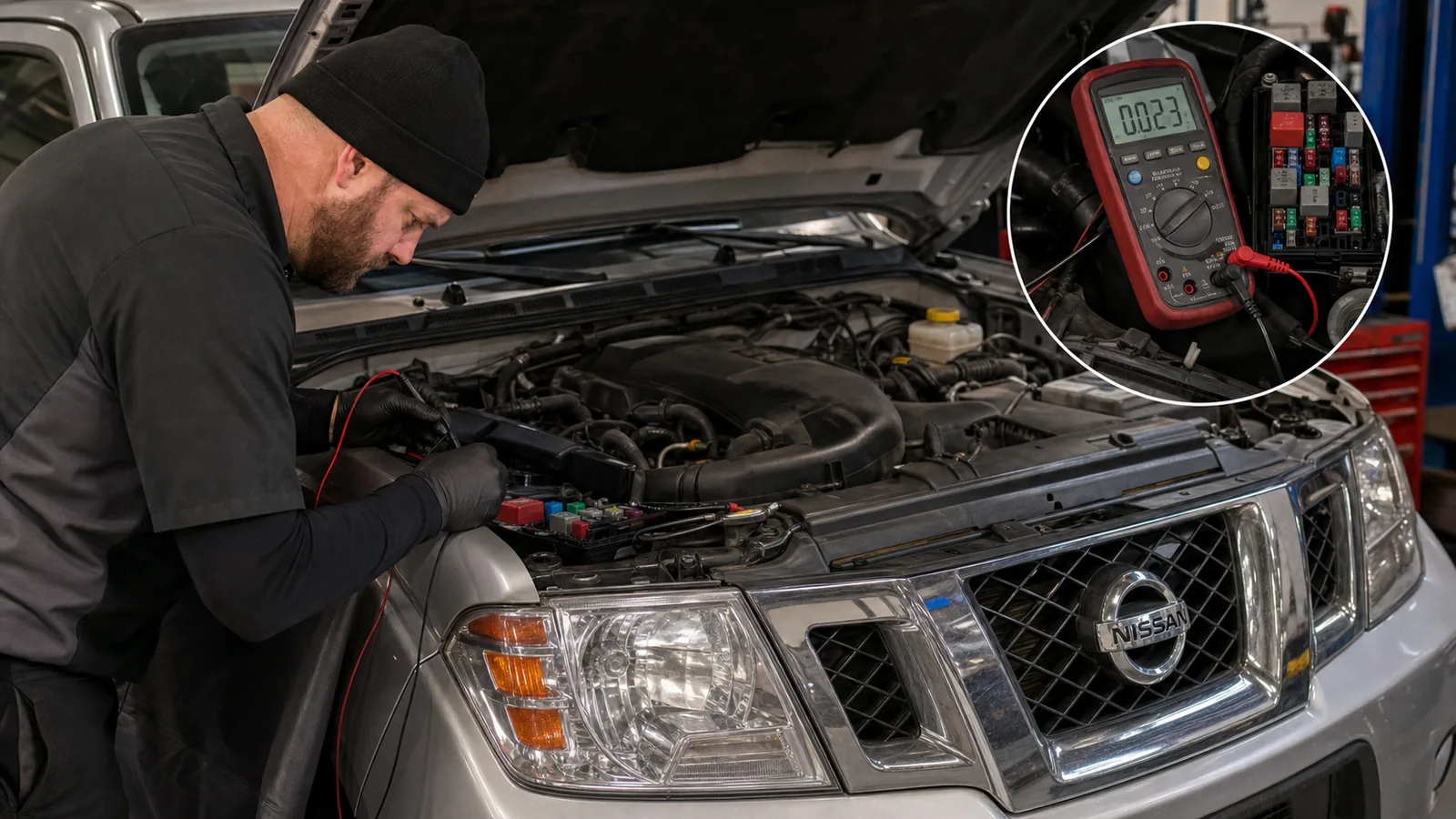
What this part does
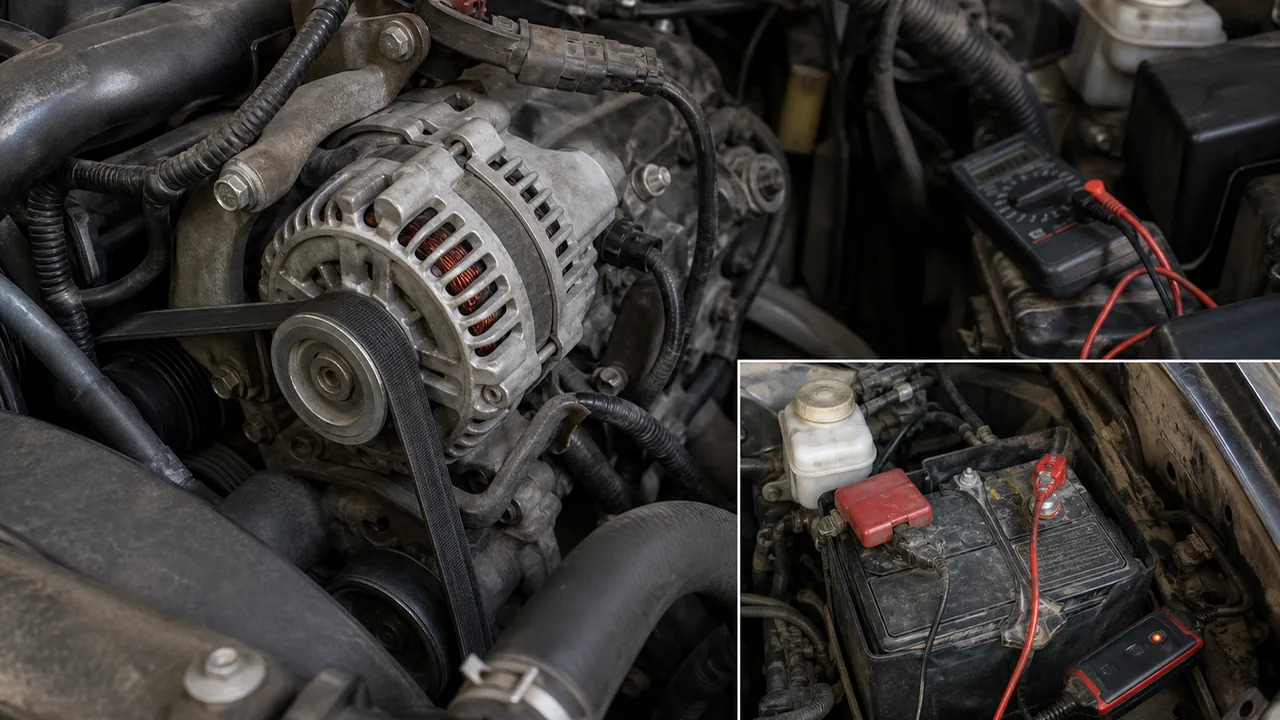
The system involved is not one single part; it is the Frontier's key-off electrical network. After the ignition is off, some circuits keep memory alive while higher-demand circuits are supposed to shut down. The battery supplies those small keep-alive loads, while relays, modules, switches, and wiring determine whether the truck actually settles.
- Keep-alive loads may support clock, radio memory, security, body-control memory, and emissions-related memory.
- Sleep-state logic depends on closed doors, inactive switches, stable module communication, and no accessory waking the network.
- A test tool, open door, key fob activity, scan tool session, or recently disturbed fuse can wake circuits and make a normal truck look faulty.
Before replacing a battery, alternator, relay, or module, the diagnostic goal is to prove which circuit remains live when the vehicle should be asleep.
Common failure signs
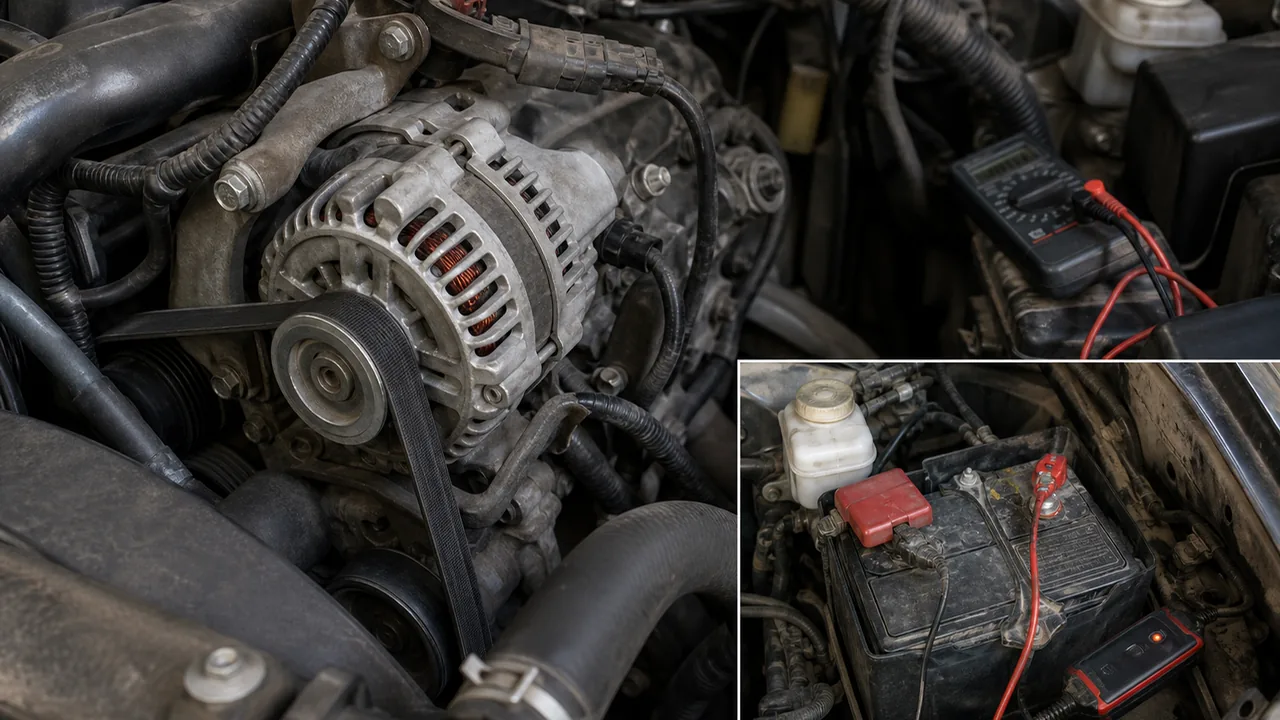
A true parasitic draw usually shows up as a repeatable key-off problem, not just one weak start. The pattern matters because a low battery, charging fault, short trip use, cold weather, or an accessory left plugged in can mimic a hidden current draw.
- Battery is dead or too weak to crank after the truck sits overnight or for several days.
- Jump-starting works, but the same no-start pattern returns after parking.
- Interior lamps, cargo lamps, glovebox lamps, or aftermarket equipment behave inconsistently.
- A relay clicks after shutdown or a module appears to wake repeatedly without driver input.
- Battery tests weak after being repeatedly discharged, even if it was not the original cause.
A battery that has been deeply discharged several times may fail testing even after the draw is repaired. Treat the battery as a victim until it has been charged and tested.
Before replacing it
Owner-safe checks should remove simple causes before any fuse-pulling or module testing begins. These checks do not prove the final fault, but they prevent wasted diagnosis when the actual issue is a weak battery, an accessory, or a light staying on.
- Fully charge the battery and have it tested before trusting any draw result.
- Remove plug-in chargers, dashcams, audio add-ons, scan tools, trailer adapters, and anything wired into constant power.
- Check that interior, cargo, glovebox, map, vanity, and aftermarket lights turn off with the truck closed.
- Confirm the hood, doors, tailgate, and locks are not being left in a state that keeps a body-control input awake.
- Look for moisture, corrosion, loose battery terminals, damaged accessory wiring, or recent repair areas.
Do not disconnect random modules or probe airbag-related connectors as an owner check. Keep DIY work limited to visible condition checks and non-invasive accessory removal.
A parasitic draw can exist with no diagnostic trouble code, and a code can be a side effect of low voltage rather than the root cause. Scan data is useful when it shows module communication, wake history, battery voltage complaints, or charging faults, but it cannot replace current measurement.
- Low-voltage or communication codes may point toward a battery drain pattern, but they do not identify the live circuit by themselves.
- Charging-system warnings should be checked before assuming the truck has a key-off draw.
- Body, security, lighting, or network codes can guide diagnosis if they match a circuit that remains active.
- Clearing codes before documenting them can erase clues about which module woke or lost power.
Do not publish a single code as definitive for this problem unless the final article is backed by Nissan service information and the visible article text explains the limits of that code.
The main mistake is treating the battery drain as proof of a bad battery or a bad module. A weak battery can make the symptom obvious, but the draw diagnosis still has to prove what remains powered after the truck is asleep.
- Do not assume both main feed branches are faulty just because both show some current.
- Do not assume an aftermarket accessory is guilty unless the draw changes when it is isolated.
- Do not assume a module is bad before checking the switch, relay, ground, connector, and wake input that controls it.
- Do not use a disconnected battery reset as proof of repair; repeat the full sleep-state test.
Inspection steps
A phantom parasitic draw usually means one circuit is staying awake after the truck is turned off. On a 2013 Nissan Frontier, that can indicate a module, relay, diode, accessory, or wiring fault that keeps current flowing after key-off, or it can mean the test was taken before the truck reached its sleep state. A small stable sleep-state load may be normal, a repeated dead battery should be investigated soon, and hot wiring, burning smell, or repeated no-start behavior is urgent. First, charge and test the battery, then repeat the draw test only after the truck is closed up, undisturbed, and allowed to enter its proper sleep condition.
- Most likely first: the truck is not fully asleep during the measurement.
- Next likely: the battery is weak or undercharged and is being blamed for a separate drain concern.
- Common cause family: aftermarket accessories, relays, body-control inputs, interior lamps, trailer wiring, audio equipment, or alarm hardware.
- Less obvious but important: alternator diode leakage, moisture in connectors, wiring rub-through, or a module that keeps waking the network.
The word phantom is owner language, not a diagnosis. A draw that appears only before modules time out is different from a draw that remains after the vehicle is fully asleep.
The best ranking starts with what is easiest to verify and most likely to mislead the test. For this Frontier concern, the first suspect is not a single Nissan component; it is whether the measurement was made after the truck was truly asleep and whether the battery and charging system are healthy enough to support a valid test.
| Rank | Cause family | What usually confirms it |
|---|---|---|
| 1 | Vehicle not fully asleep during testing | Current changes after the truck sits undisturbed, or the reading changes after doors, locks, scan tools, or fuses are disturbed. |
| 2 | Weak battery or charging fault | Battery fails a proper health test or the charging system cannot restore charge after normal driving. |
| 3 | Aftermarket accessory draw | Dashcam, alarm, remote start, audio amplifier, charger, trailer wiring, or added lighting remains powered after key-off. |
| 4 | Relay, switch, or module wake-up issue | A body, lighting, door, hood, security, or communication circuit stays active after the truck should be quiet. |
| 5 | Alternator diode leakage or wiring fault | The draw changes when the charging circuit is isolated by the correct service procedure, or inspection finds heat damage, corrosion, or rubbed wiring. |
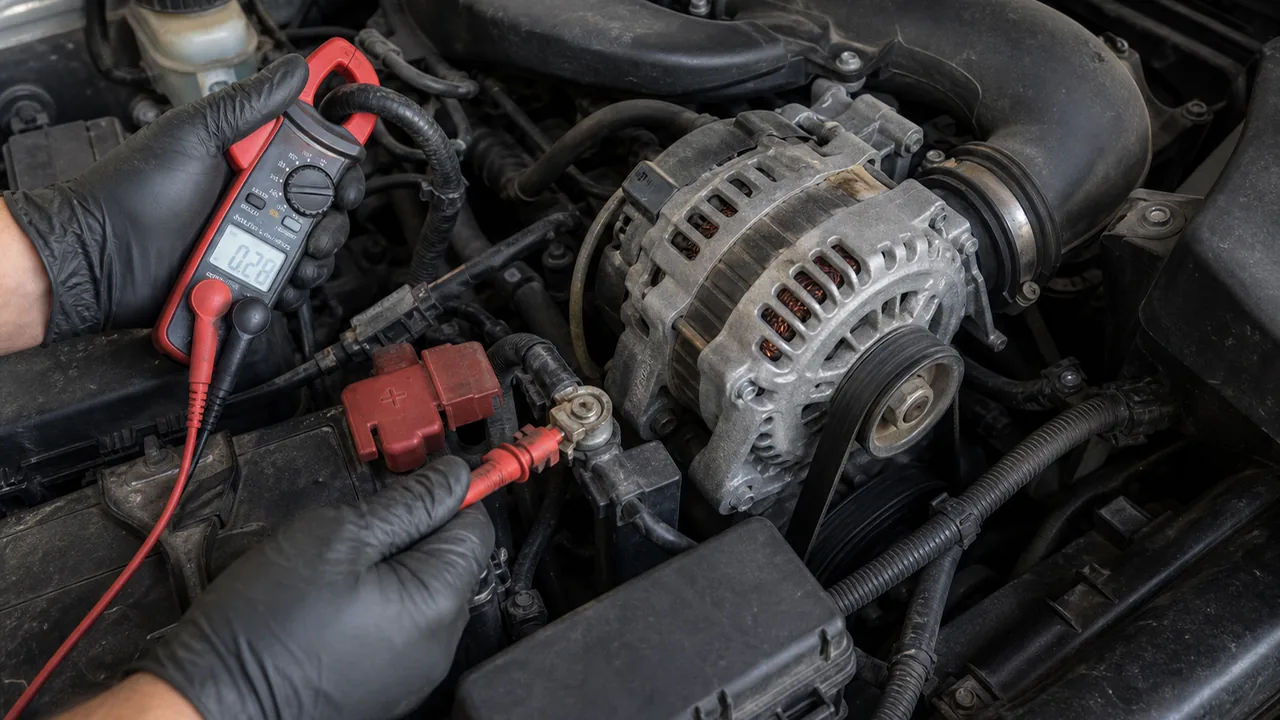
A technician diagnostic flow should preserve the vehicle state, because opening a circuit at the wrong moment can wake modules and corrupt the result. The goal is to measure key-off current under controlled conditions, compare it with verified service information, and isolate the live circuit without guessing.
- Verify battery state of charge and charging-system operation before testing for draw.
- Connect the meter or current clamp using a method that does not reset modules during setup.
- Close latches, secure switches, remove unnecessary scan tools, and keep the key fob away from the vehicle if applicable.
- Wait according to verified Nissan service information rather than assuming a universal sleep time.
- Once the truck is confirmed asleep, isolate fused branches, relays, and main feeds in a controlled order.
- Use wiring diagrams to identify what the affected circuit powers before replacing any component.
- After repair, repeat the same sleep-state test and confirm the no-start complaint does not return.
Exact acceptable draw values, sleep timing, fuse labels, and relay locations should be checked against OEM service information for the specific engine, trim, and equipment.
The common suspects should be tested as cause families, not blamed by reputation. An accessory can stay powered, a relay can stick, a module can be kept awake by a switch input, and an alternator can leak current through a failed diode path, but each one needs a confirming test.
- Aftermarket accessories: unplug or isolate dashcams, alarms, remote starts, audio amplifiers, chargers, trackers, and trailer wiring before deeper testing.
- Relays: check for a relay that remains energized, clicks repeatedly, shows heat damage, or controls a circuit that stays live after key-off.
- Modules: verify whether the module is defective or only being kept awake by a door, hood, lock, security, or communication input.
- Alternator: follow a service procedure to check for diode leakage without creating a charging-system or battery-cable hazard.
Used electrical parts can solve the wrong problem if compatibility and condition are not verified. For a Frontier battery-drain diagnosis, a used module, alternator, relay box, or harness section should be considered only after the fault has been proven and the replacement path is clear.
- Match the exact part number, connector layout, option package, engine, drivetrain, and production details before buying.
- Check for water intrusion, corrosion, overheated terminals, broken locks, cut harnesses, and evidence of previous repair.
- Confirm whether the part needs programming, initialization, key/security matching, or calibration before installation.
- Prefer parts with a return path when the diagnosis still depends on final vehicle-side verification.
A used module should not be installed as a diagnostic shortcut. Confirm the original module is the cause, not a normal module being kept awake by another input.
Stop DIY testing when the next step requires live circuit isolation, module communication analysis, alternator leakage testing, or wiring disassembly beyond visible inspection. Electrical diagnosis is smarter than parts swapping when the drain is intermittent, the truck wakes repeatedly, or the draw is tied to a main feed with many circuits.
- Use professional testing if the battery keeps dying after owner-safe checks and a battery test.
- Escalate if the draw changes with fusible links or main feeds but not with simple accessory removal.
- Stop if wiring is hot, insulation is damaged, smoke or burning odor appears, or a fuse repeatedly fails.
- Ask for a documented parasitic draw test, circuit isolation result, and post-repair verification.
Replacement notes
The truck is not confirmed asleep just because the key is out. A Frontier can still be powering modules after shutdown, and a reading taken during that transition can look like a phantom draw. Sleep confirmation means the vehicle has been left undisturbed, the test setup has not reset modules, and current has stabilized against a verified service reference.
- Do not open doors, press lock buttons, reconnect the battery, or pull fuses during the wait period unless the test method accounts for it.
- Use latch tools or closed-door procedures so interior lamps and door-ajar inputs do not stay active.
- Avoid leaving a scan tool connected unless the diagnostic plan specifically requires network observation.
- If the reading steps down after waiting, document both the initial and stabilized behavior before calling it abnormal.
A forum-origin report that current changed after a waiting period is a strong reason to verify sleep-state behavior first, not proof that a specific circuit has failed.
Circuit isolation should move from broad feeds to specific loads without waking the truck or creating a new fault. Pulling fuses at random can hide the problem if the action resets a module, so the circuit map matters as much as the meter reading.
- Start from the main feed or fusible-link branch only if the procedure and wiring diagram support that direction.
- Identify every fuse box and relay center for the exact truck, including under-hood and interior locations.
- Use a fuse-voltage-drop method or a controlled fuse removal method after the vehicle is asleep.
- When a branch changes the draw, list every device on that branch before replacing the easiest part.
- Separate the branch into loads, connectors, relays, and module wake inputs until one live path remains.
- Repair the confirmed fault, then repeat the full sleep-state test rather than assuming the drop is permanent.
Do not rely on generic fuse charts for this job. Nissan-specific diagrams and trim-specific equipment can change what a feed actually supplies.
The correct repair depends on the confirmed circuit. It may be as simple as removing an always-on accessory or replacing a weak battery after the draw is corrected, or it may require relay, alternator, connector, wiring, or module service.
- Repair wiring damage, corrosion, loose terminals, or poor accessory power routing before replacing control parts.
- Replace a relay only when it is proven to stick, stay energized, or fail the circuit test.
- Replace or service the alternator only when the charging circuit test confirms leakage or charging failure.
- Replace a module only after confirming power, ground, communication, inputs, and programming requirements.
- After the fix, charge and test the battery, clear only documented codes, repeat sleep-state draw testing, and confirm the truck starts normally after sitting.
If the battery has been repeatedly discharged, it may need replacement even when it was not the original fault. That decision should follow testing, not guesswork.
FAQ
Can a 2013 Nissan Frontier have a parasitic draw without a trouble code?
Yes. A key-off current draw can happen without a stored code, especially when the cause is an accessory, relay, lamp circuit, alternator leakage path, or wake-up input. Codes help, but current measurement confirms the draw.
Is the battery always the cause of this problem?
No. The battery is often the victim. A weak battery can make the complaint worse, but the root cause may be a circuit that stays awake, a charging fault, or an accessory that remains powered.
Should I pull fuses until the draw disappears?
Only with a controlled test plan. Random fuse pulling can wake modules, reset the system, or hide the fault. Use the correct fuse locations, wiring diagrams, and a sleep-state procedure.
Can an aftermarket dashcam or alarm cause this?
Yes, but it should be proven. Disconnect or isolate aftermarket equipment and retest after the truck is asleep before blaming the accessory.
What should be verified before replacing a module?
Verify power, ground, connector condition, communication, wake inputs, circuit load, and programming requirements. A module may be awake because another switch or circuit is commanding it.



Comments
Be the first to add a practical repair note or follow-up question.