

Common failure signs
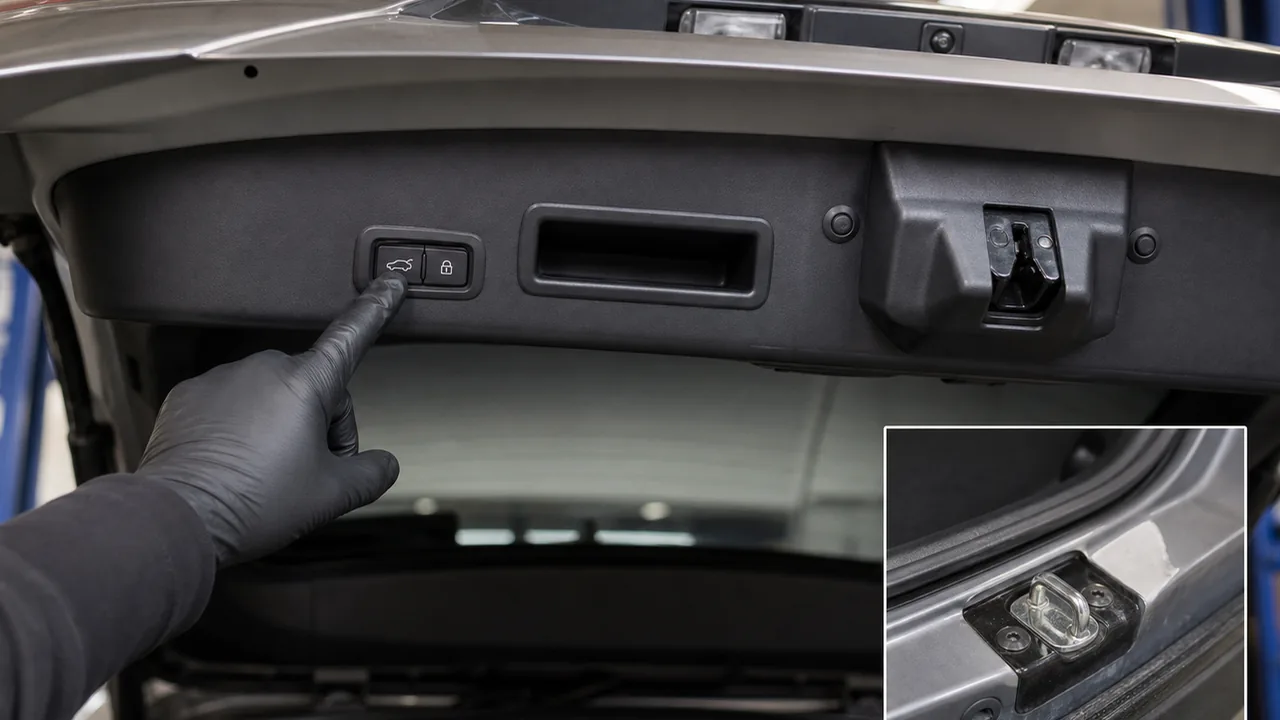
The fastest way to narrow a bZ4X close-and-lock problem is to describe exactly what the liftgate does after the button is pressed. A dead button, a beep-only response, a reversal, a close-without-lock result, and an intermittent failure point to different parts of the same system.
The Button Does Nothing
No response often points to a command that is not being accepted or not being seen. The cause can be as simple as key location or low 12-volt power, but it can also be a switch input, body ECU, wiring, or communication issue.
- Try the spare smart key if available and confirm the active key is actually near the vehicle, not left inside a bag farther away or shielded by other items.
- Check whether other remote, keyless, or lock functions are acting weak or inconsistent, because that can support a key-fob battery or key detection path.
- Look for dim interior lights, slow accessory response, warning messages, reset displays, or other low-voltage clues before blaming the liftgate hardware.
- Confirm the hatch is not already partly latched, sitting high on the striker, or resting against cargo that makes the vehicle reject the command.
- If the button is consistently dead but other liftgate commands work, the switch circuit and live switch input become a higher-priority technician check.
The Liftgate Beeps but Does Not Move
A beep-only response usually means the vehicle heard the request but refused to move the liftgate. That puts the focus on inhibited operation, obstruction logic, key authorization, door status, latch status, or a stored fault.
- Clear the cargo area and make sure nothing touches the hatch, glass, trim, weatherstrip, load floor, or rear bumper area as the liftgate begins to move.
- Check whether the instrument cluster or vehicle display shows any door, hatch, lock, or warning status that conflicts with the requested close-and-lock operation.
- Move the key to a normal outside position near the rear of the vehicle and remove extra keys or electronic devices from the hatch area if the symptom changes.
- If the beep appears after a battery disconnect, body repair, liftgate service, or latch replacement, ask the technician to check whether initialization or customization is required.
- If the beep happens only sometimes, write down the parking angle, weather, cargo load, and key used, because intermittent inputs are easier to validate when the pattern is known.
The Liftgate Starts Closing and Reopens
A liftgate that starts closing and then reopens is commonly linked to obstruction protection, binding, latch alignment, position sensing, or a control system that does not see expected movement. Treat repeated reversal as a diagnostic clue, not an invitation to force the hatch shut.
- Remove objects that can shift during closing, including bags, charging cables, cargo nets, mats, folded seats, and loose trim pieces.
- Inspect the hatch edge and seal area for anything that could increase closing resistance or make the liftgate think it has contacted an obstruction.
- Watch whether the liftgate reverses at the same point every time; a repeatable point can suggest binding, obstruction, or position-learning issues.
- If the hatch reaches the latch and then reopens, latch engagement, striker alignment, and latch-position reporting become priority checks.
- If it reverses without touching anything visible, technician diagnosis should include motor operation, position data, jam-protection logic, and related DTCs.
The Liftgate Closes but the Vehicle Does Not Lock
When the hatch closes but does not lock, the close side of the command may be working while the lock side is being blocked. That shifts attention to lock eligibility, door status, smart-key position, latch confirmation, and body-control logic.
- Confirm all side doors, the hood if monitored, and the rear hatch show fully closed before trying the close-and-lock button again.
- Make sure the smart key is not inside the cargo area or cabin in a way that prevents the vehicle from locking as a protection against locking the key in.
- Try a normal lock command from the remote or door handle to see whether the issue is specific to the close-and-lock button or part of a wider lock problem.
- Listen for normal lock actuator activity after the hatch closes; no lock action can point toward authorization or body-control logic, while partial lock action can point toward a door-status or actuator path.
- If the vehicle closes but repeatedly refuses to lock, a technician should compare latch status, door status, key location data, and lock command data rather than assuming the liftgate motor is at fault.
The Problem Is Intermittent
Intermittent close-and-lock faults are usually input, voltage, wiring, alignment, or authorization problems that appear only under certain conditions. The pattern is often more valuable than one isolated failure.
- Note whether the failure appears after the vehicle sits, after short trips, in wet weather, in cold weather, or only when parked on an incline.
- Record whether the same smart key, spare key, cargo load, or parking location is involved when the problem returns.
- Check whether unrelated electrical symptoms appear at the same time, because low or unstable 12-volt power can make body systems look inconsistent.
- Avoid clearing codes or disconnecting the battery before service unless instructed, because stored data may help identify the failing input.
- Bring a short symptom log to the service visit so the technician can reproduce the failure path instead of testing only when the system happens to work.
Inspection steps
A 2026 Toyota bZ4X trunk close-and-lock button usually points to the vehicle not seeing one of the required conditions for powered closing or locking, the button input not being recognized, the liftgate latch or obstruction logic interrupting the cycle, the smart key or 12-volt system being weak, or a body-control or power-liftgate fault needing scan-tool diagnosis.
The first checks are cargo obstruction, hatch alignment, smart key location, vehicle lock state, door status, and 12-volt or key-fob battery symptoms. Those checks separate simple operating-condition problems from faults that need Toyota-compatible diagnostics.
A close-and-lock button is not just a motor switch. The system has to accept a command, confirm the hatch can move safely, verify latch readiness, confirm that locking is allowed, and then complete both the closing and locking parts of the request. If one required input is missing or contradictory, the vehicle may ignore the button, beep, stop, reverse, close without locking, or work only sometimes.
- The liftgate path must be clear of cargo, straps, mats, ice, snow, or anything touching the trim, seal, or hatch edge.
- The liftgate and striker must be aligned well enough for the latch to close cleanly and report the expected position.
- The smart key must be detected in an allowed location, and the vehicle must be in a lock-eligible state.
- The close-and-lock switch input must be recognized by the body or liftgate control logic.
- The 12-volt system must support body electronics, latches, locks, and liftgate control reliably.
- The liftgate must not already be inhibited by a stored fault, active jam-protection response, initialization issue, or door-status conflict.
That is why the best first move is not to replace the liftgate motor. Match the symptom, verify the simple conditions, and then use scan data if the hatch still will not close, latch, or lock normally.

The likely causes should be ranked from simple and owner-visible to scan-tool level. A close-and-lock failure can come from the liftgate path, smart key authorization, latch feedback, voltage stability, the switch circuit, body-control logic, or service-related initialization.
Cargo, Obstruction, or Pinch-Protection Interruption
Cargo and obstruction issues are the easiest to miss because the hatch may look mostly clear while a strap, mat, bag handle, cargo cover, or rear seal contact still affects movement. If the liftgate starts to move and then reverses, or if it beeps and refuses to move, the closing path and pinch-protection logic deserve the first look.
- Clear the load floor and rear edge area completely for a retest.
- Check for cargo that shifts as the liftgate angle changes.
- Inspect the weatherstrip and trim for loose or folded pieces.
- Avoid holding or guiding the hatch in a way that adds resistance while testing.
Smart Key Not Detected or Key-Fob Battery Weakness
The close-and-lock command depends on authorization as well as movement. If the vehicle cannot confidently detect the smart key, or if the key is in a location that makes locking inappropriate, the system may refuse the lock part or ignore the combined command.
- Try the spare key if available.
- Move the key to a normal outside position near the rear of the vehicle.
- Look for short-range behavior or inconsistent lock and unlock response.
- Treat a key-fob battery clue as a low-cost check, not proof that the liftgate hardware is good or bad.
Weak 12-Volt Battery or Low System Voltage
Body electronics still rely on the 12-volt system for control modules, locks, sensors, and latch logic. Low or unstable 12-volt power can make a button seem dead, make a module drop a command, or create confusing combinations of warning messages and intermittent operation.
- Watch for dim lights, reset displays, slow accessory behavior, or multiple unrelated electrical warnings.
- Consider battery state if the vehicle has been sitting, has had recent electrical work, or shows other body-system oddities.
- Do not jump from a weak-voltage symptom to a liftgate motor replacement without checking power and stored diagnostic data.
- Have the 12-volt system tested with the proper procedure if the symptoms point beyond a key-fob battery.
Liftgate Latch, Striker, or Position Signal Issue
The latch has to do two jobs: physically secure the liftgate and report a believable state to the control system. If the hatch closes but is not recognized as latched, the vehicle may refuse to lock, reopen the liftgate, or report an open condition.
- Look for a hatch that sits high, uneven, or not fully seated.
- Listen for clean latch engagement rather than repeated partial catches.
- Check for cargo or trim pushing the liftgate away from the striker.
- Let a technician inspect latch status data, striker alignment, and any latch-related codes before replacing parts.
Close-and-Lock Switch Input Fault
If other liftgate commands work but the close-and-lock button itself does not, the switch input becomes more suspect. The fault can be inside the button, its connector, trim-area wiring, or the module that reads the command.
- Compare the close-and-lock button with other liftgate controls if the vehicle has more than one way to command the hatch.
- Check whether the button fails only after water exposure, washing, impact, or trim service.
- A technician should verify live switch input before replacing the switch.
- If live data does not change when the button is pressed, the switch circuit and connector path need inspection.
Door Lock, Body ECU, Wiring, or Communication Fault
The close-and-lock request passes through body-control decisions, door-lock logic, smart-key logic, and liftgate operation. A wiring, ground, connector, or network issue can block one part of the request while leaving other vehicle functions apparently normal.
- Inspect harness areas that move with the hatch, especially where repeated flexing can affect wiring.
- Check connectors for looseness, moisture, corrosion, impact damage, or prior trim work.
- Use scan data to compare requested state, actual switch input, latch status, door status, and lock command output.
- Do not bypass latch or lock circuits to make the hatch close; the system needs correct feedback to remain safe.
Initialization, Customization, or Service Procedure Needed
After battery loss, body repair, liftgate service, latch replacement, module replacement, or certain electrical repairs, the system may need a Toyota procedure before normal operation returns. This is not the same as guessing a reset; the procedure should follow the applicable Toyota repair information.
- Ask whether the symptom began immediately after a battery disconnect, collision repair, hatch adjustment, trim removal, or module work.
- Have service information checked for initialization, learning, customization, or calibration requirements.
- Confirm the system operates through a full close, latch, lock, and reopen sequence after any procedure.
- Recheck for stored or returning codes after the repair path is complete.

Owner checks are useful when they stay within normal use: clear the hatch path, verify the key and doors, look for battery clues, and confirm whether the hatch is actually latched. Stop short of forcing the liftgate, probing wiring, or defeating safety switches.
- Clear the cargo area completely. Remove cargo covers, straps, bags, folded mats, charging cables, and anything near the rear seal or bumper area.
- Check hatch alignment visually. The liftgate should sit evenly and should not appear high, crooked, or held away from the body by cargo or trim.
- Confirm the smart key is with you and in a normal outside position. If available, try the spare key to see whether the symptom follows one fob.
- Look for key-fob battery clues such as reduced range, inconsistent unlock response, or a need to hold the key unusually close to the vehicle.
- Check door and liftgate status. If the vehicle thinks another door or the hatch is open, the lock portion of the command may be refused.
- Watch for 12-volt warning symptoms, including dim lights, reset screens, slow accessories, multiple unrelated warnings, or odd body-electrical behavior.
- Try a normal lock and unlock command separately. If normal locking also fails, the issue is not limited to the liftgate close-and-lock button.
- Confirm manual latch security only through owner-manual-approved use. If the hatch does not stay securely latched, do not treat the vehicle as properly secured.
Do not repeatedly slam the liftgate or hold the hatch against the motor. Repeated force can damage trim, latch parts, or alignment and can make the original fault harder to diagnose.
If the button works after cargo is cleared or the key position changes, the issue may have been a blocked condition rather than a failed component. If it still fails with a clear opening, a known key, normal door status, and no obvious low-voltage symptoms, the next step is diagnostic data.
A technician should treat the close-and-lock button as a system request, not as a standalone part. The diagnostic goal is to prove whether the command is received, whether the system authorizes it, whether the liftgate can move and latch, and whether the lock command is allowed.
- Scan body, smart key, door lock, communication, and power liftgate related modules with Toyota-compatible diagnostics.
- Record stored, current, and history DTCs before clearing anything, because intermittent body faults can disappear during a quick retest.
- Check live data for the close-and-lock switch. The input should change when the button is pressed; if it does not, inspect the switch, connector, and circuit path.
- Check liftgate latch status, door status, hatch position, and any jam-protection or obstruction-related status while reproducing the symptom.
- Command the liftgate and locks with the scan tool if the procedure allows it, then compare commanded operation with actual hatch movement, latch engagement, and lock output.
- Inspect the latch, striker, hinges, liftgate alignment, and weatherstrip for binding, impact damage, incorrect adjustment, or partial engagement.
- Inspect wiring, connectors, and grounds, especially around the hatch harness and hinge area where movement can expose intermittent faults.
- Check body ECU communication and network faults if multiple modules disagree about door, key, or lock state.
- Review Toyota repair information for initialization, customization, calibration, or learning steps after battery, latch, motor, module, or liftgate service.
- After the repair, verify the full sequence: button input recognized, liftgate closes, latch reports secure, vehicle locks when eligible, and no related codes return.
This order matters because replacing a motor, latch, switch, or module without live data can miss the actual fault. A hatch that will not move may have a good motor and a blocked command. A hatch that closes but will not lock may have a lock eligibility or latch-status problem rather than a liftgate-drive problem.
Related DTCs may be stored in body, smart key, door lock, communication, or power liftgate systems, and they should be read with Toyota-compatible diagnostics before parts are replaced. A generic scan may not show the body and liftgate data needed to understand this symptom.
- Body ECU codes can point to switch input, door status, lock logic, module power, or network faults that prevent the close-and-lock request from completing.
- Smart key system codes can point to key authorization, antenna, key recognition, or key-position problems that affect the lock portion of the command.
- Power back door or liftgate codes can point to latch status, motor operation, position sensing, jam protection, or interrupted movement.
- Communication codes can point to wiring, grounds, connectors, or lost messages between modules that need to agree before closing and locking.
- History codes can be useful when the problem is intermittent, especially if the button works during the service visit but failed repeatedly for the owner.
DTCs should be paired with live data. For this complaint, the useful data is whether the switch input changes, whether the vehicle sees the smart key in an acceptable state, whether the hatch and all doors report closed, whether the latch reports secure, and whether the system is commanding the motor or lock actuator. If a code is cleared before those observations are made, the best clue may be lost.
A DTC points to a circuit, condition, or diagnostic path. It does not automatically prove that the named part is bad.
You may be able to manually close or lock the liftgate only if the owner manual permits that use for the vehicle configuration and the hatch can latch securely without force. Manual closure does not fix the close-and-lock button fault; it only helps secure the vehicle until the cause is diagnosed.
- Use manual closing only when the power system is not actively driving the hatch and the owner manual allows manual operation.
- Do not slam the liftgate repeatedly. A hard slam can mask latch feedback problems or create new alignment damage.
- After closing, confirm the hatch is fully latched before relying on the lock command, keyless locking, or driving.
- If the hatch closes but the vehicle refuses to lock, check whether another door status, key location, or latch-status condition is preventing locking.
- If the hatch does not stay closed, pops open, or reports ajar, treat the vehicle as not properly secured.
- If you must move the vehicle with a liftgate concern, avoid carrying loose cargo in the rear and arrange service promptly.
A secure latch is the dividing line. A button that does not work is inconvenient; a liftgate that cannot latch is a safety and security problem.
A close-and-lock button fault becomes urgent when the liftgate will not latch securely, reopens unexpectedly, reports ajar, or leaves the vehicle unable to lock. At that point, the issue is no longer just a convenience feature.
- Service promptly if the hatch will not latch securely or can be lifted open after it appears closed.
- Do not continue normal driving if the liftgate pops back open, stays ajar, or repeatedly reverses near the latch.
- Treat repeated pinch-protection reversal as a diagnostic fault until a technician confirms the cause.
- Use caution if warning messages, body electrical faults, smart-key faults, or 12-volt symptoms appear with the hatch problem.
- Book diagnosis quickly if the liftgate closes but the vehicle will not lock, especially if normal door locking is also inconsistent.
- Avoid carrying unsecured cargo in the rear if there is any doubt that the hatch is latched.
- Do not bypass latch sensors, defeat safety logic, or try to adjust striker position without the correct repair procedure.
If the hatch is securely latched and only the convenience button fails, the vehicle may still be usable while waiting for diagnosis. If the latch is unreliable, the repair should be treated as prompt service.
The clean repair path is to document the behavior, verify easy conditions, scan the right modules, and then repair the confirmed failure. This prevents a simple key, latch-status, or initialization issue from turning into unnecessary part replacement.
- Record the exact symptom: no response, beep only, closes and reopens, closes but will not lock, works intermittently, or fails only with one key.
- Clear the hatch path, confirm hatch alignment, verify door status, check smart-key location, and note any 12-volt or key-fob battery clues.
- Check whether normal lock, unlock, and liftgate commands work through other controls, because that separates a button-specific issue from a wider body-control issue.
- Use Toyota-compatible diagnostics to read body, smart key, communication, and liftgate DTCs before clearing codes.
- Review live data for switch input, latch status, hatch position, door status, lock eligibility, and key authorization while reproducing the complaint.
- Inspect the latch, striker, weatherstrip, liftgate harness, connectors, grounds, and any areas affected by recent repair, impact, water exposure, or trim work.
- Follow Toyota repair information for any required initialization, customization, calibration, or learning procedure after service.
- Replace parts only after the failed input, circuit, actuator, latch, module path, or mechanical condition has been confirmed.
- Verify the final repair by testing close, latch, lock, reopen, remote command, keyless locking, and stored-code status.
| Symptom | Most Useful Next Check | Why It Matters |
|---|---|---|
| Button does nothing | Switch input, key detection, 12-volt symptoms, and body module status | The command may not be reaching the system or may be blocked before movement begins. |
| Beeps but does not move | Obstruction, latch status, door status, authorization, and stored inhibit codes | The vehicle may be acknowledging the request but refusing operation. |
| Closes and reopens | Cargo path, binding, jam protection, latch alignment, and position data | The system may be reacting to resistance or missing expected movement feedback. |
| Closes but will not lock | Door status, latch confirmation, key location, and lock command data | The closing function may be valid while locking is being rejected. |
| Works intermittently | History codes, harness movement, voltage stability, key used, and environmental pattern | Intermittent faults often need pattern data and live data together. |
For service scheduling, bring the symptom description, which key was used, whether the hatch latched, whether normal locking worked, any warning messages, and whether recent battery, body, trim, or liftgate work occurred. That information reduces repeat visits and helps the technician test the right branch first.
FAQ
Can a weak 12-volt battery cause the close-and-lock button to fail?
Yes. Weak or unstable 12-volt power can affect body modules, latch logic, lock commands, and smart-key behavior. It is more likely when the liftgate symptom appears with dim lights, reset screens, warning messages, slow accessories, or other unrelated electrical oddities.
Why does the liftgate beep but not move?
A beep-only response usually means the vehicle heard the request but refused to run the close cycle. The likely reasons include an obstruction, door or hatch status conflict, smart-key authorization issue, latch-position problem, stored liftgate fault, or required initialization after service.
Why does the liftgate close and then reopen?
Closing and reopening often points to obstruction protection, binding, cargo shifting into the hatch path, latch or striker misalignment, or position feedback that does not match expected movement. Repeated reversal should be inspected instead of forced shut.
Why does the bZ4X liftgate close but not lock?
If closing works but locking fails, the vehicle may not see a lock-eligible state. Check that all doors are closed, the smart key is not inside the vehicle, the hatch latch reports secure, and normal lock commands work. If it continues, scan data is needed.
Should I replace the liftgate motor first?
No. The motor should not be the first assumption. The command can be blocked by key detection, latch status, obstruction logic, low 12-volt power, switch input, wiring, or body-control logic even when the motor itself is capable of moving.
Do I need a scan tool for this problem?
You need Toyota-compatible diagnostics if the hatch will not latch, reopens, closes but will not lock, works intermittently, or has warning messages. Scan data can show DTCs, switch input, latch status, key authorization, door status, and body-control communication.

Comments
Be the first to add a practical repair note or follow-up question.