
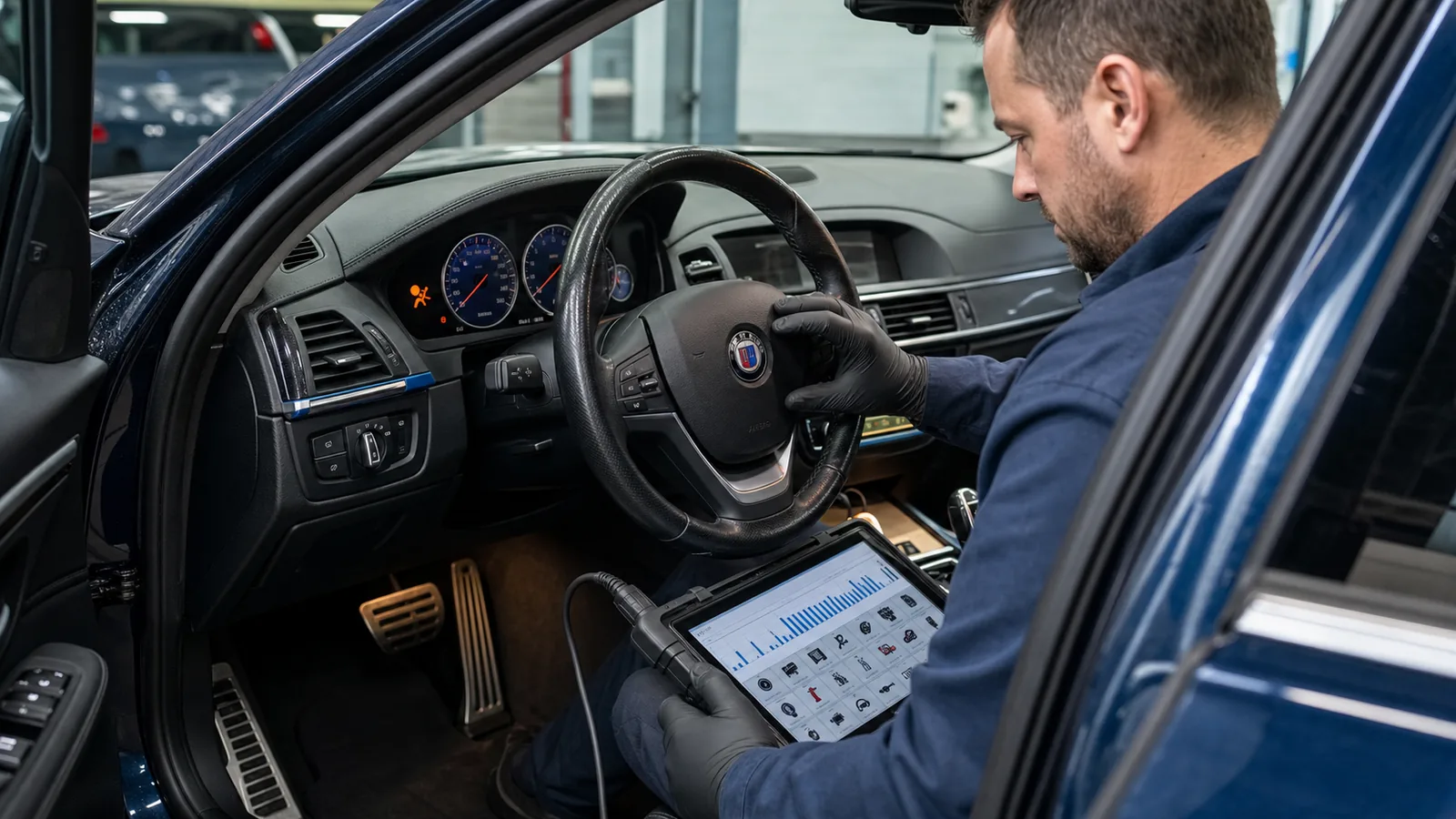
What this part does
The driver airbag assembly sits in the steering wheel and is controlled by the SRS system. When the system commands deployment in a qualifying crash, the inflator rapidly fills the airbag. Because that inflator is a pyrotechnic safety component, the inspection and replacement path is controlled by official service procedures.
The Safety Gate alert focuses on the inflator, not a routine trim, horn, or steering-wheel wear problem. If the inflator degrades and then deploys incorrectly, the hazard is occupant injury from the deployment event itself, which is why recall verification matters more than ordinary symptom chasing.
- The airbag is a passive safety device and should not be treated as a general electrical accessory.
- The SRS control unit can store faults, but recall status is decided by official campaign data, not by the presence or absence of a code.
- Replacement decisions should follow BMW campaign instructions, national recall guidance, and qualified SRS handling rules.
Common failure signs
A BMW ALPINA B3 airbag warning sign can indicate an open recall, an SRS fault, an unresolved repair record, or a database mismatch. The warning becomes most urgent when official recall wording describes an injury risk from driver airbag inflator rupture.
- A recall letter, official VIN lookup result, or dealer notice naming an airbag campaign.
- An SRS or airbag warning light on the instrument cluster.
- A buyer disclosure saying an airbag recall is open or unverified.
- A service reminder or dealer message asking for campaign confirmation.
- Prior crash repair records, steering wheel replacement notes, or missing SRS service paperwork.
- Import paperwork that may not match the market where the vehicle is currently registered.
A dashboard airbag light should be taken seriously, but it does not prove that this recall applies. A car can have an unrelated SRS fault, and a car can also have an open recall without a dashboard warning light.
Before replacing it
A BMW ALPINA B3 airbag injury-risk recall warning usually means that if the driver airbag inflator can burst, the car should be treated as a stop-driving safety risk until the recall remedy is completed. The likely risk family is inflator degradation or a VIN-specific SRS campaign, so check the VIN in official recall systems before driving decisions, code clearing, or parts replacement.
EU Safety Gate alert SR/01725/26 lists BMW Alpina B3 and BMW Alpina D3 passenger cars and describes a driver airbag inflator that may malfunction due to long-term degradation. The alert says excessive internal pressure during deployment could burst the inflator and eject metal fragments that could cause injuries. The Safety Gate source is https://ec.europa.eu/safety-gate-alerts/screen/webReport/alertDetail/10099219?lang=en.
- Find the VIN on the vehicle registration, windshield VIN plate, door label, insurance record, or BMW service paperwork.
- Check the VIN through an official BMW recall lookup, a national recall database, or an authorized BMW service center.
- Read the exact campaign wording before deciding whether the vehicle can be moved, should be parked, or needs towing advice.
- Do not remove trim, unplug airbag connectors, probe SRS wiring, or replace the airbag module yourself.
- Record the SRS warning light status, any recall letter text, the current mileage, service history, import records, and prior crash repair evidence.
ALPINA model naming can be less reliable than VIN records because the car may share BMW platform systems while still having low-volume ALPINA identification. Treat the VIN and official campaign record as the deciding source.
Airbag and SRS diagnostic trouble codes can point a technician toward a circuit, module, connector, or control-unit issue, but they do not prove that a recall is open, closed, or correctly completed. The recall record must be checked separately through BMW, an authorized dealer, or the relevant national recall system.
- Use the VIN lookup to confirm whether a campaign applies to the specific vehicle.
- Use SRS scan results to document current faults for a technician, not to override official campaign status.
- Ask whether the campaign remedy covers the driver airbag inflator, the airbag module, or another defined component.
- Keep a copy of any completed recall paperwork because resale, import, and inspection records may lag behind actual repair work.
| Information | What it can confirm | What it cannot confirm |
|---|---|---|
| VIN recall lookup | Whether an official campaign is open or completed for that VIN | The cause of every active SRS fault |
| SRS scan | Stored or current airbag system faults for diagnosis | Recall eligibility or recall completion by itself |
| Owner service records | Repair dates, dealer names, and prior campaign paperwork | Whether the current database has been updated |
| Dashboard warning light | That the SRS system needs attention | That the recall is fixed, open, or unrelated |
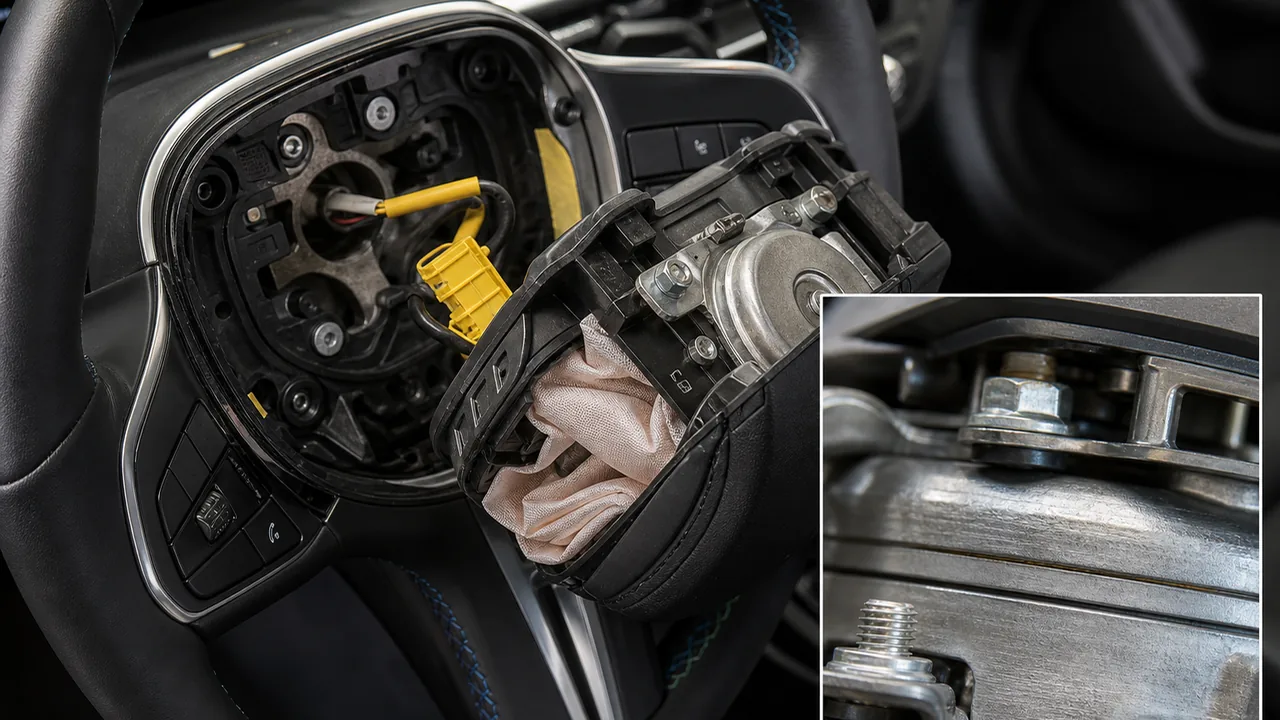
A BMW ALPINA B3 airbag recall warning usually points first to a VIN-specific recall record or safety alert, then to SRS faults or service-history problems if the VIN check does not explain the warning. This order prevents unsafe DIY work and avoids confusing ALPINA applicability with broader BMW 3 Series coverage.
- Confirmed open recall for the VIN, especially if the official wording names driver airbag inflator rupture or injury risk.
- Open inflator-related campaign that may overlap with BMW platform systems, without assuming it is a Takata campaign unless the official record says so.
- SRS system fault such as a stored airbag, seat, belt, occupancy, connector, or control-unit code that needs qualified diagnosis.
- Prior collision repair with missing documentation, incorrect repair validation, or unresolved SRS control-unit status.
- Incorrect, substituted, or unverified airbag module installed during previous repair or steering wheel work.
- Imported-vehicle database mismatch where the current market lookup does not show the same recall status as the origin market.
- Incomplete prior recall record where the remedy may have been performed but not clearly documented in the available paperwork.
Do not assume every BMW ALPINA B3 is affected. Safety Gate lists affected product identifiers, but a specific vehicle still needs VIN, market, production date, and campaign-record confirmation.
Inspection steps
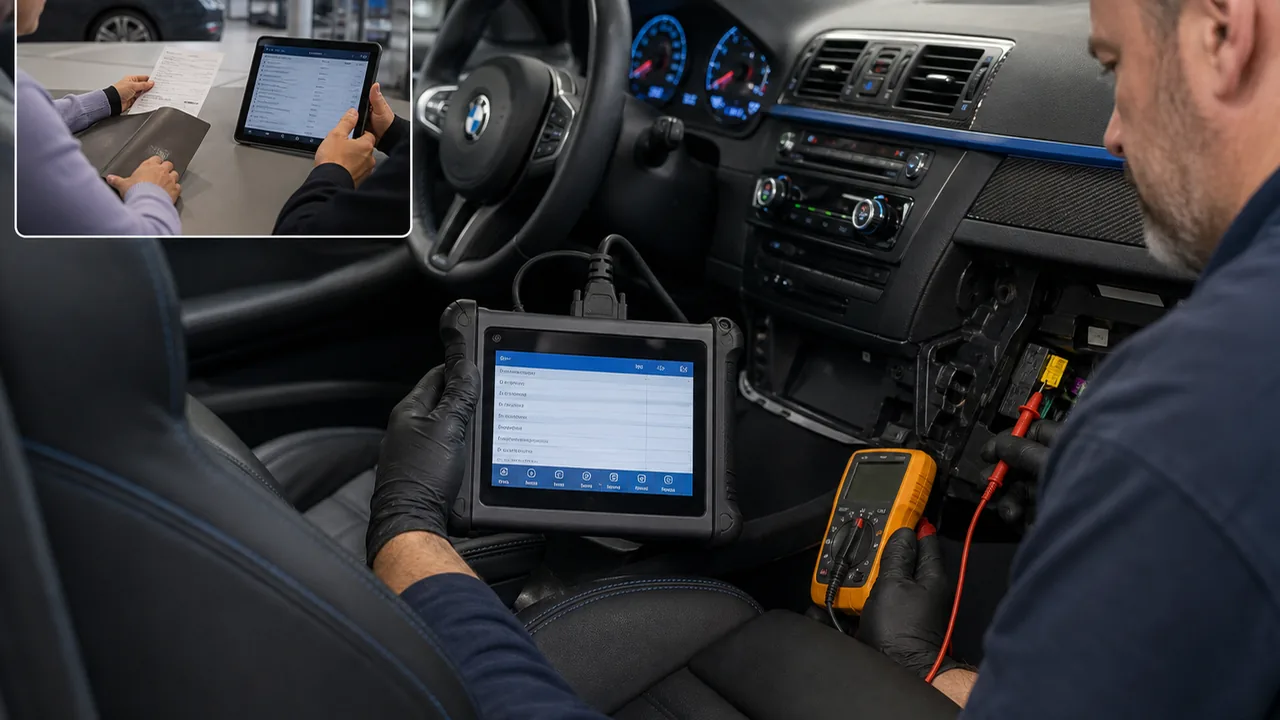
Inspection starts with the paper trail, not the airbag module. A careful owner can document the VIN, warning source, service history, and visible vehicle condition, then hand that package to BMW service or a qualified SRS technician.
- Copy the full VIN exactly from the vehicle and paperwork.
- Save the recall letter, VIN lookup result, dealer email, dashboard message, or buyer disclosure that triggered the concern.
- Check official BMW and national recall sources for the VIN, then compare the wording with the Safety Gate alert if the vehicle is in the EU context.
- Call an authorized BMW service center with the VIN, current mileage, warning-light status, import history, and any previous SRS paperwork.
- Ask whether the campaign is open, completed, pending parts, market-specific, or not applicable to that VIN.
- If there is an SRS light or crash-repair history, arrange a qualified scan and inspection without clearing codes as a repair.
- Keep written completion proof, including campaign name or reference, repair date, dealer details, and the exact remedy performed.
- Owner-safe check: documentation, VIN lookup, warning-light observation, and service-history review.
- Technician-only check: SRS scan, module identification, connector inspection, wiring validation, control-unit status, and service-procedure compliance.
If official recall wording says the vehicle should not be driven, the next action is not a test drive; it is a call to authorized BMW service for instructions. If the wording does not clearly say stop driving, still ask the dealer to confirm whether driving, towing, or mobile handling is appropriate for that VIN.
| Official wording or situation | Owner action | What to ask |
|---|---|---|
| Stop-drive, do-not-drive, park immediately, or similar language | Park the vehicle and contact authorized BMW service before moving it | Ask about towing, mobile remedy, parts status, and written safety instructions |
| Open recall with injury-risk wording but no clear transport instruction | Avoid unnecessary driving until BMW confirms the handling path | Ask whether the car can be driven to the dealer or needs alternative transport |
| SRS light with no confirmed recall result | Treat as investigate soon and arrange qualified diagnosis | Ask whether the SRS fault affects airbag readiness and whether any campaign is open |
| Buyer or imported vehicle with unclear records | Do not rely on seller claims alone | Ask for VIN-based recall status and written completion evidence |
A recall remedy is normally handled through official channels. Do not pay for or install a used airbag to work around an open safety recall unless an authorized source has confirmed the correct repair path.
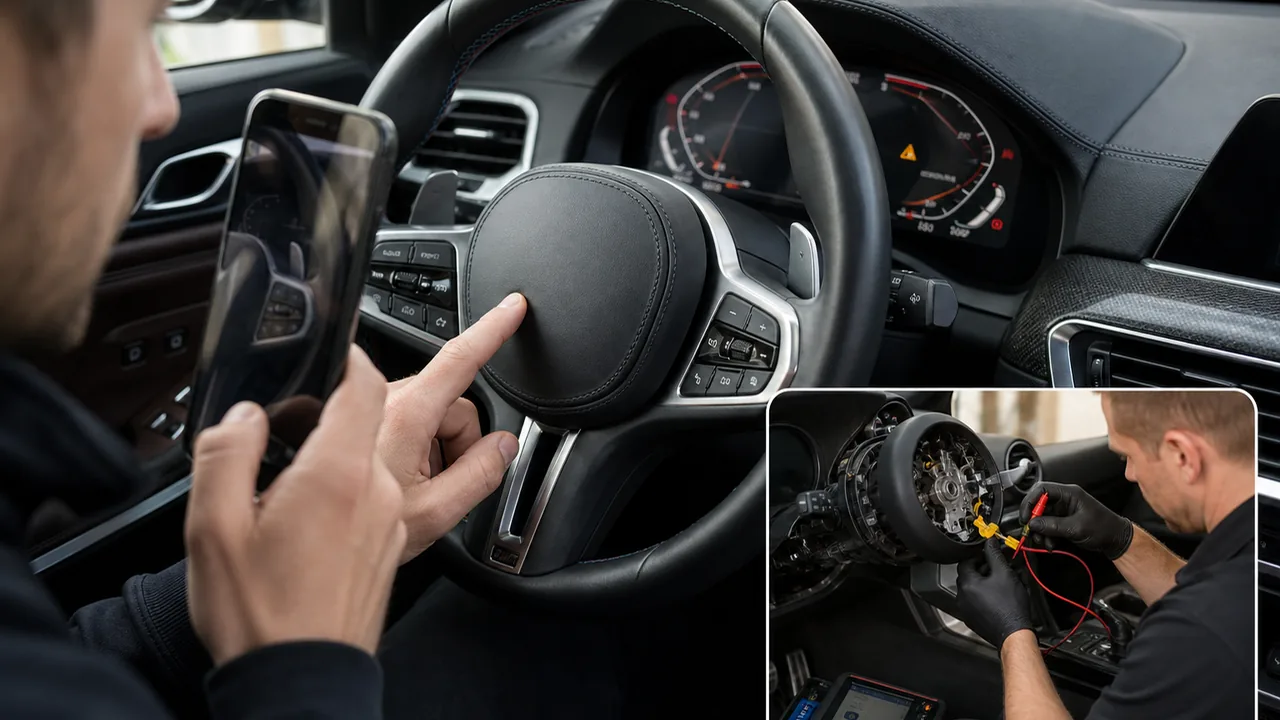
The owner-safe side of the work is documentation. The technician side is controlled SRS diagnosis and recall repair. Keeping those roles separate protects the vehicle record and reduces the risk of damaging or mishandling pyrotechnic restraint components.
| Owner-safe | Technician-only |
|---|---|
| Confirm VIN and market paperwork | Run an SRS scan with suitable diagnostic equipment |
| Photograph warning messages and lights | Verify airbag module identity through approved service information |
| Collect recall letters and service history | Inspect SRS connectors and wiring using OEM procedure |
| Note prior crash repair or steering wheel replacement | Confirm control-unit status and prior repair validation |
| Ask BMW for written campaign status | Complete the recall remedy and document compliance |
The Safety Gate alert names BMW Alpina B3 and BMW Alpina D3 passenger cars and lists official product identifiers, including a batch date range and model type. That evidence supports taking the alert seriously, but it does not replace a VIN-specific recall lookup for an individual car.
- Check whether the VIN decodes consistently across registration, insurance, import, and BMW service documents.
- Ask the dealer to check both the current registration market and any origin-market recall history if the car was imported.
- Do not assume a BMW 3 Series recall automatically includes or excludes an ALPINA B3.
- If the car has had steering wheel, dashboard, crash, or SRS work, ask for documentation before relying on the seller's statement.
For publication review, re-check official records before naming exact campaign coverage beyond the official Safety Gate alert, because recall availability and completion status can change by market and VIN.
A used airbag may look correct while still being wrong for the vehicle, previously deployed, improperly stored, or affected by the same recall concern. If the warning is recall-related, the safer route is official campaign completion, not owner-supplied airbag replacement.
- Do not buy a steering wheel airbag to clear a recall warning without written BMW guidance.
- Do not assume a matching appearance means the airbag module is correct for the VIN.
- Do not accept a cleared SRS light as proof that a used airbag is safe or recall-compliant.
- For pre-purchase inspection, ask the seller for recall completion proof and have a qualified shop document any non-recall SRS faults.
Used SRS parts can create compatibility, safety, and legal issues. If a recall is open, resolve the recall record first and treat any remaining SRS fault as a separate technician diagnosis.
Call authorized BMW service with the VIN, current mileage, recall warning source, SRS light status, import history, and prior SRS records. Ask for written confirmation of campaign status and keep the final repair record with the vehicle history.
- Is there an open airbag or inflator-related campaign for this VIN?
- Does the campaign wording include stop-drive, do-not-drive, towing, or mobile repair instructions?
- Is the remedy available now, pending parts, already completed, or not applicable?
- What document will confirm completion after the recall remedy?
- If an SRS fault is present, should it be diagnosed before or after recall verification?
- For an imported ALPINA B3, can you check origin-market and current-market recall records?
This article supports the service conversation; it is not a substitute for BMW repair procedures, national recall instructions, or qualified SRS diagnosis.
- Verify the full VIN through official BMW or national recall systems.
- Read the exact campaign wording and treat inflator rupture language as a serious safety risk.
- Do not handle, probe, remove, or replace airbag or SRS components yourself.
- Document the recall notice, SRS light status, service history, prior crash repairs, steering wheel work, and import records.
- Contact authorized BMW service with the VIN and ask for campaign status, driving or towing guidance, remedy availability, and written completion proof.
If the official source says the driver airbag inflator can burst, the vehicle should be treated as a stop-driving safety risk until the recall remedy or authorized handling instruction is confirmed.
Replacement notes
If the VIN has an open recall, ask the authorized BMW service center what remedy applies, whether parts are available, whether the vehicle should be driven, and what written proof will be supplied after completion. Do not substitute a used module or aftermarket workaround for an official campaign remedy.
- Give the service center the VIN and the exact warning or recall reference.
- Ask whether the campaign is open, already completed, pending parts, or not applicable.
- Ask whether the car should be parked, driven in, towed, or handled another way based on the campaign instructions.
- Request the repair order or completion record showing the campaign action after the remedy is performed.
- If an SRS light remains after recall work, ask for separate diagnostic documentation instead of assuming the recall repair failed.
Safety recalls are commonly handled through authorized channels without the owner buying the recall part separately, but the exact process should be confirmed through BMW or the applicable national recall system for the VIN.
FAQ
Does an airbag warning light prove my BMW ALPINA B3 has this recall?
No. An airbag warning light means the SRS system needs attention, but recall applicability must be confirmed by VIN through official BMW or national recall records.
Can I clear SRS codes to fix the recall warning?
No. Clearing codes does not complete a recall, replace an inflator, or prove the vehicle is safe. Codes may help a technician diagnose a separate SRS issue.
Is every BMW ALPINA B3 affected?
No. The official alert names BMW Alpina B3 vehicles, but the specific vehicle still needs VIN, market, production date, and campaign-record verification.
Should I drive the car to the dealer?
Follow the official wording for the VIN. If it says stop driving or do not drive, park the vehicle and ask BMW service about towing or another approved handling method.
Can a used airbag solve the problem?
A used airbag should not be used as a workaround for an open safety recall. The correct path is official recall verification and an authorized remedy.
Comments
Be the first to add a practical repair note or follow-up question.