

What the code means
P0368 often points to a circuit-level problem in the camshaft position sensor B circuit on Bank 1. In plain English, the computer is not simply saying the camshaft is out of position; it is flagging the electrical signal path used to report camshaft position.
| Code phrase | Plain meaning | Diagnostic caution |
|---|---|---|
| Camshaft position sensor | A sensor the ECM uses to track camshaft position for engine control decisions. | A sensor code can be caused by wiring, connector, signal, power, ground, or ECM-side interpretation. |
| Sensor B | A manufacturer-defined cam sensor position, often tied to intake or exhaust cam monitoring. | Do not assume the physical location without Toyota service information for the exact engine. |
| Bank 1 | The engine bank identified by the manufacturer as Bank 1. | Bank naming must be verified before swapping parts across banks. |
| Circuit High | The ECM sees a signal condition higher than expected or not switching as expected. | Avoid exact voltage judgments unless you have the OEM test procedure and the correct connector reference. |
The most important distinction is that P0368 is a circuit description. A good sensor installed into a damaged connector, wrong location, aftermarket pigtail, or compromised harness can still leave the same code.
Symptoms
P0368 can appear with only a check engine light, but it can also accompany hard starting, rough running, stalling, reduced power, or other cam and crank correlation faults. The absence of obvious drivability symptoms should not be treated as proof that the circuit is healthy.
- Light-only case: the truck starts, idles, and drives normally, but P0368 returns and emissions readiness may not complete.
- Service-soon case: the engine has occasional hard starts, uneven idle, hesitation, or repeated pending cam sensor codes.
- Higher-risk case: the engine stalls, misfires heavily, loses power, enters limp behavior, or multiple cam/crank timing codes appear.
- Stop-and-inspect case: the warning light flashes, the engine runs severely rough, or the vehicle feels unsafe to continue.
If the truck runs well but cannot pass inspection because the code returns, focus on proof: freeze-frame data, related codes, live cam data, connector condition, and circuit testing. Do not keep clearing the code and driving without documenting what changes.
Main causes

The cause list should be ranked by what the code can actually prove. P0368 proves the ECM is unhappy with the cam sensor circuit signal; it does not prove the timing chain failed, the ECM is bad, or every sensor on that bank should be replaced.
- Damaged, loose, oil-soaked, or previously repaired cam sensor connector.
- Broken, stretched, shorted, rubbed-through, or poorly spliced wiring in the cam sensor harness.
- Poor terminal tension, corrosion, or a connector lock that lets the plug move during vibration.
- Wrong sensor location, wrong bank identification, or a sensor plugged into the wrong repaired connector path.
- Incorrect, incompatible, defective, or poorly seated camshaft position sensor.
- Aftermarket pigtail mismatch, wrong wire order, or a splice that looks repaired but does not match the service diagram.
- Signal interference, intermittent open, short to voltage, or ground-side fault found only during movement or heat changes.
- Related VVT oil control, cam timing, or cam/crank correlation issue supported by additional codes or scan data.
- Rare ECM-side fault after the sensor, connector, harness, circuit integrity, and service-data checks have been completed.
A forum-origin owner report can be useful search context when the code returns after sensor and pigtail work, but it is still unresolved owner language. Treat it as a prompt to inspect the repair path, not as proof of an ECM or alternator problem.
What to check first

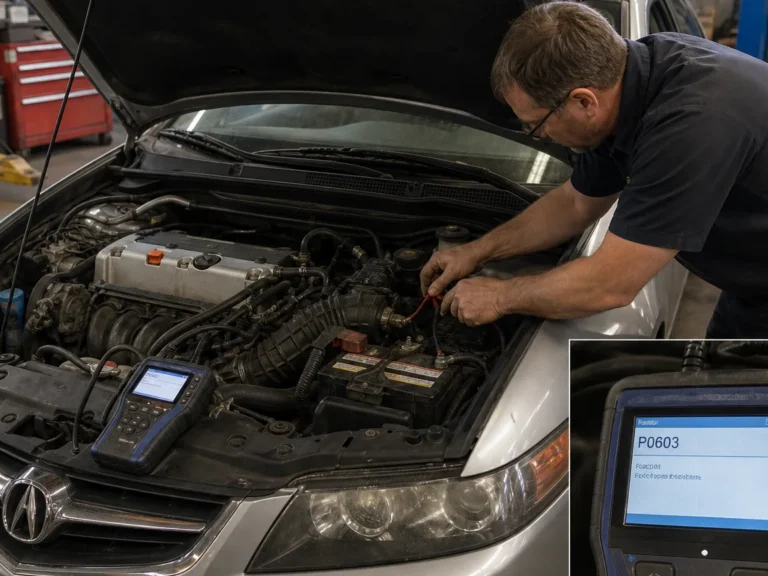
The first owner action is not another part order. Record the code state and preserve freeze-frame data, because that information tells a technician whether the fault set at startup, idle, cruise, warm operation, or immediately after clearing.
- Confirm P0368 is the code returning, not a nearby camshaft sensor code on another bank.
- Look for related codes such as P0340, P0345, P0365, P0390, cam/crank correlation codes, VVT codes, or misfire codes.
- Inspect the connector and harness visually, especially if a pigtail was already replaced.
- Do not assume a new sensor is correct until the part number, installation location, connector fit, and wiring order are verified.
If you find a repaired pigtail with mismatched wire colors, loose splices, brittle insulation, or terminals that do not lock firmly, stop guessing parts and move to wiring-diagram-based testing.
Diagnostic order

A repeatable diagnostic order matters because a returning P0368 often survives parts replacement when the real fault is a connector, splice, wire, terminal, or wrong-location assumption. Work from evidence outward rather than from the most expensive possibility backward.
- Read all codes and freeze-frame data before clearing the ECM.
- Confirm Bank 1 Sensor B from OEM information, not from a generic diagram.
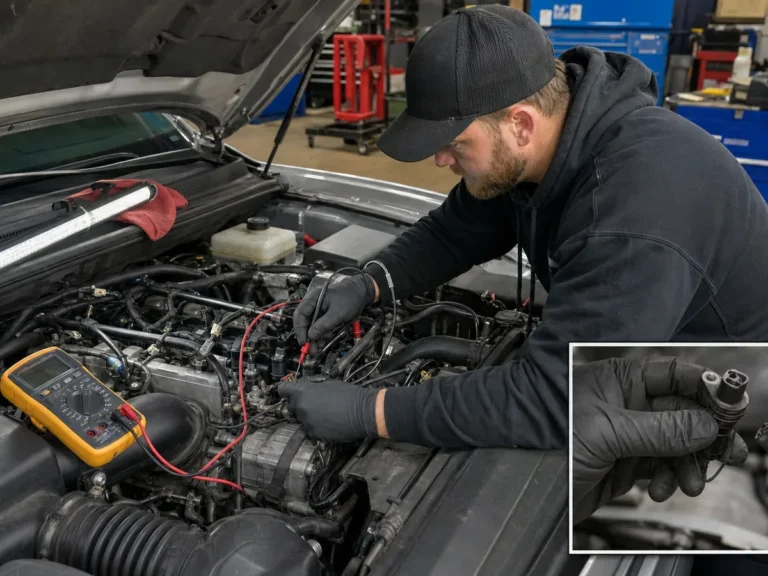
- Inspect the sensor connector, harness, pigtail repair, terminal fit, and routing.
- Confirm the correct sensor is installed in the correct location and fully seated.
- Test supply, ground, and signal behavior only with the proper service-data references.
- Compare scan-tool camshaft data against related sensors and operating conditions.
- Wiggle-test the harness while watching the fault state or signal behavior if the service procedure supports it.
- Check related VVT, oil, cam/crank, and timing evidence only after the circuit path has been inspected.
- Inspect ECM-side connector and circuit continuity only after easier circuit faults are not found.
- Clear the code and verify the repair through restart, monitor behavior, and a suitable drive cycle.
Do not publish or follow exact voltage values, pin numbers, or resistance specifications unless they are verified against the Toyota workshop manual for the exact 2014 Tundra engine.
P0368 is not automatically a tow-only code, but it is not a code to ignore. The practical decision depends on whether the vehicle is only failing readiness or whether it is showing symptoms that can affect control, reliability, or safety.
- Schedule diagnosis soon if the truck runs normally but the code returns after clearing.
- Avoid long trips if the code is active and the cause is unknown.
- Stop and inspect promptly if starting, idle quality, power delivery, or warning behavior changes.
- Use the owner manual warning-light guidance when deciding whether to continue driving.
If P0368 comes back after clearing, the readiness problem is usually a symptom of the unresolved fault. The ECM still needs to see the repaired circuit operate correctly through the required monitor conditions before readiness can settle.
- Clearing the code can reset monitor status.
- A returning current or pending code can interrupt readiness completion.
- A vehicle may drive normally but still fail an OBD-based inspection if monitors are not ready or the MIL returns.
- Do not assume a single short drive will complete every monitor after repair.
Because inspection programs vary by location, avoid state-specific claims unless you verify the local rule. For this repair path, the technical priority is the same: fix the active circuit fault, then verify the code stays cleared and readiness progresses.
Involve a technician when the next step requires wiring diagrams, connector pin identification, terminal repair, scope interpretation, or ECM connector testing. Those checks are difficult to do safely and accurately with only a generic scanner.
- Ask for documentation of the confirmed sensor identity and circuit tested.
- Ask whether the fault is current, pending, intermittent, or permanent.
- Ask for connector and harness findings before authorizing another sensor.
- Ask whether related cam, crank, VVT, or misfire data changed the diagnosis.
- Ask for post-repair code clear, restart verification, and readiness follow-up guidance.
The useful service request is not simply replace the cam sensor. Request a camshaft position sensor circuit test that includes connector, harness, supply, ground, signal behavior, and service-data confirmation.
A 2014 Toyota Tundra P0368 that will not clear usually points to an active high-signal fault in the Bank 1 Sensor B camshaft position sensor circuit. Inspect the connector, harness, pigtail repair, correct sensor location, circuit behavior, related codes, and cam/VVT data before replacing more parts.
Exact Bank 1 Sensor B location, connector pinout, and electrical test values require engine-specific Toyota service information before publication or repair.
What usually fixes it
If a new cam sensor did not fix P0368, the sensor may not have been the fault. Recheck the exact sensor location, connector lock, terminal grip, wire order, pigtail splice quality, harness movement, and related codes before blaming the ECM.
- Confirm the replacement sensor matches the vehicle and the position being tested.
- Verify the sensor was installed in the correct Bank 1 Sensor B location.
- Inspect the connector for loose, pushed-back, bent, corroded, or oil-soaked terminals.
- Look for harness contact with brackets, covers, heat, sharp edges, or previous repair areas.
- Check whether the code moved, changed, or added a related bank code after parts were swapped.
- Use live data or a scope-level signal check when the wiring looks repaired but the fault remains.
An ECM fault is possible in automotive diagnosis, but it should be treated as rare until the sensor, connector, pigtail, harness, supply, ground, signal path, and ECM connector checks have been completed with service information.
FAQ
Can I drive a 2014 Toyota Tundra with P0368?
You may be able to drive cautiously for diagnosis if the truck starts and runs normally, the warning light is steady, and no severe drivability symptoms are present. Stop driving if the engine stalls, runs rough, loses power, or shows a flashing warning.
Why did a new camshaft position sensor not fix P0368?
A new sensor will not fix the code if the problem is a connector, terminal, pigtail, harness, wrong location, circuit fault, or related signal issue.
Does P0368 mean the timing chain failed?
No. P0368 does not prove timing chain failure by itself. It is a circuit-high code and needs electrical and scan-data confirmation before timing concerns are blamed.
What confirms the repair?
The code should stay cleared after restart and appropriate driving, pending and permanent status should be checked, related cam data should be normal, and readiness monitors should progress after the fault is fixed.
Comments
Be the first to add a practical repair note or follow-up question.