
Common failure signs
If the Mass air flow sensor is contaminated, airflow reporting can drift enough to affect how the Engine control module meters fuel. That can show up as drivability complaints that seem random at first, especially when the vehicle is cold, idling, or moving from light throttle to acceleration.
- Rough idle or unstable idle speed
- Hesitation when accelerating
- Stalling, especially after startup or at stops
- Hard starting
- Surging or uneven power delivery
- Reduced power under load
- Poor fuel economy
- Check-engine light with air-metering related faults
These signs can point to MAF sensor contamination, but they are not exclusive to it. Intake air leaks, ignition faults, fuel delivery problems, Throttle body issues, and other vacuum or exhaust restrictions can create very similar symptoms. In other words, symptom overlap is normal. A dirty Throttle body can mimic some of the same low-speed behavior, so this section should be read as a symptom guide, not as proof that the sensor alone needs cleaning or replacement.
Before replacing it
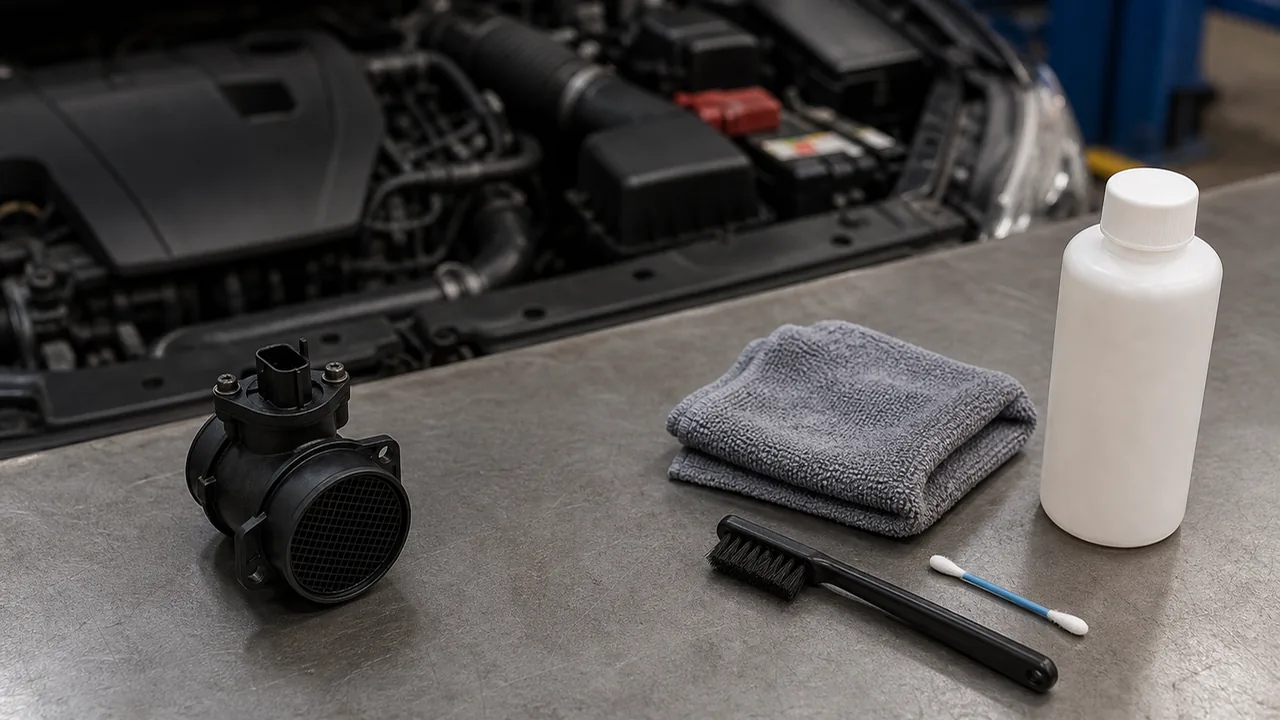
For most vehicles, this is a simple, low-tool job. The main item is dedicated MAF sensor cleaner, because the Sensor element can be damaged by the wrong solvent or by physical contact. You may also need a basic screwdriver or small hand tool if the Mass air flow sensor is secured to the Air intake tube with screws or clamps.
- Dedicated MAF sensor cleaner.
- Basic hand tools only if needed to remove sensor fasteners or loosen the Air intake tube.
- Gloves and eye protection.
- A clean work area where the sensor can air-dry fully before reinstalling.
- An optional scan tool to check stored codes before cleaning and confirm whether they return afterward.
Do not improvise with shop rags, brushes, or compressed air while handling the Sensor element. If the sensor uses unusual fasteners or the vehicle appears to need model-specific removal or relearn steps, verify service information before proceeding.
Before replacing the Mass air flow sensor, do a few owner-safe checks that often explain the same symptoms. This is the point where simple airflow and connection problems should be ruled out before moving into technician testing.
- Inspect the Air filter for heavy dirt, oil contamination, poor fit, or a filter that is not seated squarely in the air box.
- Check the Air intake tube, air box clips, and hose clamps for looseness, gaps, or visible cracks that could allow unmetered air in.
- Make sure the electrical connector is fully latched and look for obvious wiring damage, rubbed insulation, or corrosion near the plug.
- Look for dirt, oil film, or debris on or around the sensor housing. Contamination nearby can matter even when the Sensor element itself was cleaned correctly.
- Think back to recent service history. Problems often start after an Air filter change, intake work, or engine bay service that disturbed the intake path or connector.
If one of these checks turns up a problem, correct it before assuming the sensor has failed. A restricted Air filter or small Intake air leaks can mimic MAF faults and should be addressed before the next section’s technician-level diagnostic flow.
Inspection steps
Cleaning a MAF sensor without damaging it usually means using dedicated MAF sensor cleaner, avoiding any physical contact with the sensing element, letting it air-dry fully, and reinstalling it carefully. The likely risk is not routine cleaning itself, but using the wrong solvent, touching the hot wire or film, forcing brittle intake parts, or restarting before the cleaner has fully evaporated.
A MAF sensor measures incoming air so the engine computer can calculate fuel delivery. When dust, oil film, or debris coats the sensing element, the airflow signal can drift and cause rough idle, hesitation, stalling, poor fuel economy, or MAF-related trouble codes. Cleaning is reasonable when contamination is suspected, but it is not a guaranteed repair. If symptoms or codes return after safe cleaning, diagnose intake leaks, wiring faults, air filter problems, throttle body issues, fuel delivery problems, ignition faults, or a failed sensor before replacing parts.
In most cases, yes, you can clean a Mass air flow sensor safely, but only with dedicated MAF sensor cleaner and only if you avoid contact with the Sensor element. A careful cleaning attempt makes sense when contamination is visible or when symptoms started after Air filter or Air intake tube service. It is not the right first move when the vehicle has strong drivability faults that suggest a larger problem.
- Use only MAF sensor cleaner, remove the sensor only if access is safe, spray the Sensor element gently, let it air-dry fully, and reinstall it carefully.
- Do not touch, wipe, scrape, soak, blow-dry, or use compressed air on the Sensor element.
- Cleaning is worth trying when dirt, oil film, or debris is visible, especially after recent intake or Air filter work.
- Diagnose first if you have MAF-related codes, connector or wiring damage, Intake air leaks, severe stalling, no-start behavior, or limp-mode symptoms.
- Keep in mind that similar symptoms can also come from the Throttle body, ignition faults, fuel delivery problems, or other intake issues, so cleaning is not an automatic fix.
If symptoms are severe or return quickly after cleaning, the next step should be fault diagnosis rather than repeated spraying or automatic replacement.
Yes, a Mass air flow sensor can usually be cleaned without damage if you use dedicated MAF sensor cleaner, avoid touching the Sensor element, and only remove it when access from the Air intake tube is straightforward. The main risk is not the spray itself, but contamination or handling damage during removal, cleaning, or reinstallation. Problems often start with chemical residue from the wrong product, physical contact with the Sensor element, forced air pressure, reinstalling the sensor before it is fully dry, or snapping an electrical connector or housing tab on older plastic parts.
- Shut the engine off and let the area cool.
- Unplug the connector carefully and remove the sensor only if it comes out without forcing surrounding parts.
- Spray the Sensor element gently with MAF sensor cleaner only.
- Let it air-dry fully; do not wipe, brush, or blow it dry.
- Reinstall it carefully and recheck the Air intake tube for secure sealing and Intake air leaks.
If access is awkward, the fasteners feel fragile, or removal would disturb nearby components, stop and verify the correct vehicle-specific procedure in repair information before continuing.
Do not use anything except dedicated MAF sensor cleaner on a Mass air flow sensor. The risk matters immediately: the wrong chemical or any contact with the Sensor element can leave residue, attack plastics, strip delicate coatings, or physically damage the sensor enough to create new drivability problems. Before you start, set aside brake cleaner, carb cleaner, gasoline, general degreasers, and any aggressive solvent, even if they seem to evaporate quickly.
- Do not spray brake cleaner, carb cleaner, gasoline, throttle body cleaner, or general degreasers onto the sensor.
- Do not wipe the Sensor element with alcohol wipes, rags, towels, cotton swabs, brushes, or picks.
- Do not blow the sensor dry with compressed air.
- Do not use heat from a heat gun, hair dryer, or other external source to speed drying.
These shortcuts fail for the same reason: the Sensor element is delicate, and contamination or contact can change how the Engine control module interprets incoming air. Even the housing, connector area, or nearby plastic in the Air intake tube can be harmed by harsh chemicals. If you do not have dedicated MAF sensor cleaner, stop and get the correct product rather than improvising.
Before you touch the Mass air flow sensor, park on a stable surface, switch the engine off, and give the intake area time to cool. This matters because the sensor is usually mounted along the Air intake tube near components that can stay hot after shutdown. Starting with a cool, still engine also reduces the chance of brushing against moving parts while you work through the next removal steps.
- Set the parking brake and confirm the engine is fully off before reaching into the engine bay.
- Wait until nearby intake and engine components feel cool enough to work around safely rather than assuming they are ready right after shutdown.
- Keep hands, sleeves, and tools clear of belts, fans, and other moving parts that may cycle or coast after the engine is turned off.
- If access to the Mass air flow sensor is tight around hot or crowded components, stop and verify the safe removal method in vehicle-specific service information before continuing.
Do not rush this step. A careful start helps protect the Sensor element and lowers the risk of injury before you disconnect the electrical connector or loosen the sensor from the Air intake tube.
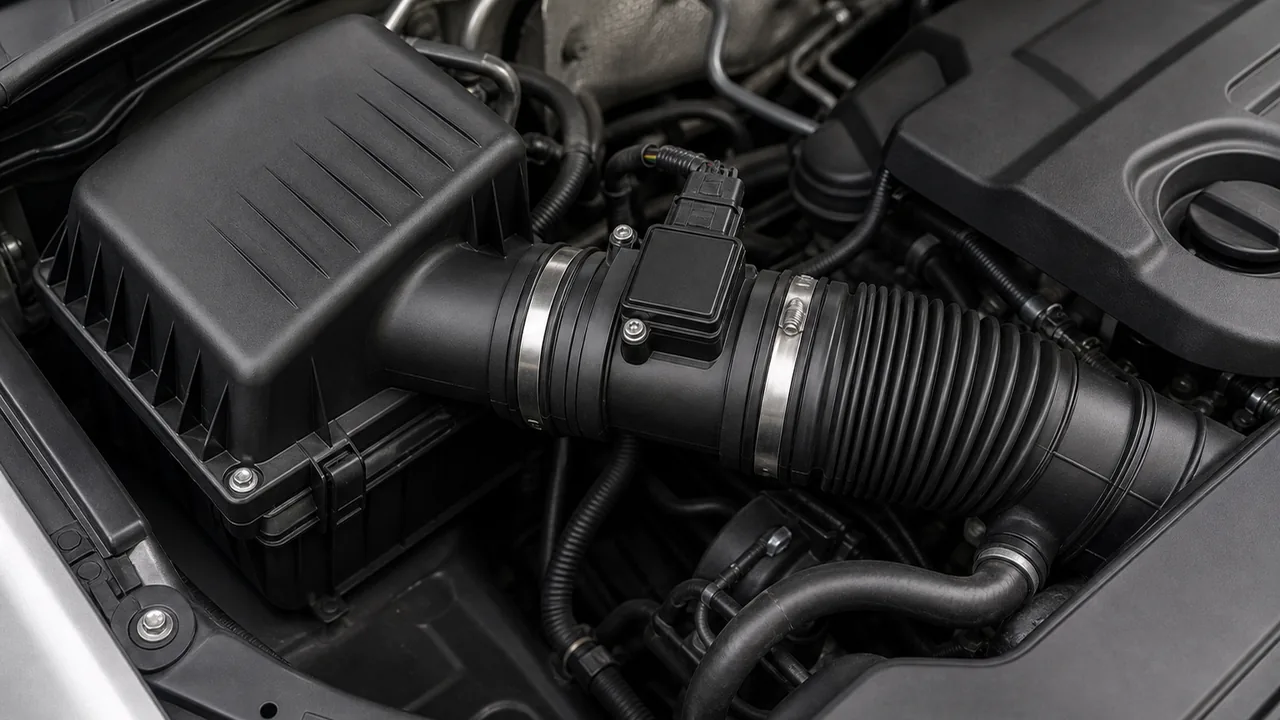
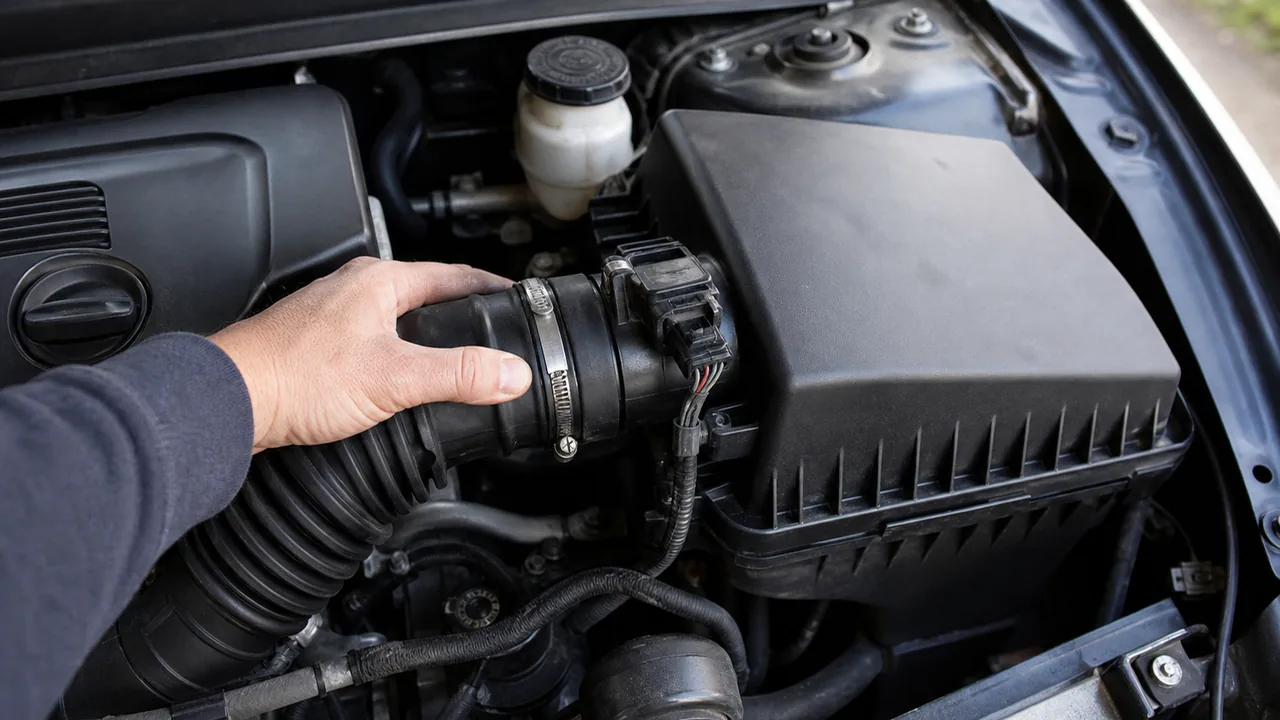
With the intake area cool, the next job is identifying the correct sensor before you unplug or remove anything. On many vehicles, the Mass air flow sensor sits in the airflow path between the Air filter box and the Throttle body. It may be bolted to the air box lid or installed inline on the Air intake tube, usually with an electrical connector attached.
- Do not confuse it with a MAP sensor, which is commonly mounted on the intake manifold rather than in the intake duct.
- Do not assume a nearby intake air temperature sensor is the same part; some vehicles keep it separate, while others combine it with the Mass air flow sensor housing.
- Follow the air path visually from the Air filter toward the engine and look for the sensor body placed directly in that stream of incoming air.
If the sensor location is not obvious, stop and verify it in the service manual or reliable repair information for your exact vehicle before continuing.
Once you have confirmed you are looking at the Mass air flow sensor, disconnect the electrical connector before attempting any removal. This step is mainly about preventing damage to the connector body, lock tab, and wiring, since a broken connection can create the same kind of drivability complaints that sent you here in the first place.
- Press or lift the lock tab gently, depending on the connector design, then pull on the connector body rather than the wires.
- If the connector feels stuck, stop and check for a secondary lock, dirt around the tab, or a poor hand angle instead of forcing it.
- Do not yank, twist, or pull by the wiring harness, because that can loosen terminals inside the plug or break the lock.
- With the connector off, inspect for bent pins, corrosion, oil contamination, cracked plastic, broken locks, or a fit that already feels loose.
If you find damaged terminals, heavy contamination, or a connector that will not release cleanly, verify the correct repair method with OEM service information before proceeding.
With the connector off, remove the Mass air flow sensor only when it is clearly accessible and the fasteners come out without a struggle. Many units are held by simple screws or clips near the Air intake tube, but that does not mean every housing is easy to service. If the sensor looks buried behind extra ducting, brittle plastic, or hard-to-reach clamps, it is safer to stop and verify the correct vehicle-specific method before taking more parts apart.
- Set the screws or clips aside in order so nothing gets mixed up during reassembly.
- Watch for an O-ring or seal and keep it clean, undamaged, and correctly positioned.
- Note the sensor orientation before lifting it out so airflow direction and connector position go back the same way.
- Do not twist, pry, or force the housing if it feels stuck, especially on older plastic intake parts.
If removal requires extra intake disassembly beyond the visible sensor fasteners, verify the procedure with OEM or model-specific service information before continuing.
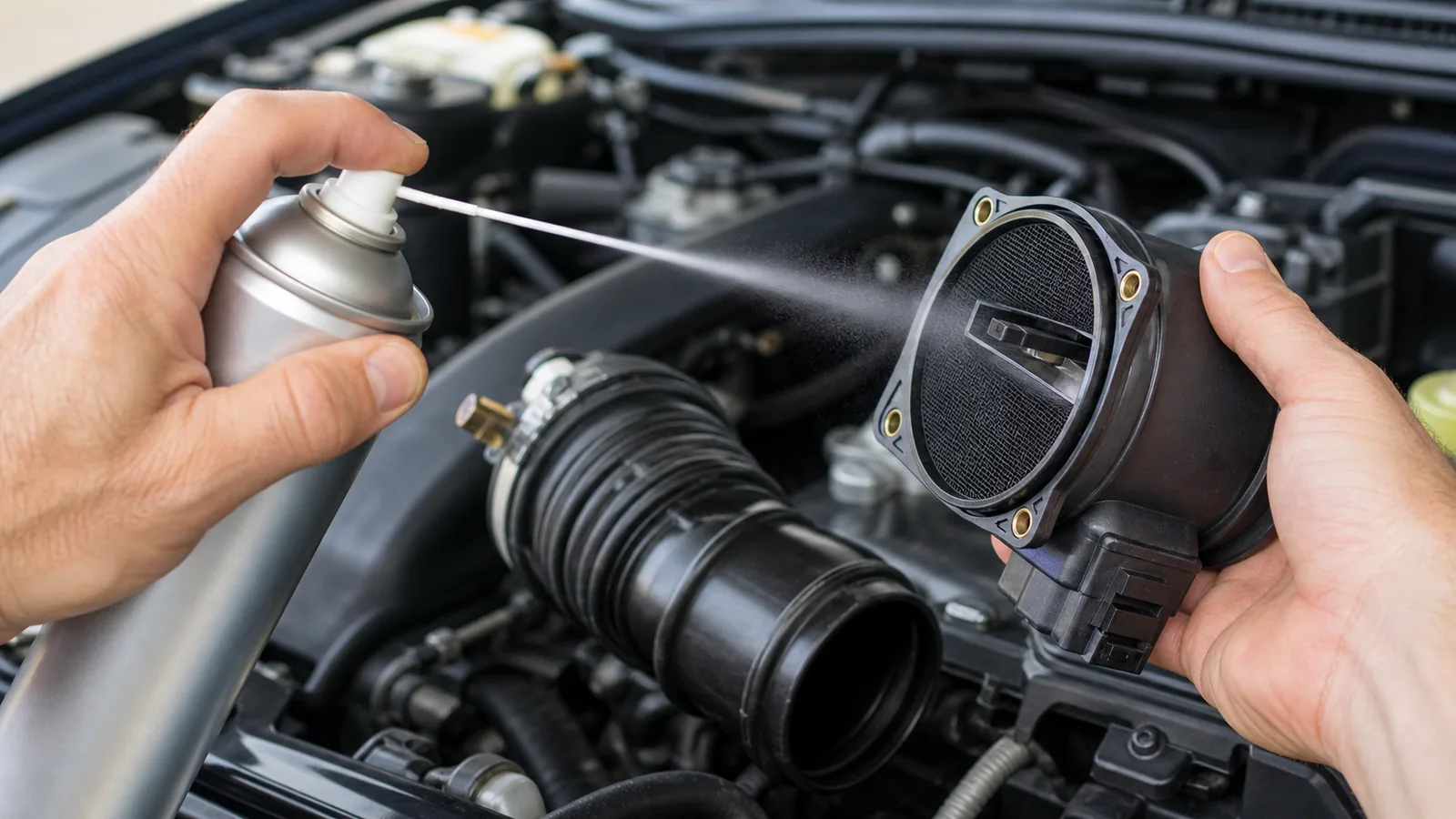
With the Mass air flow sensor out and supported securely, apply only dedicated MAF sensor cleaner to the Sensor element and the immediate interior surfaces that guide airflow past it. Use short, controlled sprays so the cleaner stream rinses dust, oil film, or fine debris away on its own. The goal is to wash contamination off, not to physically scrub it loose.
- Hold the sensor so runoff can drain away instead of pooling around the connector or housing.
- Aim the spray at the Sensor element from a safe angle and let the cleaner do the work.
- Do not wipe, brush, scrape, or touch a hot wire or hot film element with a rag, swab, or tool.
- Avoid saturating unrelated plastic or electrical areas beyond what the product instructions allow.
- If contamination looks baked on or damage is visible, stop cleaning and verify whether replacement or deeper diagnosis is the better path.
After spraying the Sensor element with dedicated MAF sensor cleaner, set the Mass air flow sensor in a clean, stable area and let it air-dry completely before it goes back into the Air intake tube. Reinstalling it while any cleaner remains can lead to incorrect readings, rough running, or a misleading next diagnostic step.
Do not speed this up with compressed air, towels, paper wipes, brushes, or heat from a gun or hair dryer. Those methods can contaminate the Sensor element, leave lint behind, or physically damage a delicate part that the Engine control module depends on for accurate airflow data.
Follow the cleaner-label instructions and vehicle service information where available. If your vehicle has any model-specific handling, relearn, or post-install requirements, verify them against OEM repair information before reassembly.
Once the Mass air flow sensor is fully dry, reinstall it in the same orientation it came out of the Air intake tube. Seat it evenly, reconnect the electrical connector until it is fully latched, and make sure the wiring is not pulled tight or left rubbing against nearby components.
Before startup, check the full intake path you disturbed during cleaning. Confirm the Air filter housing is closed correctly, the intake boots are fully seated, clamps are snug, clips are engaged, and any seals or gaskets are sitting flat. A clean sensor can still read incorrectly if unmetered air enters through Intake air leaks after reassembly.
Start the engine normally and let it settle at idle. Watch for rough running, stalling, hesitation, or an immediate warning light. If you have access to a scan tool, check whether the Engine control module is still setting MAF-related faults, but treat any code as a prompt for diagnosis rather than proof the cleaning failed. If symptoms stay away after a short confirmation drive, the service was likely successful.
P0100, P0101, P0102, P0103, and P0104 usually indicate a mass air flow sensor circuit, signal, or performance problem, but they do not prove the sensor only needs cleaning or automatic replacement. Because these faults can affect fuel delivery and drivability, start with a basic visual check of the connector, Air intake tube, and nearby clamps before assuming the Mass air flow sensor itself has failed.
| Code | General meaning | What it does not prove |
|---|---|---|
| P0100 | MAF circuit fault | It does not prove the sensor element is only dirty. |
| P0101 | MAF range or performance issue | It does not prove the sensor should be replaced without intake and live-data checks. |
| P0102 | MAF low input | It does not prove the sensor failed; wiring, connector, airflow, or intake issues can contribute. |
| P0103 | MAF high input | It does not prove cleaning will fix the signal problem. |
| P0104 | MAF intermittent signal | It does not prove contamination; intermittent wiring or connector faults are possible. |
Contamination on the Sensor element is one possibility, but so are poor connector fit, damaged wiring, Intake air leaks, an airflow restriction from a dirty Air filter, or faults elsewhere that distort how the Engine control module interprets incoming air.
Treat any MAF-related DTC as a diagnostic direction, not a parts verdict. If the problem remains after safe cleaning, diagnosis should move to live data review, leak checks, circuit inspection, and OEM test procedures.
If symptoms or MAF-related codes remain after proper cleaning and reinstallation, the fault path usually shifts away from dirt on the Sensor element alone. In most cases, start with the easiest airflow and connection issues first, then move toward broader engine faults, and treat Mass air flow sensor replacement as the last step after confirmation.
- Intake air leaks or a loose Air intake tube after the MAF. A split boot, loose clamp, or seal problem can skew measured airflow and mimic a bad sensor.
- A clogged, oil-contaminated, or incorrectly installed Air filter. This is a low-risk service issue that can disturb airflow before it reaches the sensor.
- Wiring, connector, or terminal faults. A poor connection can create an unstable signal even when the sensor itself is clean.
- A contaminated Throttle body or related airflow restriction. If airflow control is inconsistent, drivability symptoms can overlap with MAF complaints.
- Another engine problem such as a vacuum leak, ignition fault, fuel delivery issue, or an exhaust-related restriction. These can trigger similar symptoms and should be diagnosed, not guessed.
- A failed Mass air flow sensor, but only after the rest of the intake path, wiring, and related systems check out through proper diagnosis. Any vehicle-specific scan values or pass-fail thresholds should be verified against OEM repair information.
Practical next step: before buying a sensor, inspect the Air intake tube, Air filter fitment, and connector security, then use that evidence to guide the owner checks that follow.
If the owner-level checks do not expose a clear fault, the next step is a technician-style diagnostic sequence that separates a contaminated Mass air flow sensor from airflow, wiring, or control issues.
- Start with a scan tool and review live data at idle and during light throttle changes. Compare Mass air flow sensor behavior with engine load, RPM change, and fuel trim direction rather than assuming the sensor is wrong from a code alone.
- Check the sensor signal type used on the vehicle, whether voltage or frequency, and verify that the pattern changes smoothly. Any pass or fail decision should be based on OEM service information, not a universal number copied from another engine.
- Smoke test the intake tract to look for Intake air leaks between the Air filter housing, Air intake tube, Throttle body, and manifold area, because unmetered air can mimic a bad sensor.
- Verify wiring continuity, power, ground, and connector integrity. Corrosion, spread terminals, harness damage, or poor pin fit can distort the signal reaching the Engine control module.
- Only after those checks pass should the technician follow the OEM diagnostic tree to confirm whether the sensor itself is failing or whether another airflow or drivability fault is still present.
Vehicle-specific pin tests, signal values, relearn steps, and condemn criteria should be verified in OEM repair information before replacing the sensor.
After the owner checks and technician diagnostic flow, the decision usually comes down to whether the problem looks like contamination, an airflow leak, a wiring issue, or a failed sensor. Cleaning makes sense when the Mass air flow sensor is accessible, the Sensor element appears contaminated, and there is no obvious damage to the housing or connector.
| Buy or replace | When it makes sense | Diagnostic caution |
|---|---|---|
| MAF sensor cleaner | The sensor is accessible and contamination is likely. | Use only dedicated MAF cleaner and never touch the element. |
| Air filter | The filter is dirty, oil-contaminated, poorly seated, or recently disturbed. | A bad filter fit can affect airflow before the sensor. |
| Intake boot or tube | You find cracks, loose clamps, poor seating, or unmetered-air entry points. | An intake leak can mimic a bad MAF sensor. |
| Connector pigtail | The connector lock, terminals, or wiring are visibly damaged and testing supports repair. | Do not replace wiring based only on a code. |
| Replacement MAF sensor | Diagnosis supports sensor failure after cleaning, intake checks, leak checks, and circuit checks. | A code alone is not enough proof. |
For the actual repair path, the key conversion items are MAF sensor cleaner for serviceable contamination and a replacement MAF sensor when cleaning and basic intake corrections do not restore normal operation.
Replacement notes
With the right cleaner and a careful approach, this is usually a straightforward owner-level job. The steps below are general guidance, but vehicle-specific service information should take priority if access, sensor location, or removal details differ on your model.
- Turn the vehicle off, let the intake area cool, and gather only the basic tools and dedicated MAF sensor cleaner.
- Locate the Mass air flow sensor at the Air intake tube near the Air filter housing, then inspect the connector and surrounding ducting before removing anything.
- Disconnect the electrical connector carefully and remove the sensor only if access is safe and the housing design allows owner-safe removal.
- Spray the Sensor element gently with MAF sensor cleaner without touching it, then let it air-dry fully before reinstalling.
- Reinstall the sensor, secure the Air intake tube, and check for loose clamps, connector issues, or Intake air leaks before restarting the engine.
Battery disconnection, idle relearns, and code clearing can vary by vehicle. If the Engine control module requires a specific reset or relearn procedure, verify it in model-specific service information before proceeding.
FAQ
Can I clean a MAF sensor without removing it?
Sometimes, but only if you can spray the sensing element safely without touching it or soaking unrelated electrical areas.
Can I use brake cleaner or carb cleaner on a MAF sensor?
No. Use dedicated MAF sensor cleaner only.
Will cleaning a MAF sensor clear P0101 or other MAF codes?
It may help if contamination is the cause, but codes still require diagnosis.
What are signs that the MAF sensor may be dirty instead of failed?
Visible contamination, recent intake service, and matching symptoms can make cleaning worth trying.
When should I replace the MAF sensor instead of cleaning it?
Replace it when testing supports sensor failure after intake, connector, wiring, and leak checks.
Do I need to reset anything after cleaning a MAF sensor?
Follow vehicle-specific service information if codes, idle behavior, or relearn procedures apply.

Comments
Be the first to add a practical repair note or follow-up question.