
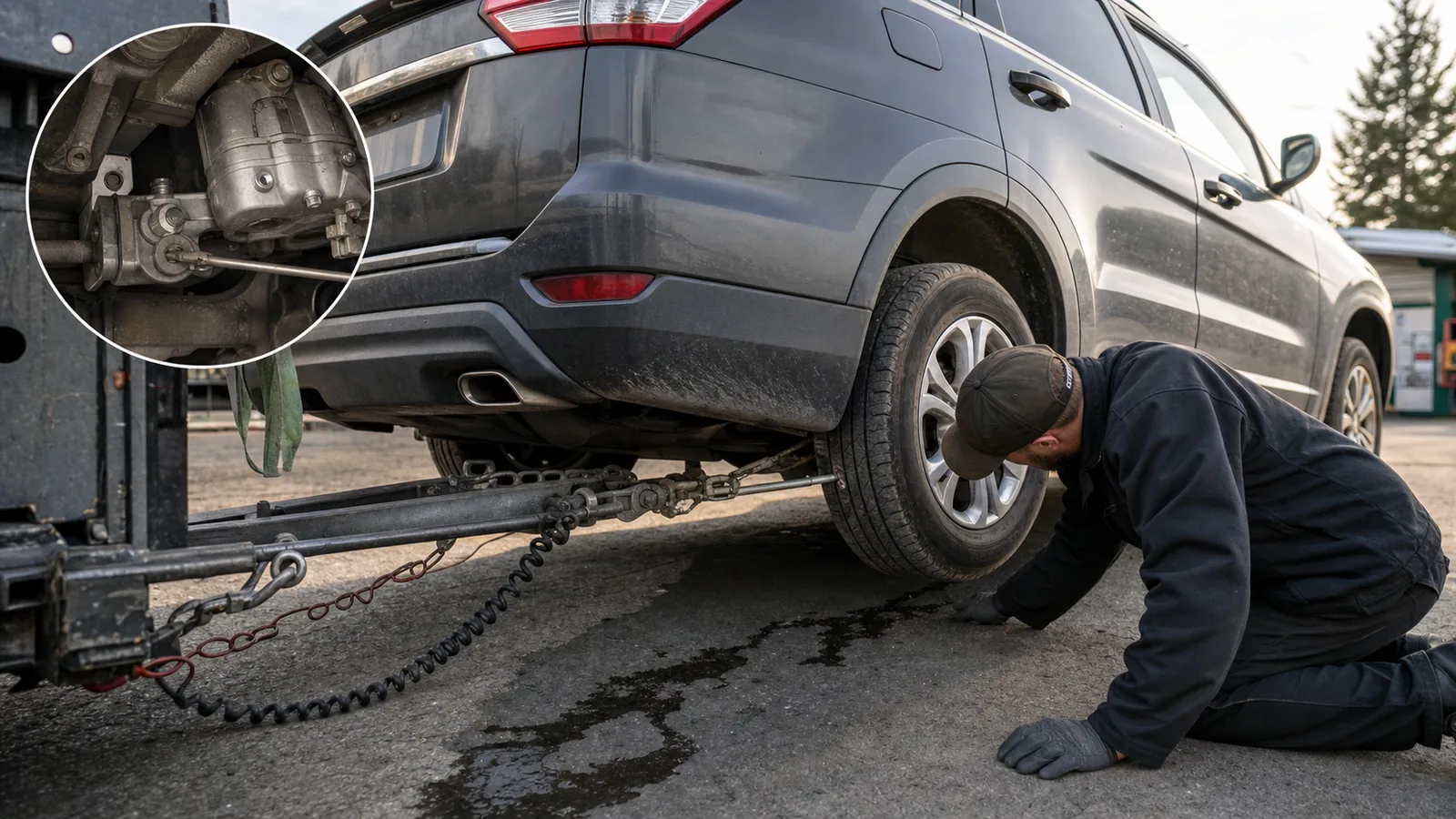
Common failure signs
Improper flat towing can damage the transmission or transfer case even when the vehicle still seems normal afterward. The first likely cause family is unintended drivetrain rotation without the lubrication, disengagement, or neutral-mode condition the OEM procedure requires.
The most important damage areas are the automatic transmission and transfer case first, then the front and rear differentials, driveshafts, U-joints or CV joints, wheel-end components, and related control modules. The fluid evidence matters as much as the first drive impression: burnt smell, dark fluid, glitter-like metallic debris, friction material, or fresh leaks can point to heat stress or internal wear.
Stop driving and arrange inspection if the SUV has new grinding, whining, severe vibration, harsh engagement, no-move behavior, fresh fluid leakage, burning smell, overheating messages, drivetrain warning lights, or binding in turns. These are not proof of one specific failed part, but they are strong enough to treat the vehicle as unsafe for normal use until the drivetrain is checked.
If there are no immediate warning signs, the next step is still verification, not assumption. Confirm the exact owner-manual flat-towing procedure, scan the powertrain and drivetrain modules, inspect fluid condition, and have a technician check the underside before a normal road test. Mechanical damage can exist before a code is stored, and a clean scan cannot rule out early wear by itself.
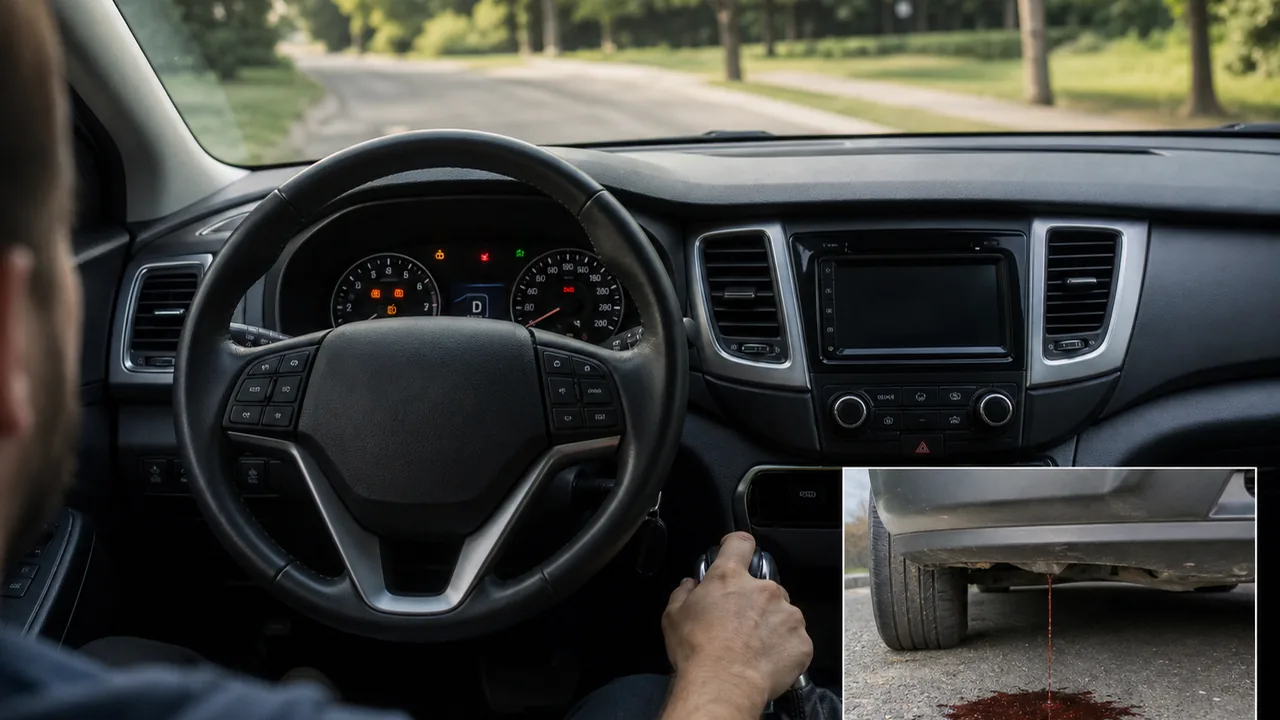
Warning signs after improper flat towing often point to drivetrain stress before they identify one failed part. Treat new noise, vibration, harsh shifting, leaks, burning smell, warning lights, or no-move behavior as evidence that the transmission, transfer case, differentials, or driveline may need inspection.
Immediate warning signs to look for
- Grinding, whining, humming, clunking, rumbling, or shudder that was not present before the tow
- New vibration through the floor, seat, or steering wheel during takeoff, turning, or steady movement
- Delayed engagement when selecting Drive or Reverse, or a hard bang into gear
- Slipping, flare between gears, binding in turns, or a feeling that the drivetrain is fighting itself
- A burning fluid smell, smoke haze, or visible fluid under the vehicle
- Transmission, AWD, 4WD, ABS, stability control, or powertrain warning lights
- Little or no vehicle movement after selecting a gear
Noise location helps frame the fault path. Whining or humming that changes with vehicle movement can suggest bearing, gear, differential, or transfer case stress. Grinding can suggest harder mechanical contact or internal distress. Clunking on engagement or takeoff can point toward mounts, shafts, joints, couplers, transfer case slack, or transmission engagement problems.
Shift and movement symptoms are especially important on an automatic SUV. Delayed engagement, harsh engagement into Drive or Reverse, slipping, flare between gears, or a no-move condition can point toward transmission fluid damage, pressure-control problems, clutch distress, internal gear damage, or a transfer case that is not transferring torque correctly.
When to stop driving
- Do not continue road testing if the vehicle will not move normally, lurches into gear, makes severe grinding or whining noises, or leaves visible fluid.
- Do not keep driving to see if it clears up when there is a strong burning smell or fresh leak.
- Stop if the SUV binds in turns, vibrates severely, overheats, or shows drivetrain warning messages.
- If symptoms are mild but new, document them and arrange inspection before regular use.
Warning lights help, but they do not control the whole decision. Codes may be absent when damage is mechanical, early, intermittent, or not active during the scan.
Schedule a drivetrain inspection after improper flat towing if any stop-drive sign, fluid abnormality, warning light, or new drivability symptom is present. The concern is not panic; it is that transmission, transfer case, differential, or driveline wear can start before the SUV completely fails.
- Stop driving if the SUV will not move normally, engages harshly, vibrates, makes new drivetrain noise, overheats, leaks fluid, smells burnt, binds in turns, or shows visibly abnormal fluid.
- Bring tow facts, photos, warning-light records, fluid evidence, prior service records, and the owner-manual towing procedure to the appointment.
- Ask for a full-system scan, lift inspection, fluid inspection, and cautious road test only if the vehicle is mechanically safe.
- Expect the repair path to depend on evidence: monitoring, service inspection, component repair, replacement, or teardown may be appropriate depending on findings.
A normal first drive and a clean code scan are helpful, but they are not proof that improper flat towing caused no mechanical wear.
Inspection steps
Flat towing an automatic SUV without transfer case disengagement usually means the transmission or transfer case may have been forced to rotate outside the OEM towing procedure, so hidden drivetrain damage is possible even if the SUV still drives. The first check is a stop-drive screen: leaks, burning smell, grinding, severe vibration, harsh engagement, or a no-move condition are signs to park it and arrange inspection rather than keep testing it on the road.
The main damage checks are the transmission, transfer case, differentials, driveshafts, fluid condition, leaks, noises, warning lights, and scan tool data. Also verify the OEM flat-towing procedure for that exact SUV, because transfer case neutral, transmission neutral, and approved four-down towing are model-specific conditions.
Start with evidence that does not require disassembly. Fresh fluid under the SUV, burnt odor, new whining or grinding, warning lights, delayed engagement, binding in turns, or new vibration all matter because mechanical damage may not appear as a fault code right away. A clean scan, normal first shift, or short drive around the block is reassuring only when it agrees with fluid condition, lift inspection, and the OEM tow procedure.
- Stop driving if there are leaks, burning smell, grinding, severe vibration, harsh engagement, or no-move symptoms.
- Check under the transmission, transfer case, and differentials for fresh fluid leaks or sling-off fluid.
- Smell for burnt transmission fluid or gear oil odor after the tow.
- Listen for new whining, grinding, clunking, rumbling, shudder, or driveline vibration.
- Watch for transmission, 4WD, AWD, ABS, stability control, or check-engine warning lights.
- Scan the powertrain, transmission, transfer case, ABS, and AWD or 4WD modules for stored and pending data.
- Inspect driveshafts, U-joints or CV joints, mounts, and visible underbody areas for looseness, heat evidence, leaks, or impact damage.
- Confirm the OEM flat-towing procedure in the owner manual or service information before further road use.
If any stop-drive sign is present, arrange inspection instead of adding road miles. Continued driving can add secondary damage and make the original towing-related evidence harder to separate.
Transfer case disengagement matters because transmission neutral is not the same as separating the road wheels from the driveline parts that can be damaged during four-down towing. On an automatic SUV, the wheels can back-drive shafts, gears, bearings, clutches, chains, or couplers if the transfer case or AWD system remains mechanically connected.
Why the two neutral settings are different
The how-it-works point is simple but important. In normal driving, the engine, transmission pump behavior, transfer case state, and drivetrain controls operate together. During flat towing, the engine may be off and the tires are turning the drivetrain from the opposite end. If the OEM procedure requires transfer case neutral mode, that mode is the protection step that prevents the wheels from forcing internal parts to rotate in an unintended state.
- Transmission neutral mainly changes transmission gear engagement; it does not automatically confirm transfer case disengagement.
- Transfer case neutral mode, where provided by the design, is meant to separate the driveline path used during flat towing.
- AWD and 4WD systems can use different couplers, clutches, chains, gears, and control logic, so one SUV's towing setup should not be copied to another.
- Lubrication risk is design-dependent because some components may depend on operating conditions that are absent during improper towing.
The wear path usually begins as heat, oil-film loss, abnormal load, or rotation of parts that were not supposed to be active during towing. That can lead to burnt fluid, bearing noise, clutch distress, chain or gear wear, seal leakage, binding, delayed engagement, or vibration.
This is why the inspection should combine procedure verification, fluid evidence, scan data, lift inspection, and cautious operational checks rather than one quick road test.
Scan data after improper flat towing can indicate which modules noticed abnormal operation, but it cannot prove the drivetrain is undamaged. Use diagnostic trouble codes as supporting evidence alongside fluid condition, noise, vibration, shift feel, towing history, and lift inspection.
What to scan
- Powertrain and transmission modules for range-position faults, speed-sensor faults, shift-related faults, limp-mode records, and temperature-related history where available
- Transfer case, AWD, or 4WD modules for actuator faults, neutral-mode problems, clutch-control issues, and speed-correlation faults
- ABS and stability control modules for wheel-speed disagreement or chassis data that may support the towing timeline
- Gateway or body modules for communication records that may explain warning messages or mode-selection problems
What codes can suggest, and what they cannot prove
Codes are useful when they match the symptoms. A transfer case actuator fault plus binding supports a transfer case inspection. A transmission range or speed-sensor fault plus delayed engagement supports deeper transmission checks. A wheel-speed or driveline-related fault plus vibration may point the technician toward wheel-end, shaft, or AWD inspection.
The limitation is that many towing-related damage paths are mechanical. Burnt friction material, bearing wear, gear scoring, chain stretch, seal distress, or contaminated fluid may not set a code until the condition affects a monitored input.
A clean scan should never be the only clearance step after towing outside the OEM procedure.
The highest-risk damage areas after flat towing without transfer case disengagement are the components most likely to be back-driven outside their intended operating state. Inspect the automatic transmission and transfer case first, then the differentials, driveshafts, joints, mounts, wheel-end parts, and control modules.
- Automatic transmission: inspect first because transmission neutral may not prevent internal rotation or lubrication risk during four-down towing. Look for delayed engagement, slipping, harsh shifts, burnt fluid, dark fluid, debris, or abnormal noises.
- Transfer case: inspect alongside the transmission because missed disengagement can load gears, chain assemblies, bearings, clutches, actuators, or mode-selection hardware. Look for grinding, rumbling, binding in turns, warning lights, leaks, or mode-selection faults.
- Front and rear differentials: inspect if the wheels and axle shafts rotated through an improper towing event. Look for whine, howl, rumble, contaminated gear oil, seepage, or vibration.
- Driveshafts, U-joints, CV joints, couplers, mounts, and wheel bearings: inspect for looseness, impact damage, heat evidence, torn boots, sling-off fluid, clunking, or vibration.
- Electronic modules: scan for mode faults, actuator problems, speed disagreement, temperature history where available, and communication faults, but do not use a clean scan as mechanical clearance.
This inspection order prioritizes likely core damage first, then secondary driveline effects and electronic evidence.
Flat-tow rules differ between SUVs because drivetrain design differs underneath similar body styles. The owner manual and OEM service information are the controlling sources because they define whether that exact year, drivetrain, transfer case, transmission, and AWD or 4WD configuration can be flat towed.
The key editorial point is not that one rule fits all automatic SUVs. Some vehicles have a true transfer case neutral mode. Some use electronically controlled transfer cases that must complete a mode-change sequence. Some AWD systems do not provide a mechanical neutral path suitable for four-down towing. Some hybrid or electronically managed drivetrains have additional restrictions.
The owner manual usually separates recreational towing from emergency towing. Recreational towing instructions are intended for repeated towing behind another vehicle. Emergency towing instructions may only describe how to move a disabled vehicle under limited conditions. Mixing those two sections can lead to the wrong conclusion.
- Verify the exact year, make, model, drivetrain, and transfer case or AWD configuration.
- Use the recreational towing section when evaluating four-down towing approval.
- Do not assume transmission neutral equals transfer case neutral.
- Do not rely on broad charts or owner reports when the OEM procedure is available.
For diagnosis, compare the actual towing setup against the exact OEM procedure before assigning the damage path.
The most likely damage mechanisms after improper flat towing are ranked by which parts may have rotated, how they were lubricated, and whether the drivetrain was mechanically coupled when it should have been disengaged. The ranking is risk-based, not a guarantee that every vehicle has the same failure.
- Automatic transmission internal rotation without the intended operating state: the wear path may involve heat, clutch material distress, bearing wear, bushing wear, or fluid breakdown. Symptoms can include delayed engagement, slipping, harsh shifts, flare, burnt odor, or contaminated fluid.
- Transfer case damage from missed neutral mode or incomplete disengagement: gears, bearings, chains, clutches, actuators, or mode hardware may be loaded incorrectly. Symptoms can include rumble, grinding, binding in turns, new leaks, metal in fluid, or 4WD or AWD warnings.
- Fluid breakdown and seal distress: heat and abnormal rotation can darken fluid, create a burnt smell, reduce lubrication quality, and expose weak seals. A fresh leak after the tow should be documented before service changes the evidence.
- Differential or axle-support bearing wear: abnormal driveline state can add load or noise patterns. Watch for whine, howl, rumble, contaminated gear oil, or vibration.
- Driveshaft, joint, coupler, mount, or wheel-end stress: these parts can reveal damage or preexisting weakness after an abnormal tow. Clunking, shudder, torn boots, loose joints, or shaft vibration should be inspected.
Exact severity depends on drivetrain design, the towing setup, fluid condition, and what the inspection finds. Avoid assuming either total failure or no damage without evidence.
Owner checks before driving further should be limited to documentation, visible inspection, odor checks, warning-light checks, and cautious observation. Do not crawl under an unsupported SUV, do not run repeated road tests, and do not clear codes before a shop can capture them.
What to document first
- Vehicle year, make, model, drivetrain, and whether it uses AWD or 4WD
- Whether the SUV was flat towed four-down or moved another way
- Gear selector position, ignition state, and whether the engine was running
- Whether transfer case neutral mode or transfer case disengagement was confirmed
- Warning lights, messages, noises, leaks, smells, or drivability changes after the tow
Safe owner checks
- Park on a level surface, set the parking brake, and look for fresh fluid without crawling under an unsupported vehicle.
- Check the ground under the transmission, transfer case, differentials, and wheel ends.
- Look for fluid thrown onto the underbody, wet seams, damaged boots, or a fresh stain that was not present before the tow.
- If the vehicle has owner-accessible fluid checks, note level, color, odor, and visible debris without performing a service.
- If there are no severe stop-drive signs, start the SUV and observe warning lights, abnormal noises, and engagement quality.
- Stop immediately if there is harsh engagement, hesitation, mechanical noise, vibration, warning lights, or no movement.
Do not clear codes, flush fluids, or continue road testing before diagnosis if towing damage is being evaluated.
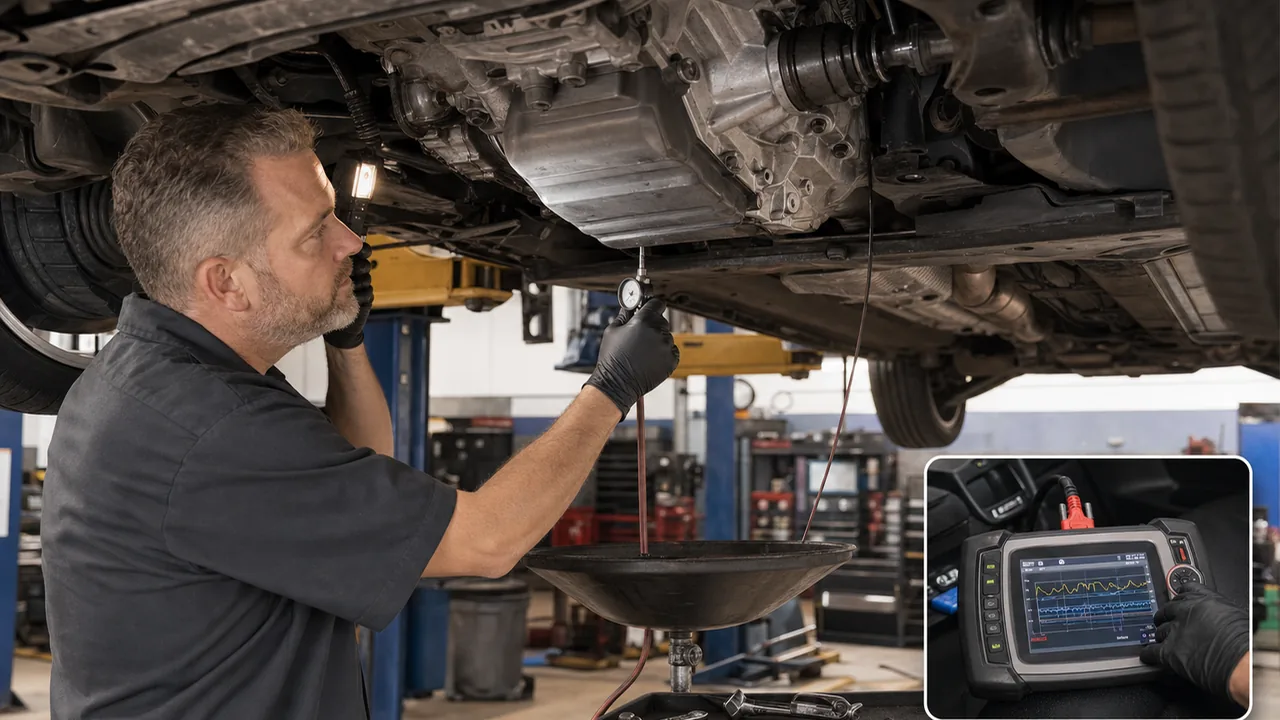
A technician should diagnose improper flat towing in a sequence that preserves evidence and avoids adding load before the drivetrain is known to be safe. The practical order is documentation, OEM procedure verification, lift inspection, fluid inspection, full-system scan, cautious functional testing, and then deeper repair decisions.
- Document the towing event and compare it with OEM instructions. Record the tow setup, vehicle configuration, transfer case mode, transmission selection, ignition state, symptoms, warning lights, and visible fluid evidence.
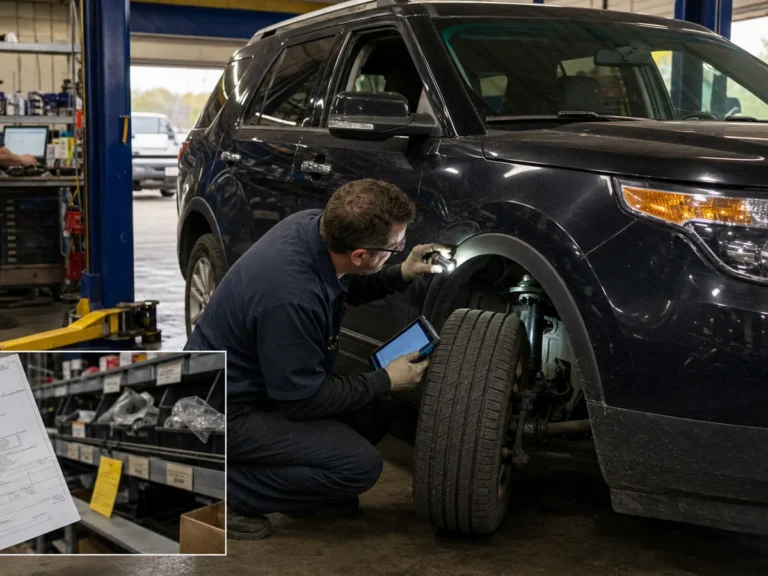
- Inspect on a lift before road testing. Look for fresh leaks, venting, case cracks, wet seals, damaged mounts, loose shafts, U-joint or CV joint looseness, torn boots, heat discoloration, impact damage, and abnormal play.
- Inspect fluids using OEM procedures. Confirm level where possible, then look for burnt odor, darkened fluid, metallic debris, friction material, milkiness, or cross-contamination.
- Scan all relevant modules before clearing anything. Include powertrain, transmission, transfer case, AWD or 4WD, ABS, stability control, body, and gateway modules where available.
- Road test only after leak, fluid-level, mechanical-safety, and scan checks support it. End the test if delayed engagement, flare, harsh shifts, shudder, bind, vibration, warning messages, overheating, or abnormal noise appears.
- Choose the repair path from evidence. Fluid contamination may justify pan removal or component service inspection; persistent mechanical symptoms may justify pressure checks, borescope inspection, component removal, or teardown.
Codes may be absent even when early wear has started, so normal scan results should be read together with towing history, fluid evidence, and lift inspection findings.
The best evidence after a suspected flat-tow mistake is a clean timeline matched with photos, symptoms, fluid findings, scan data, and the OEM towing procedure. This helps a repair shop inspect the correct systems and helps any tow company or warranty discussion stay tied to verifiable facts.
- Vehicle year, make, model, drivetrain, transmission, transfer case type if known, and whether it uses AWD or 4WD
- Towing method, gear selector position, transfer case mode, ignition state, steering lock state, and whether the OEM procedure was followed
- Warning lights, noises, vibration, leaks, burning smells, delayed engagement, harsh shifts, binding, overheating messages, or no-move behavior
- Photos of dashboard messages, warning lights, fluid spots, underbody wet areas, tow bar setup, and visible mechanical damage
- Tow invoices, roadside records, prior maintenance records, inspection sheets, scan reports, and fluid inspection notes
| Evidence | Why it matters | How to preserve it |
|---|---|---|
| OEM towing procedure | Shows whether the SUV was set up according to the controlling source | Save the manual page or service information reference used |
| Fluid condition | Can show heat, debris, contamination, or leakage after the tow | Document odor, color, debris, metal, friction material, and leak location |
| Scan report | Can support mode, speed, range, actuator, or communication issues | Save active, pending, history, freeze-frame, and event data before clearing codes |
| Symptom timeline | Links the first abnormal behavior to the towing event | Write down what happened before hookup, after disconnecting, and during first operation |
Do not flush fluids, clear codes, replace parts, or continue road testing before the initial inspection if a damage claim or warranty review may follow.
Preventing future flat-towing damage starts with the OEM recreational towing procedure for the exact SUV. Do not assume an automatic SUV is towable because another trim, model year, or drivetrain version can be towed four-down.
- Read the owner manual section for recreational towing or flat towing before hookup.
- Confirm that the specific vehicle is approved for flat towing. If approval is unclear, use a trailer, flatbed, or another approved method.
- Verify transfer case neutral mode separately from transmission neutral when the procedure requires it.
- Follow the OEM sequence for ignition position, steering lock status, battery handling, fuse steps, parking brake release, and mode confirmations.
- Check any OEM limits, recheck intervals, or setup confirmations instead of relying on generic towing advice.
- After arrival, reverse the setup in the OEM sequence and inspect for leaks, warning lights, odor, abnormal noises, harsh engagement, or binding.
If any part of the procedure is unclear, verify it before towing. Guessing at transfer case mode is the exact failure path this inspection guide is trying to avoid.
Comments
Be the first to add a practical repair note or follow-up question.