
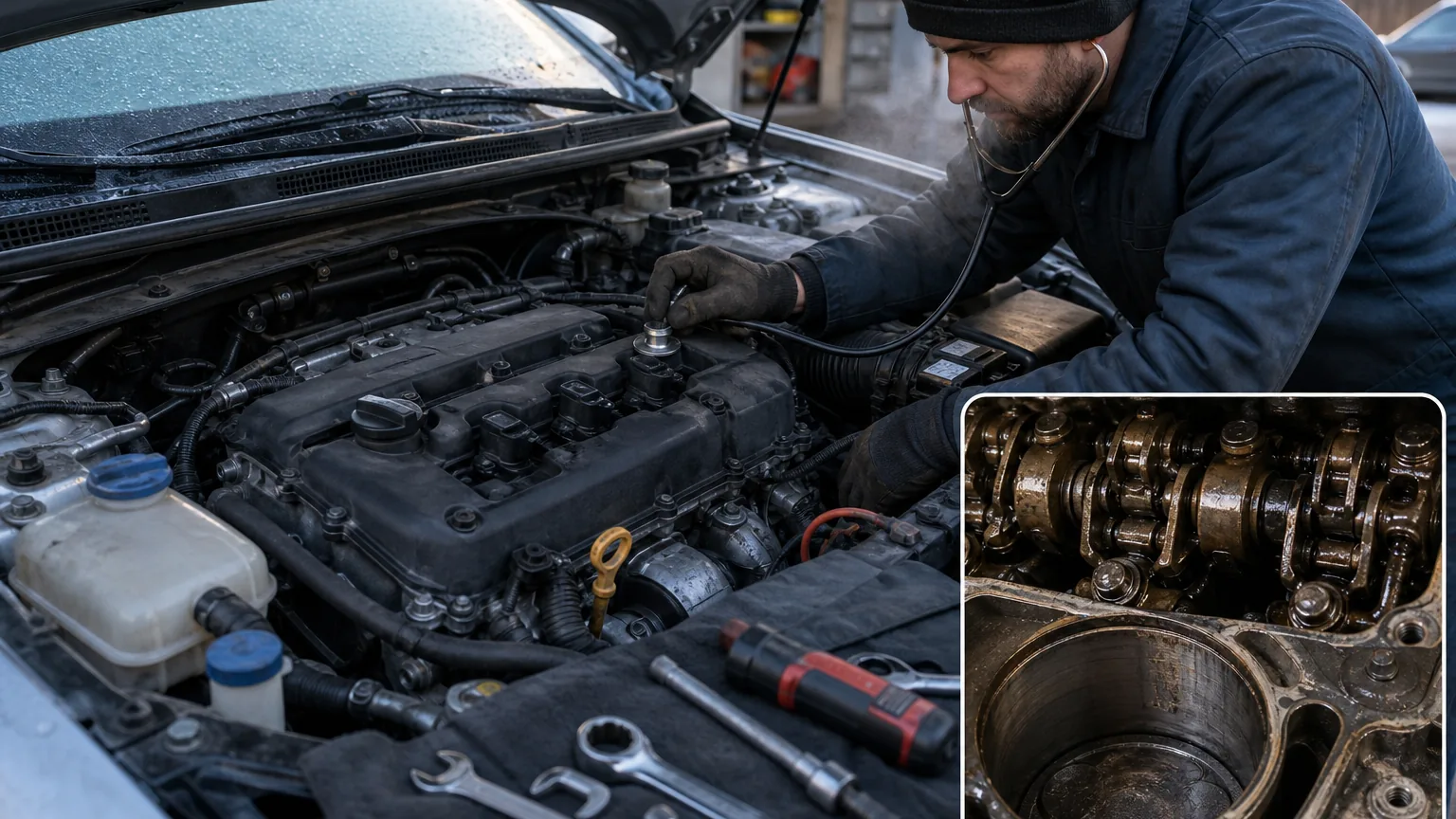
Common causes
Cold ticking at idle often means normal valvetrain noise on a cold start, but persistent ticking can also indicate lifter noise or piston slap. The first owner-safe check is the oil level and oil condition, then whether the sound fades as the engine warms or stays sharp, deep, or localized. Cold ticking at idle is commonly caused by lifter noise, piston slap, low or thick oil, exhaust leaks, injector tick, or timing-related noise. The sound pattern can suggest the cause, but a mechanic may need to confirm it with oil-pressure checks, scan data, and sound localization.
- Lifter noise: A sharper tick from the top end often points to a hydraulic lifter that is slow to fill with oil on startup. If it softens as oil circulation settles, that pattern fits valvetrain noise more than a deeper internal knock.
- Piston slap: A deeper tap or knock from lower in the engine can reflect extra piston-to-cylinder wall clearance while the engine is cold. If the noise remains strong after warm-up, the concern is higher.
- Low or thick oil: Low oil level, degraded oil, or oil that does not flow well when cold can delay lubrication and make startup ticking more noticeable. This is why the dipstick and recent oil-service history are the first safe checks.
- Exhaust leak: A small leak near the manifold can sound like a metallic tick because exhaust pulses escape in rhythm with idle. It often seems more external and may change as the exhaust parts heat up.
- Injector tick or timing-related noise: Injectors usually make a light, even click, while chain or tensioner noise is often harsher and may come with startup rattle, rough running, or warning lights.
- Stop driving and arrange an inspection if the sound becomes a heavy knock, persists after warm-up, or appears with a low-oil-pressure warning, misfire, power loss, overheating, or fresh leaks. Continued driving with persistent unexplained mechanical noise should be treated cautiously.
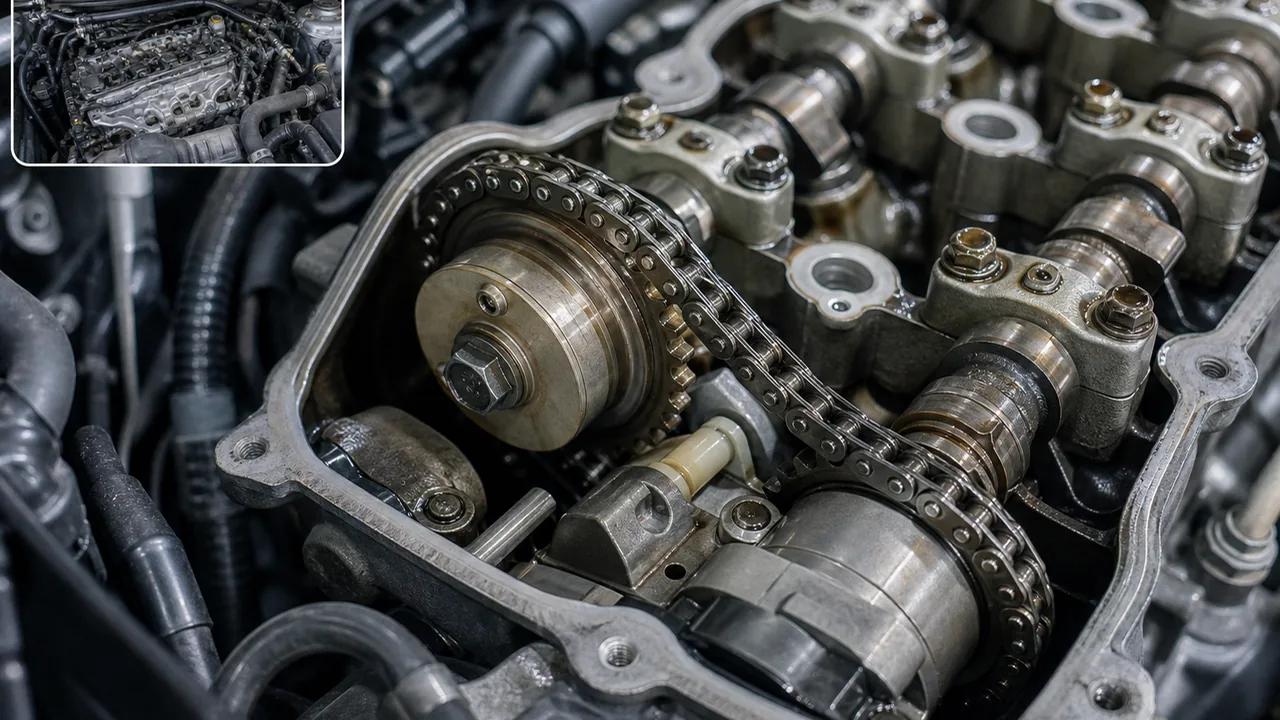
Cold ticking at idle most often starts with cold oil and valvetrain behavior, but similar sounds can also come from a small exhaust leak or normal injector clicking. The key is to rank the common, lower-risk causes first, then move toward timing and bottom-end noises that deserve faster attention.
- Hydraulic lifter bleed-down or light valvetrain tick: This is one of the most common patterns on a cold engine. A Hydraulic lifter or Valve lifter may tick until oil pressure and oil flow stabilize, especially if the engine sat for a while. The clue is a sharper top-end tick that becomes quieter as the engine warms. Urgency: monitor.
- Low oil level, dirty oil, or unsuitable Engine oil viscosity: If the oil film is slow to build, valvetrain parts can sound louder at idle. This cause fits when Cold ticking at idle appears together with overdue oil service history, a questionable oil grade, or a recent drop in oil level. Urgency: inspect soon.
- Small exhaust manifold or gasket leak: An exhaust leak near the cylinder head can mimic internal engine tick, especially when metal is cold and gaps are larger. The sound may be crisp and rhythmic, then soften as parts expand with heat. Light soot around the leak area can be a clue. Urgency: inspect soon.
- Fuel injector ticking: Injectors can make a steady, repeating click that owners describe as a tick. This is usually more uniform and less hollow than Piston slap, and it does not usually turn into a heavy knock. Urgency: monitor unless other symptoms appear.
- Timing chain, tensioner, or related timing hardware wear: If the noise is harsher on startup, lasts longer than expected, or is joined by rough running or warning lights, timing components move higher on the list. This is no longer a casual watch-and-wait item. Urgency: prompt inspection.
- Piston slap or other bottom-end mechanical wear: Piston slap is tied to Piston-to-cylinder wall clearance and often sounds deeper than Lifter noise. If the tick becomes a heavier knock, stays pronounced warm, or comes with drivability changes, treat it as a higher-risk mechanical issue. Urgency: prompt inspection, and persistent mechanical noise should be professionally evaluated before assuming continued driving is safe.
Use this ranking as a starting point, not a final diagnosis. The next step is to match the sound location, warm-up behavior, and oil condition before concluding whether the engine is dealing with Lifter noise, Piston slap, or a lookalike noise.
When it is urgent
Cold ticking at idle is often harmless when it fades as the engine warms, but it becomes urgent when the noise stays, gets sharper, or appears with warning signs. If the sound turns into a heavy metallic knock, the oil pressure warning comes on, or the engine starts running poorly, stop driving and arrange a tow rather than trying to limp home.
After you have confirmed the oil level and used the correct engine oil viscosity, persistent warm ticking should be inspected promptly. Lifter noise, Valve lifter problems, or Piston slap may start as a cold-start concern, but urgency should be judged by symptom change and engine behavior, not by the ticking sound alone.
- Stop driving and tow the vehicle if the oil pressure warning light appears with the noise.
- Stop driving if the ticking changes into a heavy metallic knock or rapidly gets louder.
- Stop driving if overheating starts or coolant temperature rises abnormally.
- Seek urgent inspection if smoke becomes obvious or suddenly increases, especially with an oil smell.
- Stop driving if you notice severe misfire, shaking, loss of power, or hesitation that was not present before.
- Stop and check for help if fresh oil or coolant loss is visible under the vehicle or in the engine bay.
- Book prompt inspection if the ticking remains after warm-up, even if drivability still feels normal.
Safe-to-drive guidance: brief cold ticking that fades without warning lights, smoke, fluid loss, or drivability problems is usually lower risk to monitor. Persistent mechanical noise should be reviewed cautiously, and any decision to keep driving after that point is best confirmed by a qualified mechanic.
Diagnostic order
Cold ticking at idle usually stays a cold-start noise question unless another symptom redirects the diagnosis. If the sound continues beyond idle, arrives with warning lights, starts right after an oil change, or sounds more like a puff than a sharp tick, follow that branch next before assuming Lifter noise or Piston slap.
- First, decide whether the noise is only at idle or also follows acceleration. If it ticks at idle and under throttle, move to broader engine ticking noise at idle guidance, because the pattern is no longer limited to a simple cold-idle scenario.
- Next, check for an oil warning light or any clear lubrication concern. If the oil light appears with the noise, treat low oil pressure symptoms as the next diagnostic path rather than continuing to sort the sound by ear alone.
- Then review what changed just before the ticking began. If it started after an oil change, wrong oil viscosity symptoms become the sensible next branch, since an oil-related change can alter Hydraulic lifter behavior without proving internal damage by itself.
- After that, listen for the character of the sound. If the tick seems more like a puff, tap at a manifold area, or leak-like pulse, shift to exhaust leak sound guidance before focusing on Valve lifter or piston-to-cylinder wall clearance.
- Finally, look for a check engine light, rough running, or a misfire feel. If any of those appear, use check engine light with ticking noise as the next path, because combustion or valvetrain faults may need a scan and a closer inspection together.
If these early branches do not clearly explain the noise, the next best confirmation step is a cold-start inspection with the symptom documented from first startup through warm-up, including whether Cold ticking at idle changes off idle. That gives a technician the cleanest path to confirm whether the sound fits normal valvetrain behavior, Lifter noise, Piston slap, or another source without jumping to a hard conclusion.
Parts that may be involved
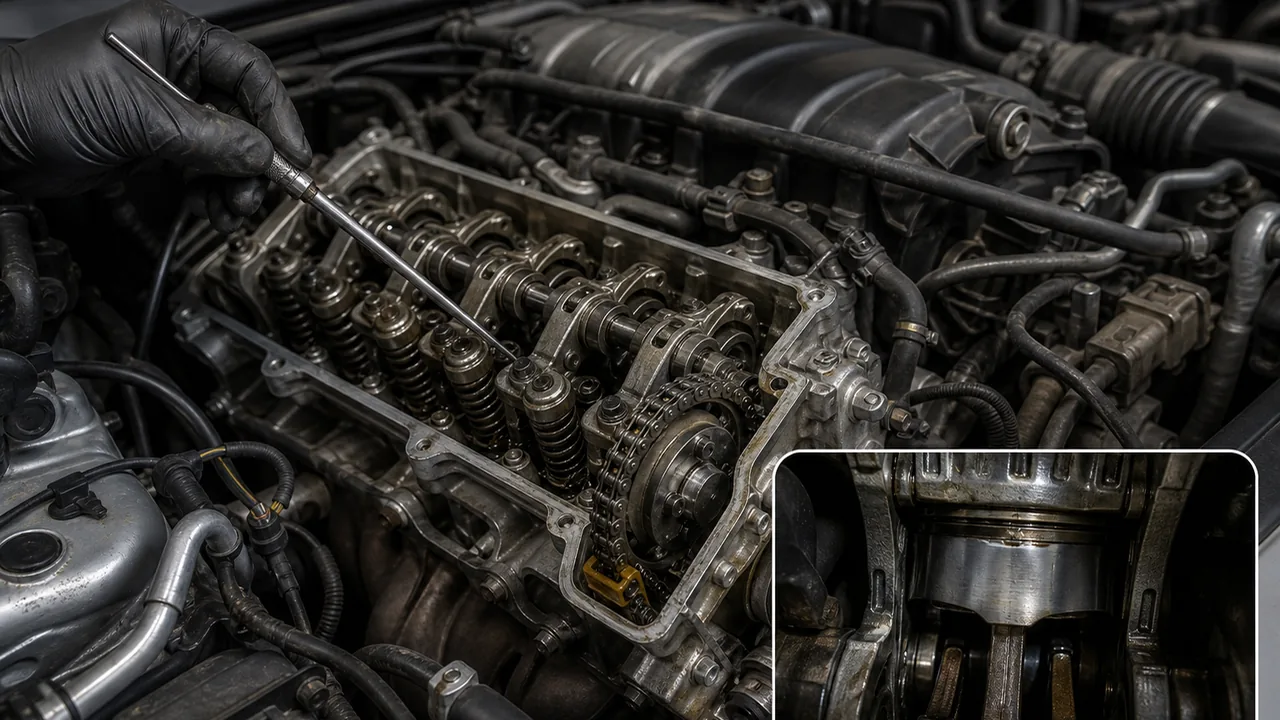
A sharp tick from the top of the engine usually points more toward Lifter noise, while a deeper hollow knock from lower in the block leans more toward Piston slap. That said, Cold ticking at idle can overlap on a cold start, and both noises may soften as oil circulates and parts warm, so sound location alone is not a final diagnosis.
| Sound | Sharper, lighter tick | Deeper, hollower knock or tick |
| Typical location | Top of engine around the valvetrain | More block-centered or lower-engine in character |
| Warm-up behavior | May fade as oil flow stabilizes a Hydraulic lifter or Valve lifter | May lessen as pistons and cylinder walls expand with heat |
| RPM behavior | Often changes pace cleanly with engine speed | Often follows RPM too, but may sound heavier under light throttle |
| Risk | Can be minor at first, but persistent noise still needs inspection | Can be harmless on some cold starts, but persistent mechanical noise should be verified |
| Next test | Check oil level, oil condition, and correct Engine oil viscosity; then listen from the top end | Check oil condition, note whether the sound is strongest cold, and have the lower-engine source verified |
Use this as a fast sorting tool, not proof. If the noise grows louder, stays after warm-up, or comes with a warning light, misfire, or rough running, move from owner checks to a technician inspection rather than assuming it is safe to keep driving.
- More likely and less urgent: a short cold-start bleed-down tick that settles quickly.
- More concerning: a tick that remains after warm-up or returns consistently at idle.
- Do not assume an additive will fix it; some cases need oil service, inspection, or repair.
- Verify the engine oil level and condition first.
- Listen for whether the tick is strongest at the top of the engine.
- If it stays warm or gets louder, book an inspection before the noise is ignored.
Piston slap is a deeper cold-start noise tied to piston movement in the cylinder when piston-to-cylinder wall clearance is larger before the engine warms. It often fades as parts expand with heat, but a loud slap that gets worse, lasts after warmup, or changes character should be inspected.
- Piston slap is often more noticeable on a cold start and may soften as the engine warms.
- It can be design-related or wear-related, so avoid guessing the brand or engine family without evidence.
- Compared with rod knock, piston slap is usually lighter and more cold-dependent; rod knock is typically heavier and more alarming.
- If the noise stays strong when warm, treat that as a verify-first sign rather than a normal cold-start quirk.
For owners, the useful question is not just whether the sound is present, but when it fades and where it seems to come from. A brief cold tick that disappears can fit piston slap; a persistent lower-end knock deserves faster diagnosis before more driving.
Cold ticking at idle can come from a lubrication problem, not just a noisy engine. Low oil level can delay oil delivery to the valvetrain, while dirty or degraded oil can affect hydraulic lifter, VVT, and timing chain tensioner operation. If the oil viscosity is wrong for the engine, cold-start flow can change enough to make ticking more noticeable until the oil warms.
Compared with piston slap, oil-related ticking is often more directly tied to lubrication condition and service history. It may improve after an oil change or after the engine builds heat, but persistent noise still needs a check rather than an assumption.
- Verify the oil level on the dipstick before any harder diagnosis.
- Look for oil that is dark, sludgy, diluted, or past its service interval.
- Confirm the oil specification and viscosity in the owner manual or manufacturer service information.
- If the noise started after a recent oil change, recheck that the correct oil was used and the level was set properly.
If the ticking keeps getting louder, is paired with a warning light, or comes with loss of power or knocking, stop driving and have the vehicle inspected before continuing.
A small exhaust manifold leak can sound like cold ticking at idle, especially on a cold start, and then quiet down as the metal expands and seals. Because the noise is sharp and rhythmic, it is easy to mistake for lifter noise or another internal engine tick.
Compared with Hydraulic lifter or Valve lifter noise, an exhaust leak is often louder near the manifold area and may sound more like a fast puffing tick than a deep mechanical tap. It can also seem to rise and fall with engine speed. If the sound is strongest from outside the engine bay, that leans toward exhaust leak sound guidance rather than an internal valvetrain problem.
- Look for soot marks around the manifold, gasket, or nearby heat shield, but only from a safe distance on a cold engine.
- Check for a brief exhaust smell after startup, especially near the front of the engine or around the cabin intake area.
- Listen for cold-start puffing that fades as the engine warms, which is a common leak clue.
A technician will usually confirm the source with a cold inspection, fastener and gasket checks, and other leak-finding methods if the visual signs are unclear. If fumes are entering the cabin or the ticking becomes a louder exhaust leak, book service soon and avoid assuming it is only normal cold noise.
A light, even tick at idle can be normal fuel injector operation rather than engine damage, especially if the sound stays consistent warm or cold and the vehicle otherwise runs normally. After ruling out obvious cold-start sounds like an exhaust leak, injector noise is another common source owners mistake for Lifter noise or deeper internal trouble.
Injector tick is usually a small, rhythmic clicking from the top side of the engine. It tends to sound uniform instead of heavy, hollow, or metallic, and it is not usually limited only to cold startup. Normal injector sound also should not come with an oil pressure warning, rough idle, misfire, loss of power, or a hard knocking sound. Those clues point away from harmless injector noise and toward a separate issue that needs diagnosis.
- More likely normal injector tick: light, fast, consistent clicking with no change in drivability.
- More concerning: ticking that is louder on one side, suddenly worse than before, or mixed with rattling, knock, smoke, or warning lights.
- Still worth evaluating: the engine has a normal injector tick, but there is also a second noise during cold idle that does not match the same even rhythm.
If you cannot clearly separate a normal injector tick from another mechanical noise, have the sound checked before assuming it is harmless. Persistent engine noise should be reviewed with safety in mind.
A cold-start tick that turns into a brief rattle or clatter can point to timing chain, chain tensioner, or VVT noise rather than normal injector tick or simple Lifter noise. This becomes more urgent when the sound seems to come from the front or top of the engine and appears with a check engine light, rough idle, or hard starting.
After simpler causes like injector tick or a small exhaust leak have been considered, the concern here is usually startup oil control or wear in parts that should steady chain slack and cam timing quickly. Owners often describe this as timing chain noise or a ticking noise with a check engine light. That symptom wording is useful, but the next step is to verify whether the engine also has cam/crank correlation codes, unstable idle quality, or noise that keeps returning after cold starts.
- Lower concern: a very brief startup rattle with no warning lights and no drivability change still deserves attention, but it is less suggestive of immediate failure.
- Higher concern: repeated metallic rattle, lingering clatter, or noise that continues as the engine warms points more toward a worn tensioner, chain issue, or VVT actuator problem.
- Highest concern: ticking or rattling plus rough running, misfire, stalling, or a check engine light should move this out of the watch-and-wait category and into prompt inspection.
Do not judge timing-system condition by sound alone or by generic online pass/fail claims. If the noise is persistent or the engine runs poorly, book an engine noise inspection promptly, and if severe warning symptoms are present, have the vehicle reviewed before continued driving.
A heavy, dull metallic knock from low in the engine is not the same as ordinary cold ticking at idle, and it deserves urgent attention. Unlike lighter Lifter noise, injector tick, or some Piston slap sounds, a bottom-end knock usually points to a more serious internal problem that should be verified quickly.
This noise is more concerning when it gets louder with RPM, sharp throttle input, engine load, rising temperature, or signs of low oil pressure. Owners may describe it as a deep hammering or thud rather than a fast top-end tick. That does not confirm a failed bearing on its own, but it does move the problem out of the lower-risk cold-start noise category and into a do-not-ignore mechanical noise path.
- Treat the noise as urgent if it becomes heavier as the engine warms or revs.
- Stop the engine if an oil pressure warning appears, the knock turns severe, or overheating is present.
- Do not use repeated test drives to "see if it clears up" when the sound suggests bearing risk.
- If the vehicle still runs, limit owner checks to safe basics such as verifying oil level and noting when the knock changes.
Persistent lower-end knocking should be inspected professionally as soon as possible. Continued driving after severe mechanical noise may increase damage, so the safer next step is shutdown and towing when warning signs are present.
Before booking service, focus on a few owner-safe checks that help separate normal cold-start behavior from a problem that needs diagnosis. Cold ticking at idle is often normal valvetrain noise, but if it stays after warm-up, changes with RPM, or appears with warning lights or rough running, the sound needs closer attention.
- Check the engine oil level on level ground using the procedure in the owner’s manual. A low oil level can make Lifter noise more noticeable and can also make any existing mechanical noise harder to judge accurately.
- Look at the oil’s general condition and confirm the most recent oil grade against the service label or manual. If the wrong Engine oil viscosity was used, cold-start ticking may sound worse until the engine warms.
- Pay attention to the pattern of the noise. Note whether it fades as the engine warms, stays the same, gets faster with RPM, or shows up more clearly under light load. That pattern helps separate a brief Hydraulic lifter tick from a more persistent concern such as Piston slap.
- Check the instrument cluster for oil pressure, check engine, overheating, or misfire warnings. Those signs matter more than the sound alone and should be included when you describe the problem.
- Record a short cold-start video from a safe position outside the vehicle. Capture the first moments after startup and, if possible, the change in sound as idle settles. That gives the technician a better starting point than a warm engine arriving at the shop.
Do not place hands near belts, pulleys, fans, or hot engine parts while listening for noise. If the ticking is accompanied by a heavy knock, strong misfire, overheating, or any oil-pressure warning, move to the urgent guidance in the next sections rather than continuing owner checks.
A technician should confirm whether Cold ticking at idle is harmless cold-start valvetrain noise or a sign of Lifter noise, Piston slap, an exhaust leak, or a lubrication problem. The safest diagnostic path is to verify basic oil-related conditions first, then scan for control-system clues, then localize the sound before moving into deeper engine testing.
- Verify the oil level, oil condition, recent maintenance history, and whether the engine is using the correct Engine oil viscosity for the vehicle. Low oil level, degraded oil, or the wrong viscosity can change Hydraulic lifter behavior and make normal cold-start noise sound worse.
- Check for stored or pending fault codes with a scan tool, especially anything related to misfire, variable valve timing, cam/crank correlation, or oil-pressure-related control issues. These clues help separate a mechanical tick from a timing or control problem.
- Localize the noise with proper listening tools. Comparing the top end, engine block, exhaust manifold area, and front accessory drive helps distinguish Valve lifter noise from Piston slap, accessory noise, or a small exhaust leak.
- If lubrication concern remains, test oil pressure against manufacturer procedure and specifications rather than guessing from sound alone.
- If the noise source is still unclear, inspect for exhaust leaks and consider compression or leak-down testing when internal wear or Piston-to-cylinder wall clearance concerns are suspected.
If the early checks do not explain the tick, the most sensible next confirmation step is a hands-on noise localization and oil-pressure evaluation before any repair decision is made.
Yes, sometimes, but only with caution. If Cold ticking at idle is brief, fades as the engine warms, and appears without warning lights or drivability problems, it is usually reasonable to monitor it short-term after confirming the oil level is correct. If the ticking is new, louder, lasts longer than usual, or comes back when warm, limit driving and book an inspection before long trips or hard driving.
When to monitor, stop, or get a mechanic involved
- Monitor only if the ticking fades quickly on a cold start, the oil level is correct, and the car otherwise runs normally.
- Book a mechanic soon if the noise is getting louder, lasting longer, or showing up more often from one cold start to the next.
- Limit driving if the ticking returns after warm-up, because persistent Lifter noise or Piston slap needs diagnosis before heavier use.
- Stop driving if an oil pressure warning appears or you notice obvious fluid loss.
- Stop driving if the engine starts overheating, smoking heavily, misfiring, losing power, or stalling.
- Tow the vehicle if the sound changes from a light tick to a sharp metallic knock or any clearly harsher mechanical noise.
Persistent mechanical noise should be evaluated before continued regular driving. For safety, any final decision about driving with ongoing engine noise is best confirmed by a qualified mechanic.
Cold ticking at idle should be repaired only after the source is confirmed. If the noise points to a service issue, the path may be simple oil service correction, a minor exhaust leak repair, or injector confirmation. If it tracks to Lifter noise, Piston slap, timing components, or low oil pressure, the repair can become more involved and should not be guessed at.
Ask the shop to confirm the diagnosis
- Where was the noise actually located, and did it change when the engine warmed up?
- Was oil pressure tested, and did the engine show any codes or misfire data?
- Did the shop rule out an exhaust leak, injector tick, or oil-related issue before recommending deeper work?
- If the noise persists warm, did they inspect the valvetrain or timing system before discussing internal-engine repair?
Low-risk fixes should stay separate from major mechanical repair paths. Do not approve internal work unless the diagnosis clearly supports it. If the source is still uncertain, book an engine noise inspection and ask for the confirmed fault path in writing before any teardown.
Comments
Be the first to add a practical repair note or follow-up question.