
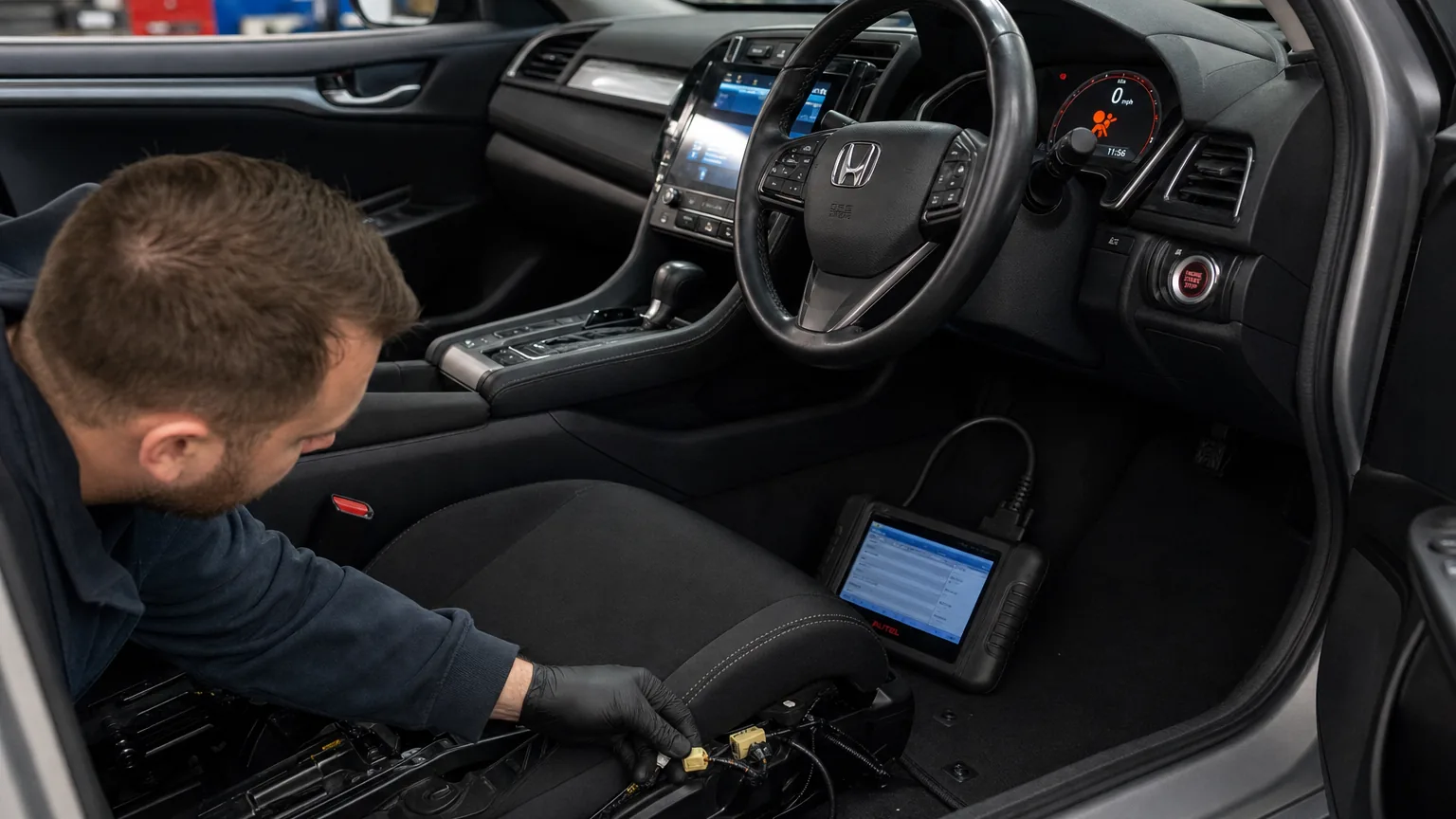
What the symptom usually means
- SRS or airbag warning light stays on after startup.
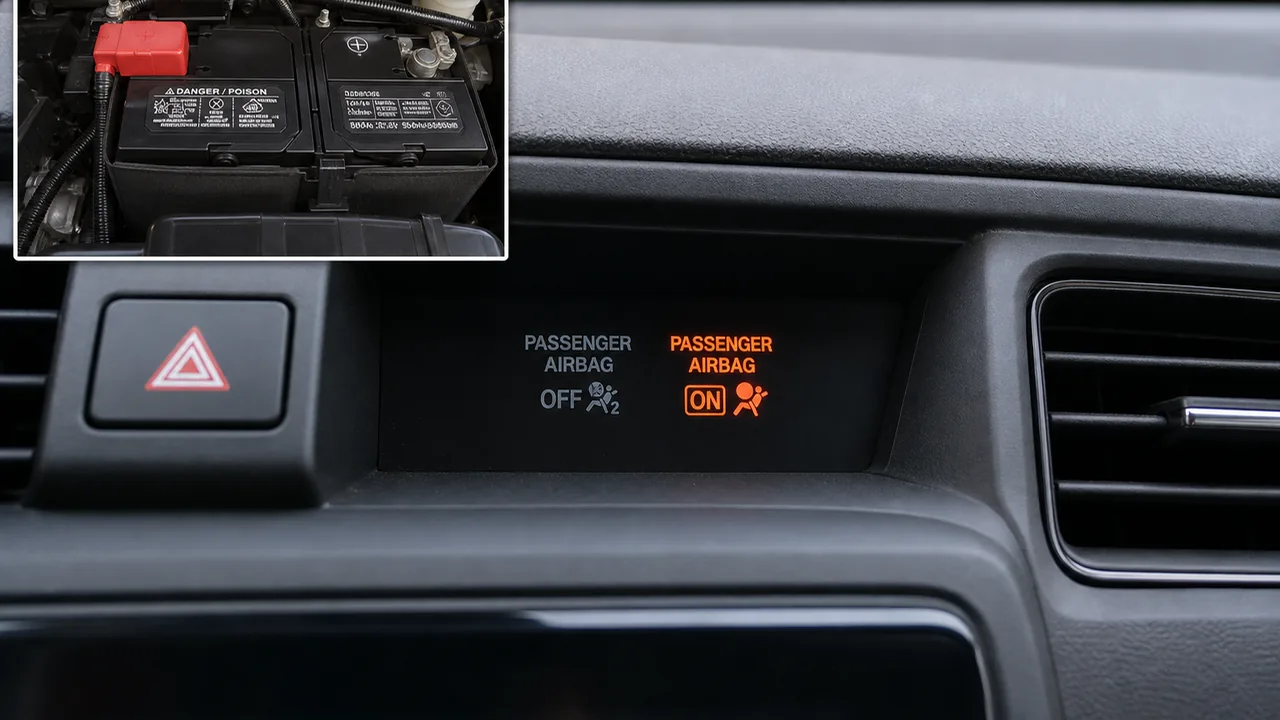
- Passenger airbag off indicator appears with an adult seated correctly.
- Passenger airbag indicator stays off when the seat is empty or the behavior does not match the manual.
- Warning returns after battery work, seat movement, interior cleaning, or under-seat obstruction.
- Seat belt warning, pretensioner, or occupant classification codes are stored with the SRS fault.
| What you see | What it can indicate | Best next step |
|---|---|---|
| Passenger airbag off only | Normal suppression or seat classification issue | Check seat position, objects, floor mat, and occupant posture |
| SRS warning light | Stored restraint-system fault | Avoid front passenger use and read SRS codes |
| Warning after seat movement | Under-seat wiring, connector disturbance, or sensor input issue | Do not unplug connectors; inspect safely and have the system scanned |
Common causes
- Passenger seat classification condition: seat empty, small occupant, posture, heavy objects, or a floor mat pressing behind the seat can affect what the system sees.
- Passenger seat weight sensor fault: official recall data identifies faulty circuit board behavior in the front passenger seat weight sensor on certain Honda vehicles, including some Civic variants.
- Under-seat wiring or connector disturbance: seat movement, debris, moisture, or previous interior work can disturb wiring without proving the sensor itself is bad.
- Seat belt buckle or pretensioner circuit issue: the SRS system also monitors belt-related components, so a passenger-airbag complaint may share stored restraint codes.
- Low voltage or recent battery work: weak battery history, jump-starting, or power interruption can expose stored SRS faults, but voltage alone should not be assumed to be the repair.
- SRS control unit, crash sensor, or previous collision history: deeper faults require service information, compatible scan tools, and documented test results.
EU Safety Gate alert A12/03280/24 describes a serious injury risk for certain Honda passenger cars, including Civic, linked to a faulty passenger seat weight sensor circuit board. The alert describes a manufacturer recall from end users and a risk that airbag triggering may be wrong for a child occupant.
In the United States, NHTSA recall campaigns 24V064000 and 26V332000 cover certain Honda and Acura vehicles for front passenger seat weight sensor defects. Civic owners should verify by VIN rather than assuming coverage from model name alone.
- A reset does not repair a cracked sensor circuit board.
- A reset does not repair a damaged harness or connector.
- A reset does not confirm passenger-airbag classification.
- A reset does not verify seat belt pretensioner readiness.
- A reset can delay recall verification or erase useful fault history.
If the light stays off only briefly, the system is still telling you the cause has not been fixed. If the light was cleared before diagnosis, tell the technician what happened so they can interpret history codes and current behavior correctly.
Quick checks
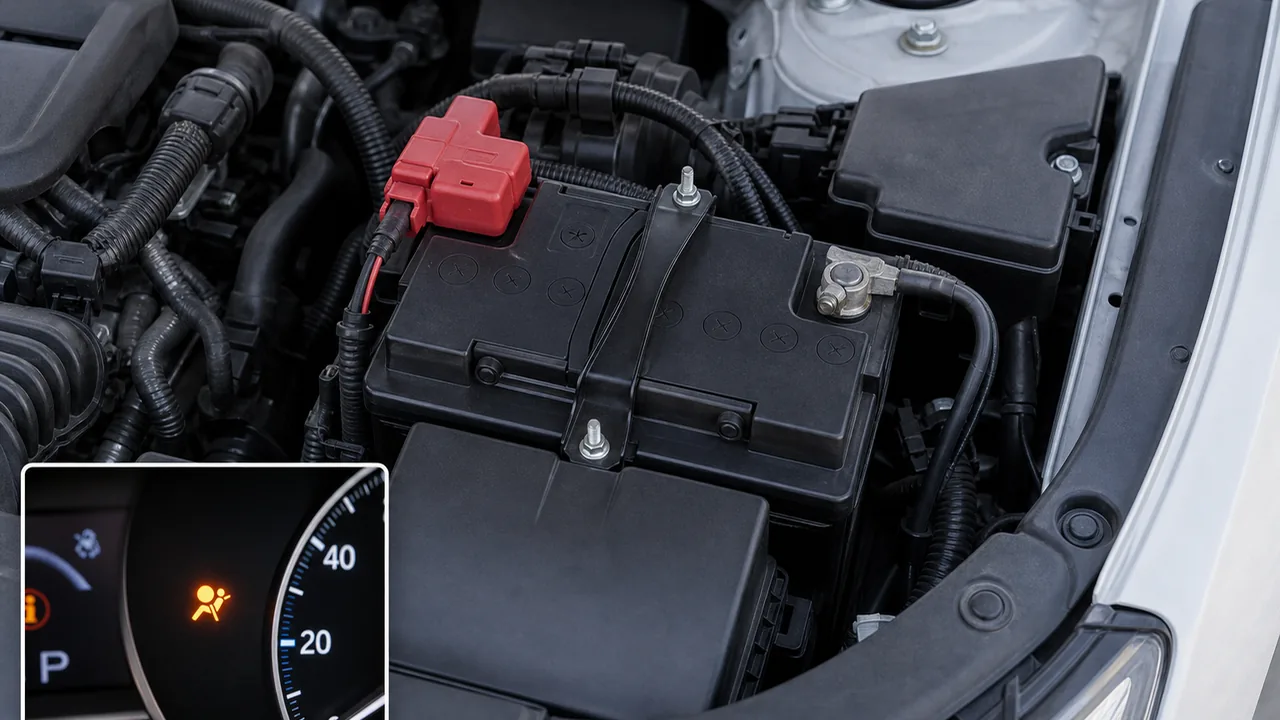
Start with the seat, not the wiring. Honda's occupant classification logic depends on the passenger sitting normally, with no object pressing the seat, seat-back, floor area, or rear of the front passenger seat. If the indicator behavior changes after clearing objects, the note is useful for the technician.
- Check for liquid spills on or under the front passenger seat.
- Make sure no rear passenger is pushing against the front passenger seat-back.
- Confirm the head restraint and seat-back are not positioned unusually.
- Check whether the warning appears only with a passenger, only with an empty seat, or all the time.
- Record any dashboard message wording before the vehicle is scanned.
Do not move to connector handling after these checks. SRS circuits can be damaged or made unsafe by casual testing, and clearing a code before reading it can erase the evidence needed for a correct repair path.
Diagnostic order
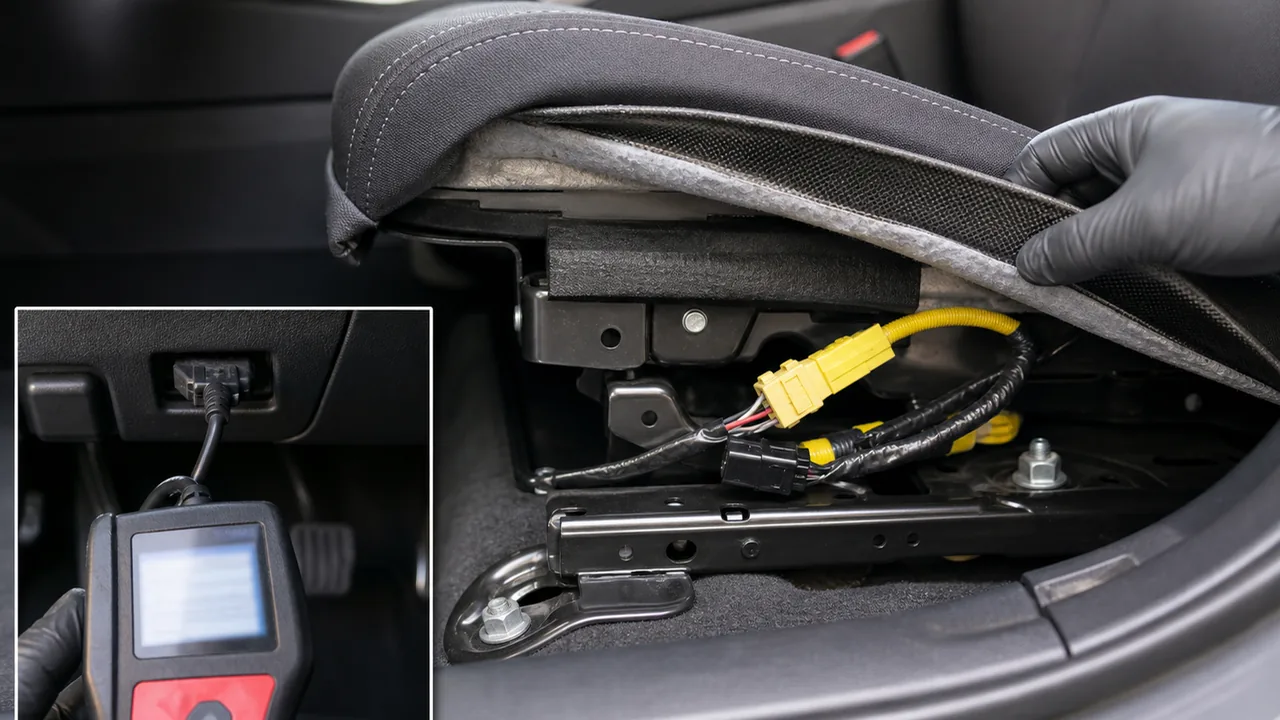
- Recall and service-campaign lookup.
- Compatible SRS scan, not only a generic OBD scan.
- Code-guided inspection of the passenger seat sensor and under-seat harness.
- Seat belt buckle and pretensioner checks when codes point there.
- Occupant detection calibration when required by service data.
- Module and crash-sensor evaluation only after simpler inputs are ruled out.
DTC intent should stay separate from symptom advice. A Civic owner can describe the warning and perform safe visual checks, but the actual repair decision depends on stored SRS codes, market-specific service data, and whether the vehicle is included in an open recall.
No airbag-system part should be replaced only because a dashboard light is on. The failed input, wiring fault, recall eligibility, or calibration requirement needs to be confirmed first.
Parts that may be involved
The passenger airbag off indicator can be normal when the seat is empty, when a child-sized occupant is detected, or when the system is suppressing the passenger airbag. An SRS warning light is different: it indicates a possible problem with the airbag system or seat belt tensioners and should be checked with compatible diagnostic equipment.
Honda owner information for recent Civics describes front passenger seat weight sensors as part of occupant classification. If the system cannot trust that input, the warning may appear and the vehicle may store SRS fault data that a generic code reader may not retrieve.
Do not treat the light as a simple reset issue. Airbag and seat belt pretensioner circuits are safety systems, and the stored fault is evidence that should be read before any part is replaced or any code is cleared.
The EU Safety Gate alert for Honda passenger cars lists affected models including Civic and describes production dates from 1 June 2020 to 1 March 2021. It identifies the passenger seat weight sensor circuit board as the fault area and describes manufacturer recall action from end users.
NHTSA recall filings in the U.S. also identify certain Civic variants within broader Honda and Acura seat-weight-sensor campaigns. Because recall databases are VIN-based, a Civic owner should check the VIN before paying for sensor replacement or assuming a recall repair has already been completed.
Any claim that a specific Civic generation, trim, or market has a known occupant sensor pattern should be verified against Honda service information, owner notices, or an official recall database before publication as a firm model-year statement.
- Avoid carrying a child or small passenger in the front seat when any passenger-airbag status is uncertain.
- Use the rear seat for children and follow the owner's manual restraint guidance.
- Do not ignore a persistent SRS light even if the engine, brakes, and steering feel normal.
- After a collision, have the SRS system inspected even if airbags did not deploy.
- If multiple electrical warnings appear with the SRS light, prioritize diagnosis before normal use.
The urgent part is not that the Civic will suddenly stop running. The urgent part is that the restraint system may not provide the intended protection or may make the wrong deployment decision for a particular occupant.
If your Civic is recall-eligible, the safest next step is dealer or manufacturer-authorized recall action rather than owner trial-and-error. If no recall applies, the next step is an SRS diagnostic inspection that documents the codes and verifies the affected circuit.
- Use recall lookup before paying for a passenger seat weight sensor.
- Use an SRS-capable scan tool, not only a standard OBD reader.
- Approve sensor, buckle, pretensioner, harness, or module work only after test evidence supports it.
- Keep copies of recall status and diagnostic findings for future ownership or sale records.
FAQ
Is the passenger airbag definitely disabled when the SRS light is on?
Not definitely. The SRS light means the system has detected a possible restraint-system problem. Airbag behavior depends on the exact fault, so avoid using the uncertain passenger seat until the system is diagnosed.
Can a Honda Civic passenger seat sensor cause the SRS light?
Yes. Passenger seat weight sensor or occupant classification faults can trigger an SRS warning, and official recall filings identify seat weight sensor defects on certain Honda Civic populations.
Can I clear the Honda Civic airbag light myself?
Clearing the light is not a repair. The stored SRS code should be read first, because it points to the circuit or component that needs inspection.
Should I check recalls before paying for SRS diagnosis?
Yes. Check the VIN through Honda, NHTSA, or the relevant market recall database before paying for a passenger seat sensor or related SRS repair.
What parts may be involved?
Possible parts include the passenger seat weight sensor, occupant detection wiring, seat belt buckle, pretensioner, SRS control module, or related connectors, but parts should not be replaced without confirmed fault evidence.
Comments
Be the first to add a practical repair note or follow-up question.