
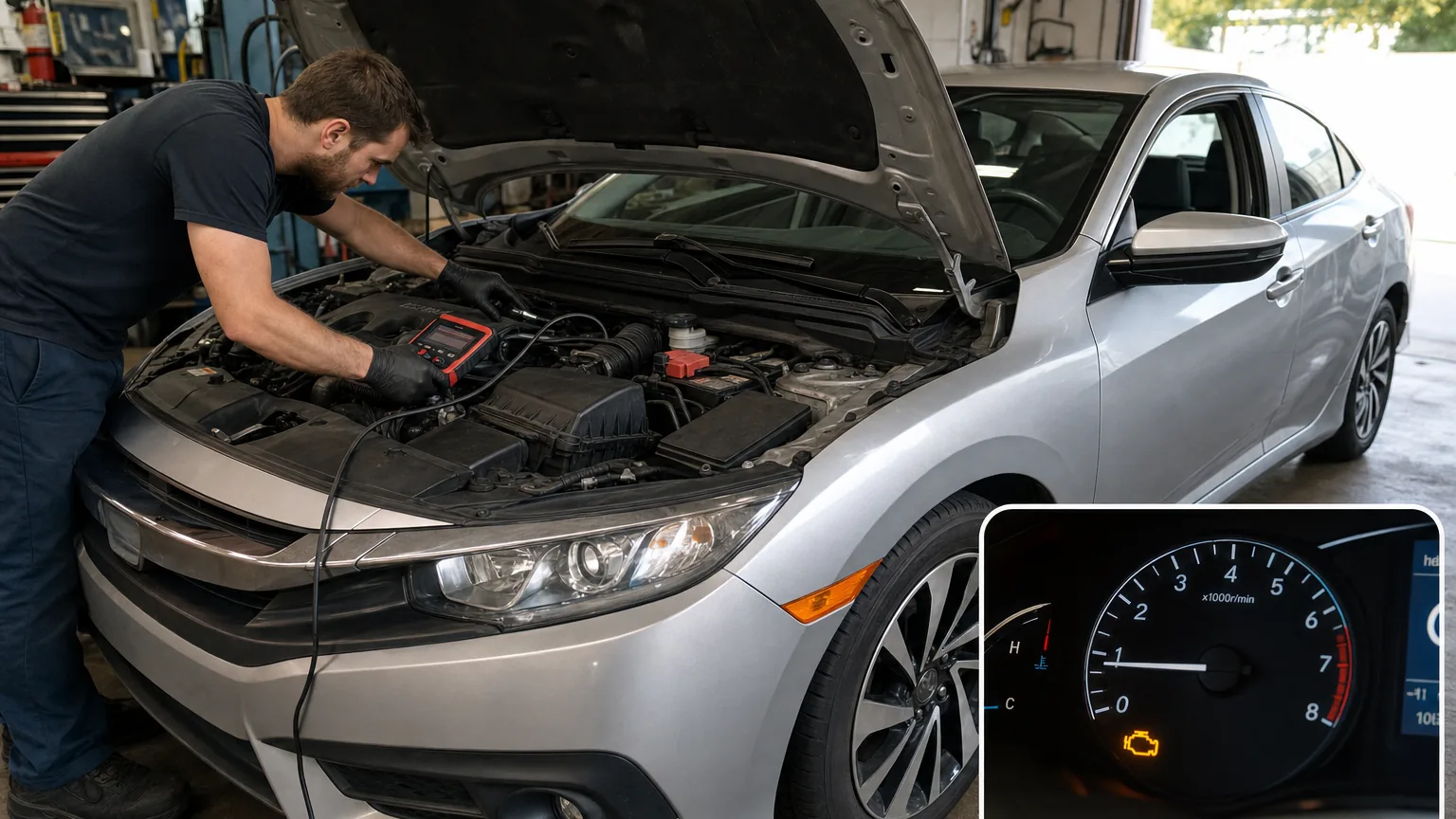
What the symptom usually means
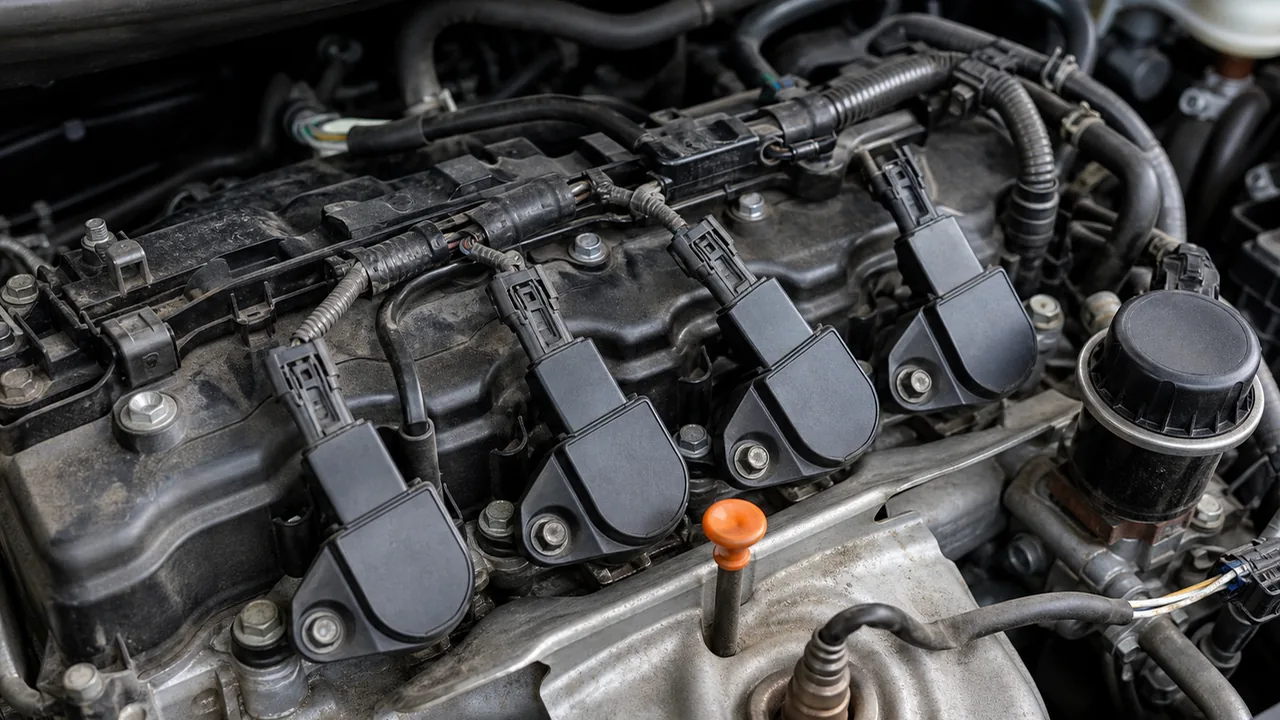
A Civic can stall because the engine cannot keep combustion stable, because the throttle and idle control strategy cannot react correctly, or because a sensor or electrical signal drops out at the wrong moment. The check engine light means there is diagnostic information to retrieve, but it does not prove that the part named in a code is bad.
- A misfire path can feel like shaking, hesitation, rough idle, or a stall after the engine loads up.
- An air or vacuum leak path can make idle unstable and may become more obvious when stopping.
- A fuel delivery path can show up as choking, loss of power, hard restart, or stalling under demand.
- A throttle or sensor path can cause the computer to lose accurate airflow, pedal, or engine position information.
- An electrical or charging path can create intermittent faults that appear unrelated until scan data is reviewed.
If the vehicle recently had maintenance, repairs, intake work, battery service, or fuel-system work, include that detail when documenting the symptom. Recent changes often narrow the inspection path.
Write down the pattern before clearing codes or disconnecting the battery. A short symptom log can keep the diagnosis from turning into a parts guess, especially when the Civic only stalls occasionally.
| Stalling pattern | What it may suggest | Useful next check |
|---|---|---|
| Stalls at idle or while stopped | Idle control, intake leak, throttle contamination, misfire, or EVAP purge behavior may be involved. | Scan codes, inspect intake connections, and review idle-related scan data. |
| Stalls while slowing down | Airflow control, vacuum leak, throttle response, or sensor transition data may be unstable. | Check for intake leaks, throttle data, and freeze-frame conditions. |
| Stalls on acceleration | Fuel delivery, misfire under load, airflow measurement, or ignition breakdown may be involved. | Review misfire counters, fuel trim direction, and fuel-system test results. |
| Stalls after warm-up | Heat-sensitive sensor signals, ignition faults, or electrical connection issues may be possible. | Compare cold and warm scan data and test crank or cam signal behavior if codes support it. |
| Stalls after refueling | EVAP purge behavior may need inspection, especially if EVAP codes are also present. | Check codes first and test the purge system before replacing EVAP parts. |
| Hard to restart after stalling | Fuel delivery, crank signal, flooding, voltage drop, or intermittent electrical faults may be involved. | Do not keep road testing; capture codes and move to a controlled diagnostic process. |
Common causes
The most useful cause list starts with systems that can actually shut the engine down or make idle unstable. A single code may name one area, but the fault still needs confirmation with visual checks, scan data, and basic testing.
- Misfire or ignition faults: suspect this path if the engine shakes, hesitates, runs rough, or stores misfire-related codes.
- Air intake or vacuum leaks: suspect this path if the idle is unstable, intake parts were recently disturbed, or fuel trims point toward unmetered air.
- Fuel delivery problems: suspect this path if the Civic feels starved, loses power before stalling, or restarts only after a delay.
- Throttle or airflow sensor issues: suspect this path if throttle response, idle behavior, or airflow readings do not match the driving condition.
- EVAP purge or leak-related faults: suspect this path when codes or symptoms cluster around refueling, purge behavior, or fuel vapor control.
- Crank, cam, or engine speed signal faults: suspect this path when the engine cuts out abruptly or will not restart until the signal returns.
- Battery, charging, ground, or wiring issues: suspect this path when multiple unrelated codes appear, communication faults are present, or the symptom is intermittent.
A fuel pump, crank sensor, throttle body, purge valve, MAF sensor, ignition coil, or battery cable may be involved, but none should be treated as the confirmed fix until testing supports it.
Quick checks
Before buying parts, check the simple items that can affect airflow, electrical stability, and basic drivability. Stop if the inspection requires removing fuel lines, probing wiring, or road testing an unsafe vehicle.
- Make sure the fuel level is believable and the fuel door area is clean and undamaged.
- Inspect the intake duct between the air filter box and throttle body for cracks, loose clamps, or disconnection.
- Confirm the air filter housing is closed correctly and no tool, rag, or debris was left inside after service.
- Look for obvious vacuum hose problems, especially hoses that were moved during recent work.
- Check the battery terminals and visible grounds for looseness or corrosion.
- Record any recent maintenance, jump-starts, battery replacement, air filter work, or EVAP repairs.
If the check engine light is flashing, the car stalls in traffic, or the engine is hard to restart, do not continue owner testing on public roads.
A professional diagnostic path makes sense when the car has already stalled more than once, the check engine light is active, or the owner cannot safely confirm the problem. The goal is to identify the failed system before any part is ordered.
- Collect the scan report and freeze-frame data.
- Write down the exact stall pattern and restart behavior.
- List any recent maintenance or parts replacement.
- Use internal diagnostic guides to match the symptom to the right system path.
- Move to technician testing if the evidence points to fuel pressure, wiring, smoke testing, crank or cam signals, or charging-system faults.
Diagnostic order
A good diagnosis does not start by replacing the part named in the first code. It starts by preserving the data, matching it to the stall pattern, and testing the system that can explain both the warning light and the shutdown.
- Scan for stored codes, pending codes, and permanent codes before clearing anything.
- Record freeze-frame data, including whether the fault set at idle, cruise, acceleration, deceleration, or restart.
- Check for service history clues, including prior EVAP repairs, intake work, battery service, or recent parts replacement.
- Inspect visible intake ducts, vacuum routing, battery terminals, grounds, and connectors.
- Use scan data to review misfire counters, fuel trims, throttle position behavior, airflow readings, and sensor plausibility.
- If supported by codes and symptoms, test fuel delivery, smoke-test the intake, check charging-system health, and verify crank or cam signal behavior.
- Confirm the repair with a controlled retest only when the vehicle can be operated safely.
A code is evidence, not a shopping list. For example, a sensor-related code may be caused by wiring, contamination, airflow problems, voltage issues, or a mechanical condition that makes the sensor report an abnormal value.
| Code family | What it can guide | Why confirmation matters |
|---|---|---|
| Misfire codes | Ignition, fuel injector, air leak, or mechanical-condition testing. | A misfire code does not automatically identify the coil, plug, injector, or cylinder cause. |
| Fuel trim or airflow codes | Intake leak checks, airflow sensor review, exhaust leak suspicion, or fuel delivery testing. | The computer may be reacting to unmetered air or fuel control problems rather than a failed sensor. |
| Throttle or pedal codes | Throttle data, connector checks, adaptation history, and related wiring inspection. | Cleaning or replacing the throttle body without scan confirmation can miss the real fault. |
| EVAP codes | Purge behavior, vapor control, leak path, and refueling-related symptom checks. | An EVAP leak code may coexist with stalling without being the direct cause. |
| Communication or voltage codes | Battery, ground, charging system, network, and connector inspection. | Multiple unrelated codes often need electrical testing before component replacement. |
Do not clear codes until the information has been recorded. Clearing codes can erase freeze-frame data that would help explain when the stall occurred.
Avoid treating one online suggestion or one code description as the final repair. The correct repair path depends on the actual scan report, the stall pattern, and whether the fault can be reproduced safely.
- Do not replace the fuel pump only because the car feels starved for fuel.
- Do not replace the throttle body only because idle is unstable.
- Do not replace a sensor only because a code mentions that sensor circuit.
- Do not ignore battery terminals, grounds, or charging-system condition when codes seem unrelated.
- Do not keep driving to recreate the stall if the car may shut off in traffic.
Parts that may be involved
A 2016 Honda Civic that stalls with the engine light on usually means the engine needs fuel, air, ignition, and scan-data checks in that order before parts are replaced. Pull over safely first, then note whether the check engine light is steady or flashing and whether the car restarts cleanly. Scan stored and pending OBD-II codes, and save freeze-frame data if your scanner can show it. Repeated unpredictable stalling should be treated as a safety concern, not as a normal drivability annoyance.
- Move out of traffic and shut the car down if it is unsafe to continue.
- Note when the stall happens: idle, stopping, accelerating, after refueling, after warm-up, or during restart attempts.
- Check whether the check engine light is steady or flashing.
- Scan for stored codes, pending codes, and freeze-frame data before clearing anything.
- Avoid repeated road testing if the stall is unpredictable or the restart is unreliable.
A code reader is a starting point, not a final diagnosis. The same symptom can come from air metering, fuel delivery, ignition misfire, sensor signal loss, EVAP purge behavior, or electrical voltage instability.
A 2016 Honda Civic is specific enough to guide the diagnostic path, but it is not enough to prove the failed part. Confirm the engine, scan report, maintenance history, and whether the stalling happens after refueling, at idle, during deceleration, under acceleration, or after warm-up.
- If EVAP-related codes are present, test the purge and leak path instead of assuming a gas cap or purge valve fixes the stall.
- If communication codes are present, include battery, ground, connector, module communication, and charging-system checks.
- If misfire-related codes are present, diagnose ignition, fuel, compression-related clues, and injector operation in context.
- If airflow or throttle-related codes are present, inspect the intake path and review live data before cleaning or replacing parts.
- If no codes are present after a stall, pending codes and freeze-frame history may still contain useful clues.
Forum-origin symptom wording can help describe the problem, but it is not diagnostic proof. Editorial source context used for owner-language alignment: https://community.cartalk.com/t/engine-light-on-and-stalls-randomly-for-honda-civic-2016/204684
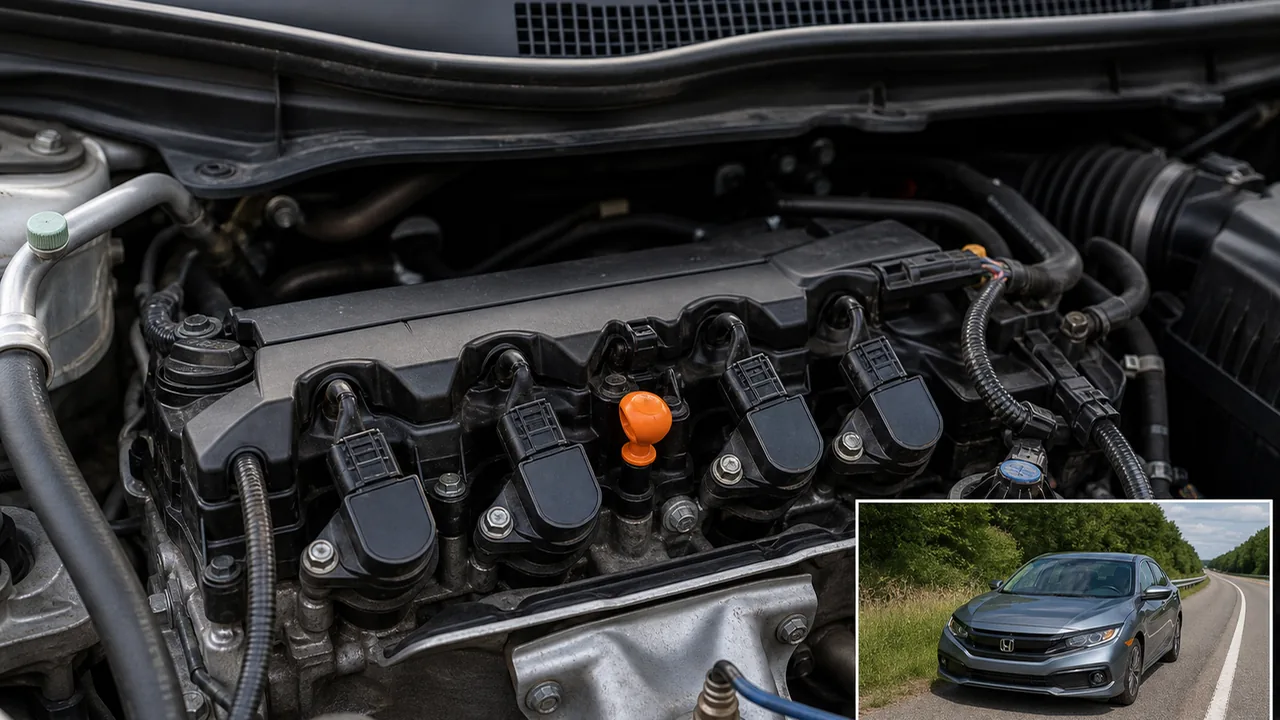
Limit driving if the stall is repeated, unpredictable, or followed by a hard restart. A steady check engine light is not automatically safe when the engine is shutting off.
- Do not continue driving if the Civic stalls at intersections, in traffic, while merging, or while turning.
- Do not keep cycling the starter if the engine will not restart reliably.
- Do not road test the vehicle to reproduce the fault if there is no safe place to do it.
- Use towing or mobile diagnosis if the car stalls repeatedly or the light flashes.
- Keep the symptom notes and scan data with the vehicle for the next diagnostic step.
FAQ
Should I replace the part named by the check engine code?
Not automatically. The code points to a circuit, system, or condition that needs testing, but wiring, air leaks, fuel delivery, voltage, or another related fault can trigger the same code.
Can an EVAP problem make a Civic stall?
EVAP purge behavior can contribute to rough running or stalling in some situations, especially around refueling, but EVAP leak codes alone do not prove the stalling cause.
Is a steady check engine light safe if the car stalls?
Not always. A steady light may be less urgent than a flashing light, but repeated stalling, hard restart, or shutdown in traffic makes the vehicle unsafe to keep driving normally.
What should I bring to a diagnostic inspection?
Bring the stored and pending codes, freeze-frame data, mileage, engine size if known, stall pattern, restart behavior, and any recent maintenance or repair history.
Comments
Be the first to add a practical repair note or follow-up question.