
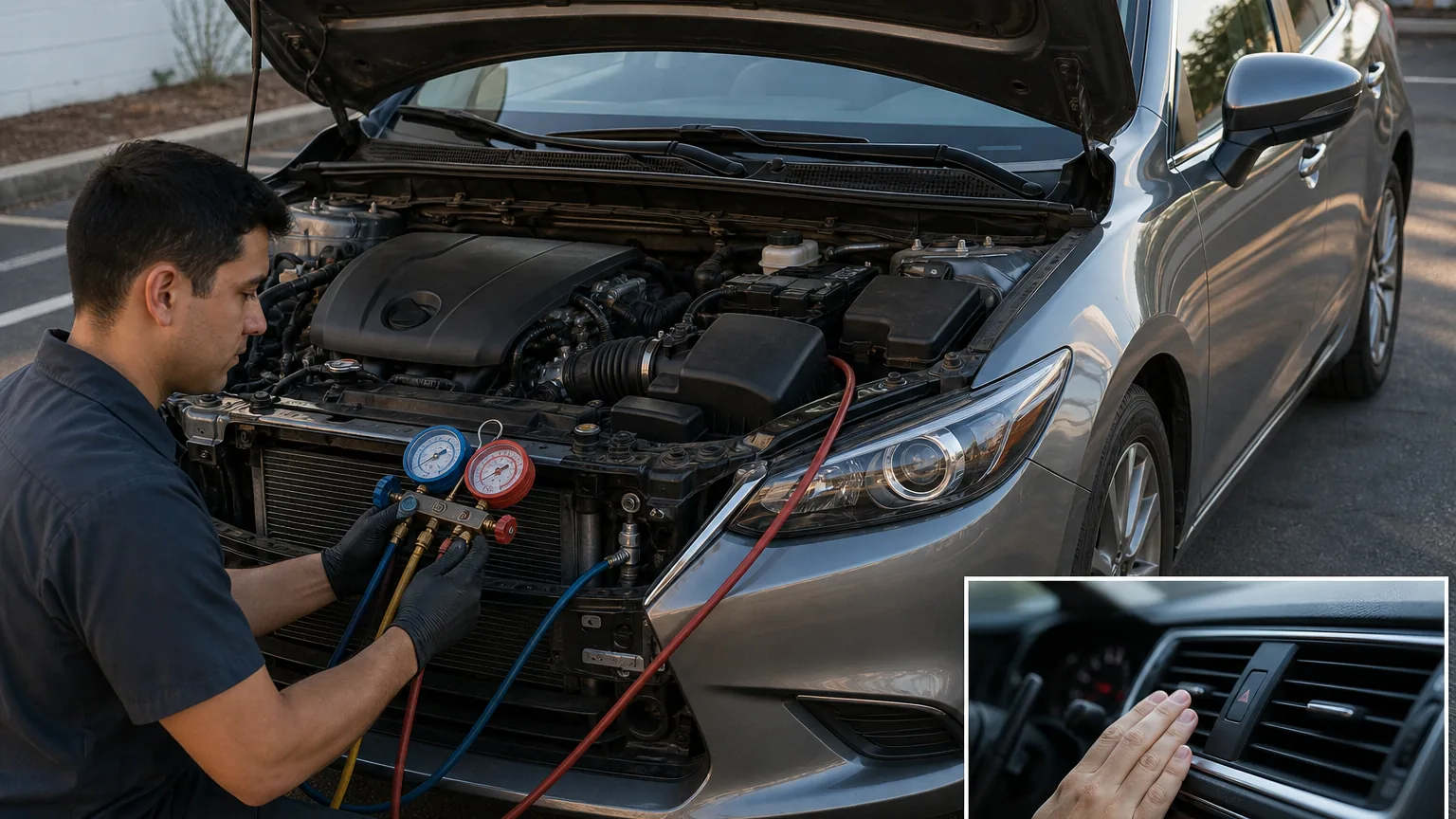
What this part does
A vehicle AC system depends on airflow across the condenser before the refrigerant can return to the evaporator and absorb cabin heat again. When the vehicle is moving, road airflow can cover for a weak fan, dirty condenser, or marginal pressure-control problem.
At a stoplight, the condenser loses that natural airflow. If the fan is slow, off, blocked, or not commanded correctly, refrigerant pressure and temperature behavior can drift out of the range where the cabin vents feel cold.
Common failure signs
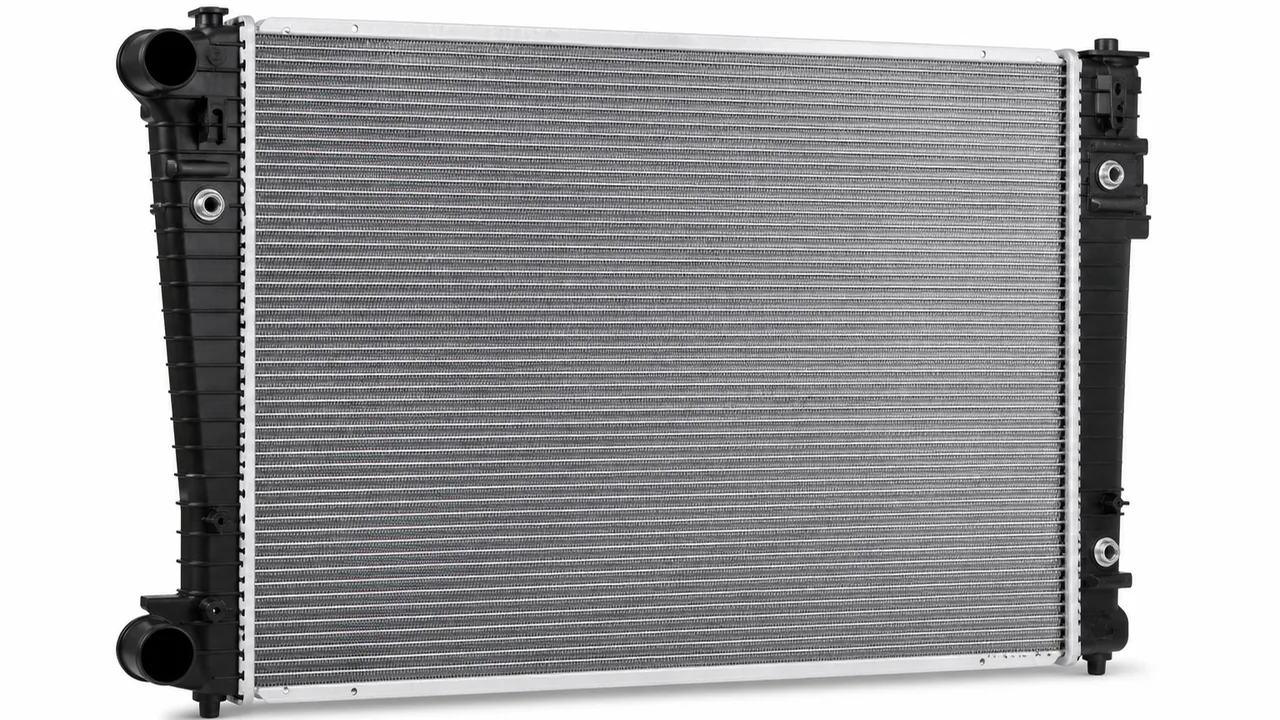
- Cooling fan or condenser fan not moving enough air with AC requested at idle.
- Low refrigerant charge or a refrigerant leak causing weak cooling that is most obvious at low airflow.
- Compressor clutch, variable compressor control, relay, module, or command issue.
- Dirty, blocked, bent, or internally restricted condenser reducing heat rejection.
- Overcharge, air in the system, or pressure sensor fault causing poor control decisions.
- Cabin air restriction or blend door fault that feels like AC loss but is not a refrigerant-side problem.
Replacement should follow confirmation. A non-running fan may be the visible fault, but some vehicles use variable fan strategies, modules, and pressure inputs that must be checked against vehicle-specific service information.
| Fan does not run with AC requested at idle | Cooling fan circuit test and fan/module diagnosis |
| Cooling is weak at all speeds or gradually worse | Leak inspection, recovery, evacuation, and correct recharge verification |
| Fan works and charge is verified but cooling still drops | Compressor control, clutch, sensor, and pressure-side diagnosis |
| Vent airflow is weak before temperature is judged | Cabin filter, blower, duct, or blend door inspection |
For a repair-shop conversation, describe the pattern plainly: cold while driving, warm at idle, whether the fan runs, and whether engine temperature rises. Ask which test will confirm the failed function before any major part is replaced.
- Schedule service soon if the AC warms only at idle but engine temperature stays normal.
- Prioritize fan diagnosis if the fan does not run with AC requested at idle.
- Stop driving and inspect if the engine temperature warning appears or the gauge rises abnormally.
- Stop using AC if there is smoke, burning odor, belt noise, or harsh compressor noise.
- Avoid repeated recharge attempts when the system likely has a leak.
The practical risk frame is simple: comfort-only symptoms can be scheduled, but overheating, electrical smell, severe noise, or visible damage should be treated as urgent because the fault may involve engine cooling or compressor protection.
Before replacing it
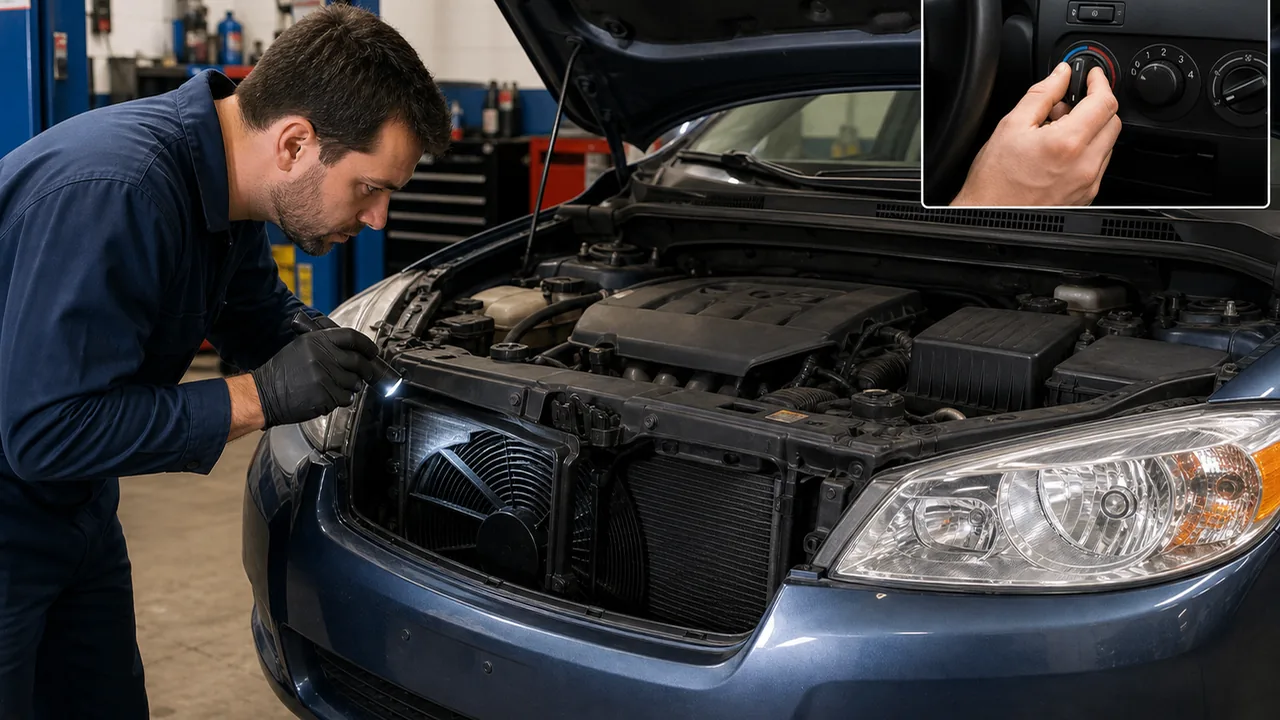
- Fan check: stand clear of moving parts and confirm whether the fan cycles or runs when AC is selected.
- Debris check: inspect the condenser face from outside the vehicle; do not use aggressive tools that can fold fins.
- Cabin airflow check: compare vent airflow on different blower settings and consider cabin filter restriction.
- Pattern notes: record whether the problem happens only in traffic, only after heat soak, or at all speeds.
Do not add refrigerant repeatedly as a guess. A low system has a leak path, and an overfilled or contaminated system can create new performance and compressor risks.
Inspection steps
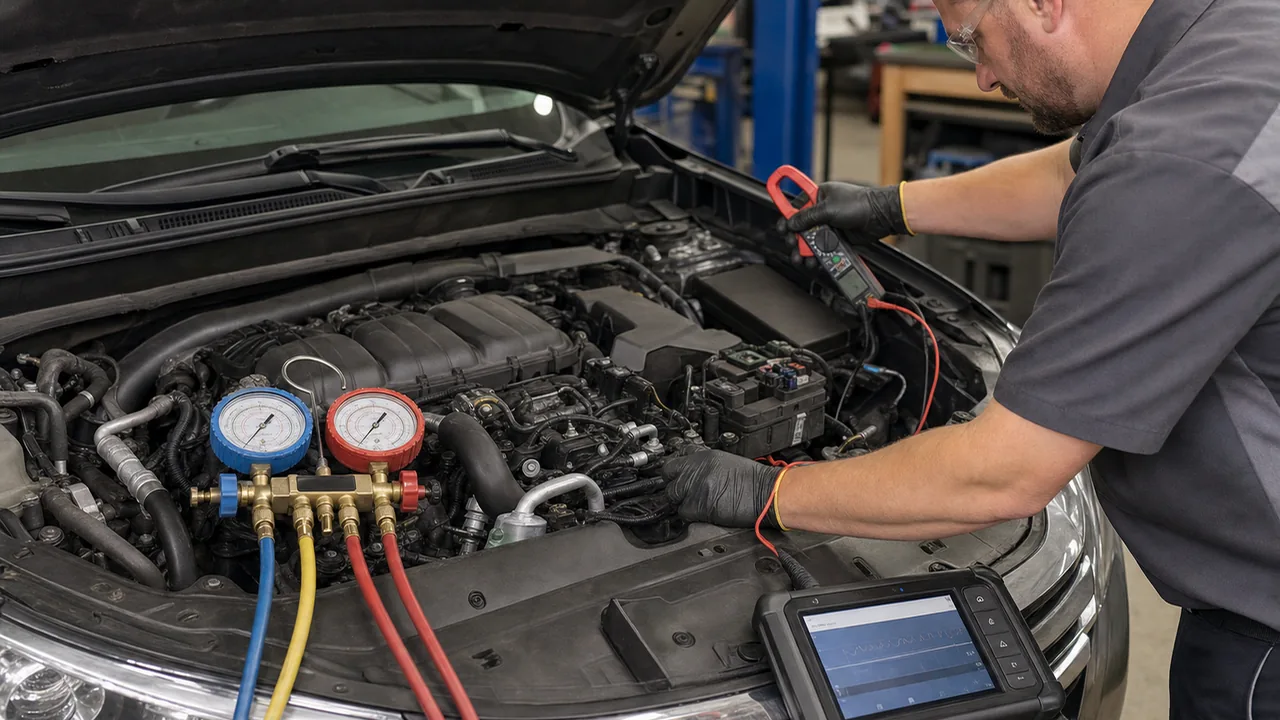
- Confirm the exact idle-versus-driving pattern.
- Check fan operation and condenser airflow before condemning the compressor.
- Read relevant scan data and DTC categories.
- Verify refrigerant charge by proper recovery and recharge procedures when needed.
- Leak test before adding refrigerant as a repair.
- Evaluate compressor command, clutch, control valve, wiring, and pressure inputs.
Pressure readings are useful only when interpreted with ambient conditions, vehicle design, fan command, and service information. Exact pressure targets, fan thresholds, and compressor electrical values are vehicle-specific and should not be guessed.
- Fan control codes may indicate command, relay, module, motor, wiring, or feedback faults.
- AC pressure sensor codes may indicate sensor, wiring, connector, refrigerant-side, or control logic problems.
- Compressor command or clutch codes may show that the module is blocking or losing compressor engagement.
- HVAC control codes may involve blend doors, temperature doors, in-car sensors, or control head inputs.
- Engine cooling codes matter because an overheating strategy may limit AC operation.
Code definitions vary by make, model, year, and powertrain. Use DTCs as direction, not as a parts list, and confirm any code-driven repair with wiring checks, scan data, and service information.
A used fan assembly may be reasonable if it matches the connector, shroud, control style, and mounting points. Used compressors and condensers are higher risk because internal contamination and moisture exposure are harder to see.
If a compressor failed internally, the repair may require contamination checks and related component service. Installing another compressor without correcting debris or restriction risks another failure.
FAQ
Why does my AC work while driving but not at idle?
It usually points to poor condenser heat rejection at low speed. A weak or non-working fan, blocked condenser, incorrect refrigerant charge, or compressor-control issue can all improve temporarily when road speed adds airflow.
Can a bad cooling fan make AC blow warm at idle?
Yes. If the condenser fan or radiator fan is not moving enough air when the AC is on, the system may cool poorly at idle and feel colder again once the vehicle is moving.
Can low refrigerant cause warm air only at idle?
It can. Low charge can make cooling weak in multiple conditions, and the symptom may be most noticeable at idle. The correct fix is leak diagnosis and proper recharge verification, not repeated top-offs.
Does warm air at idle mean the compressor is bad?
Not by itself. Compressor faults are possible, but fan operation, condenser airflow, refrigerant charge, leak status, pressure inputs, and command signals should be checked first.
Comments
Be the first to add a practical repair note or follow-up question.