
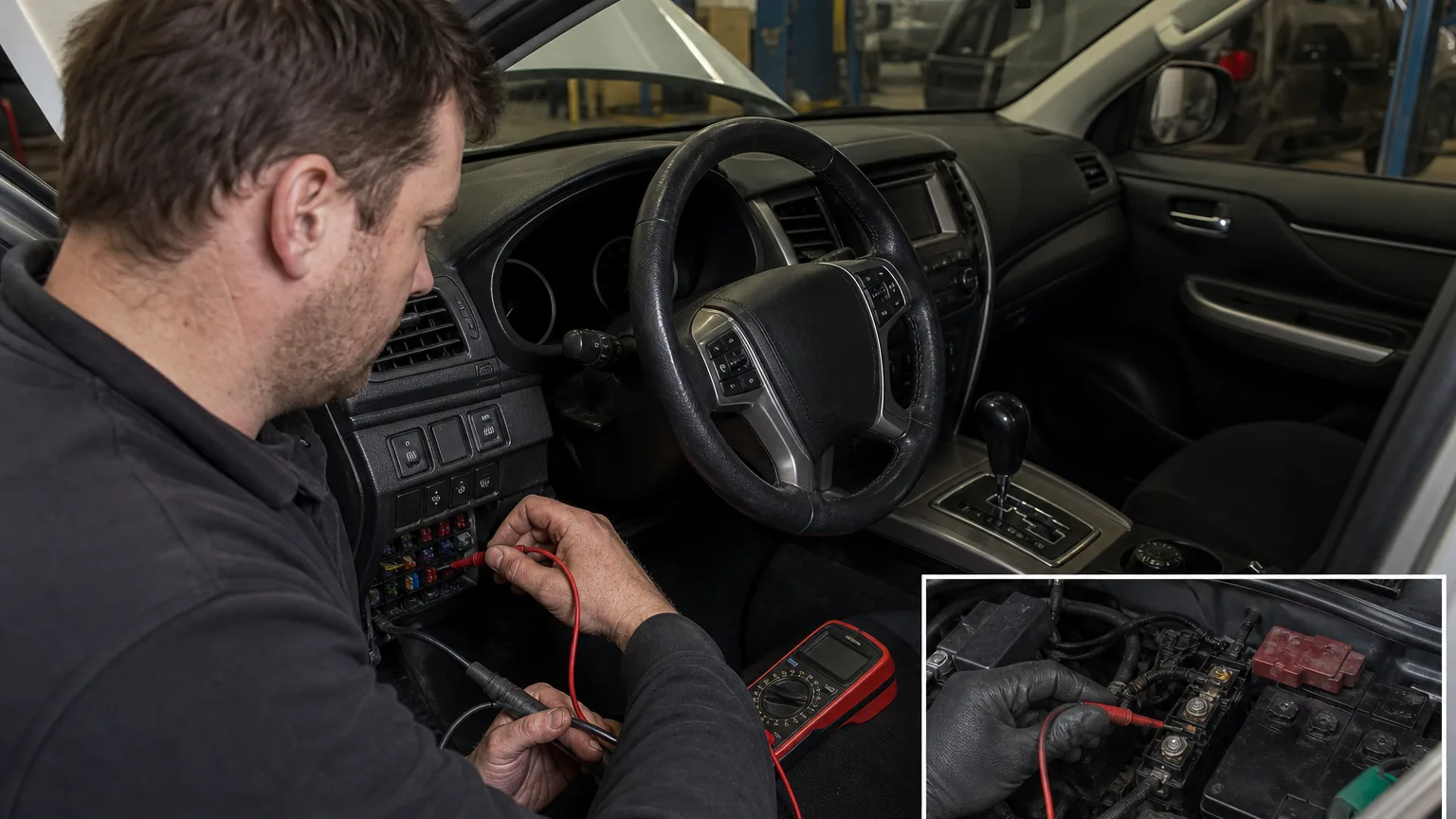
Common failure signs
A 2017 Mitsubishi L200 with dead gauges and a locked transmission usually points to a serious shared electrical or communication fault first, not an automatic transmission failure by default. The first checks are battery voltage, main power feeds, grounds, fuses, relays, scan-tool communication, and CAN network status because one supply or network problem can affect the cluster and transmission controls at the same time.
Do not continue driving if the speedometer, gear indication, warning lights, or transmission behavior is unreliable.
What This Symptom Usually Means
When the gauges, warning lamps, and shifting behavior fail together, the fault path is often upstream of any single component. A weak power feed, poor ground, blown fuse, sticking relay, or network communication fault can leave multiple modules offline or force the transmission into a protective mode. Start with owner-safe checks for terminal security, obvious fuse issues, recent jump-start history, or water ingress, then move to a full-system scan, confirm which modules communicate, review DTCs as direction rather than proof, check CAN network integrity, and only then continue to component-level testing.
Dead gauges and a locked transmission on a 2017 Mitsubishi L200 should be treated as a shared electrical, power supply, ground, or communication problem until testing proves otherwise. Before any deeper diagnosis, do not drive normally if the speedometer, warning lights, gear display, or shifting behavior is not reliable.
- Check the battery terminals for looseness, heavy corrosion, cracked clamps, or poor contact at the posts.
- Think about recent history: a weak battery, hard starting, dim lights, charging warnings, or a recent jump-start can point the diagnosis back to power supply problems. If reverse polarity is even suspected, escalate carefully.
- Inspect only accessible fuses visually. Look for obvious damage, heat marks, or melted plastic, but do not bypass a fuse or substitute improvised protection.
- Look for water intrusion around the cabin, fuse areas, and visible connectors. Damp carpets, corrosion, or symptoms that started after rain or washing matter.
- Note any aftermarket alarm, radio, tracker, tow wiring, lighting, or accessory installation that may affect shared feeds or network wiring.
- At key-on, watch what wakes up and what does not: cluster sweep or no response, warning lamps, starter behavior, gear display, windows, and exterior lighting.
If multiple systems fail together, fuses blow again, water damage is visible, or the transmission remains stuck, stop at these owner-safe checks and move to full technician-level testing.
Dead gauges and a locked transmission on a 2017 Mitsubishi L200 should be treated as a shared electrical, power supply, ground, or communication problem until testing proves otherwise.
Do not drive normally if the speedometer, warning lights, gear display, or shifting behavior is not reliable.
The stronger electrical or network pattern is when several unrelated systems fail together. If the instrument cluster is blank or missing data, multiple modules will not communicate, U-codes or voltage-related faults appear across systems, fuses fail repeatedly, water intrusion is present, or the behavior changes from one key cycle to the next, the fault direction stays with shared power, ground, relay, wiring, or CAN bus integrity.
A transmission-specific direction becomes more credible only after those shared checks pass. If the cluster and other modules communicate normally, powers and grounds test correctly under load, CAN health is confirmed, and scan data keeps pointing to transmission inputs or internal behavior, then the problem may be inside the transmission control path rather than the wider vehicle network.
Internal transmission faults should be considered only after shared electrical causes are ruled out, and any exact part decision should follow OEM service information and confirmed test results.
Dead gauges and a locked transmission on a 2017 Mitsubishi L200 should be treated as a shared electrical, power supply, ground, or communication problem until testing proves otherwise. Do not drive normally if the speedometer, warning lights, gear display, or shifting behavior is not reliable.
- Book professional diagnostics early if a full-system scan shows multiple modules offline, because that shifts the fault path toward shared power, ground, fuse, relay, or CAN bus issues rather than a single failed part.
- Escalate immediately if fuses keep blowing, there is signs of water ingress, the transmission remains stuck or locked, or the vehicle has no dependable speed display. Those conditions raise safety risk and can hide deeper wiring or module damage.
- Use scan-tool communication status, stored DTCs, freeze-frame data, and live data together. U-codes, voltage faults, and transmission-related codes can point the direction, but they are not part-replacement proof by themselves.
- Confirm powers and grounds under load before condemning the cluster, TCM, ECU, or transmission. Proper diagnosis may require wiring diagrams, OEM service information, relay and feed tracing, load testing, and network testing.
- If the early checks do not expose a simple battery, fuse, or connection problem, the next sensible step is a dedicated car electrical diagnostic service that can verify module communication and follow the correct service-manual chart safely.
Before replacing it
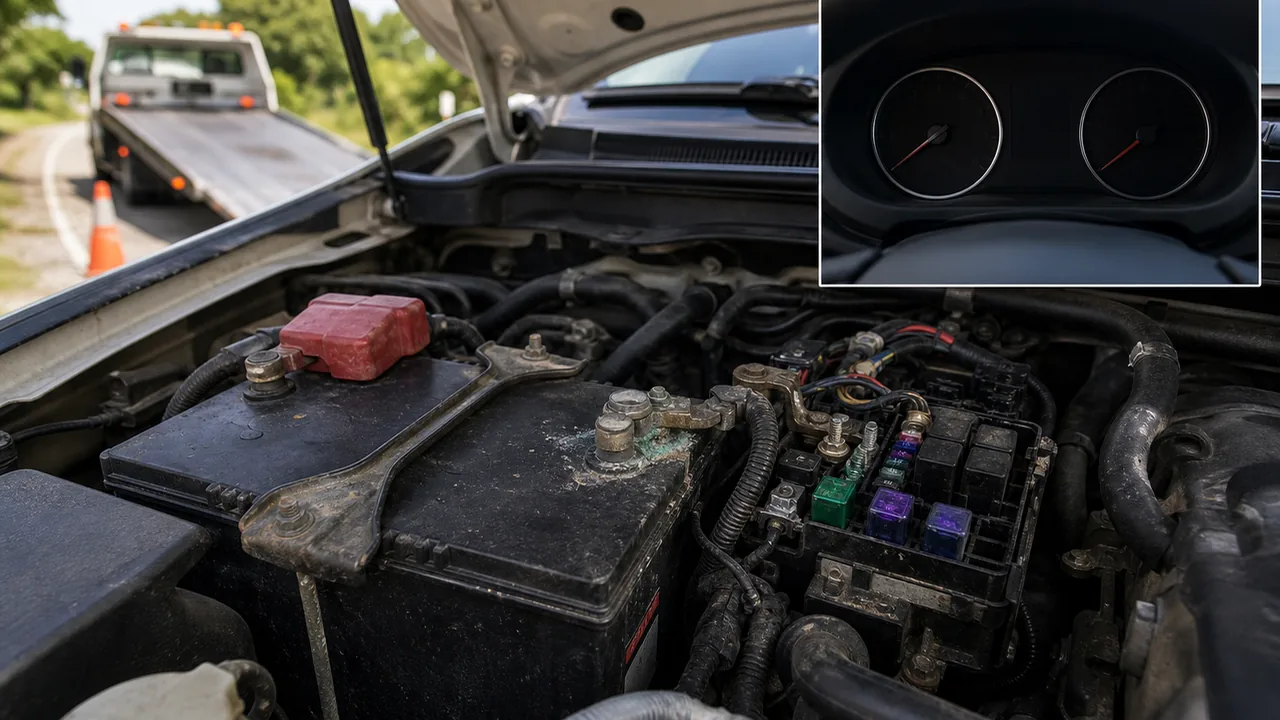
Dead gauges and a locked transmission on a 2017 Mitsubishi L200 should be treated as a shared electrical, power supply, ground, or communication problem until testing proves otherwise. Before any deeper diagnosis, treat this as a safety issue rather than just an inconvenience.
Do not drive normally if the speedometer, warning lights, gear display, or shifting behavior is not reliable. If the cluster is dark or the transmission is stuck, unpredictable, or in fail-safe behavior, towing is the safer choice. Missing warning lamps can also hide overheating, charging, brake, or engine faults that would normally tell you to stop.
- Stop driving and tow the vehicle if it is stuck in one gear, will not come out of park, or shifts unpredictably.
- Stop driving if the speed display is dead or clearly unreliable.
- Stop driving immediately if warning lights disappear along with new drivability symptoms.
- Stop and seek a mechanic if smoke, burning smell, or worsening electrical behavior appears.
- Stop and seek a mechanic if the engine begins overheating or charging behavior seems abnormal.
- Stop and seek a mechanic if fluid loss is visible or new leaks appear under the vehicle.
If symptoms stay unchanged and the vehicle only needs to be moved a short distance for safety, do so cautiously only if basic control is intact; otherwise, do not drive it.
Inspection steps
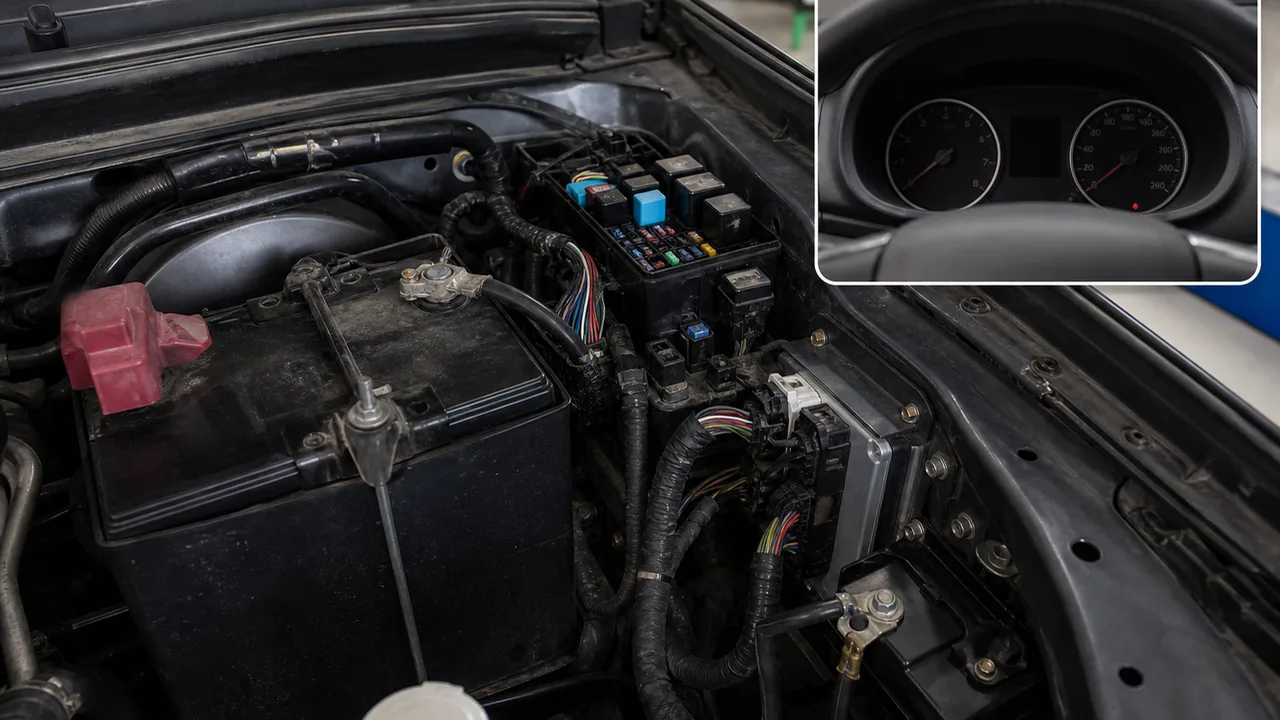
Dead gauges and a locked transmission on a 2017 Mitsubishi L200 should be treated as a shared electrical, power supply, ground, or communication problem until testing proves otherwise. Do not drive normally if the speedometer, warning lights, gear display, or shifting behavior is not reliable. The first practical step is to check for a broader electrical problem and plan a full-system scan before blaming the transmission itself.
In plain language, the instrument cluster is not just a set of gauges. It is also part of the vehicle's information network, showing data that other modules send and, in some systems, helping confirm that those messages are present. The ECU, TCM, BCM, immobilizer, ABS module, and cluster can all depend on shared power feeds, grounds, ignition supply, and CAN bus messages. If that shared path fails, the cluster can go dead while the transmission loses the data or permissions it needs, which can trigger fail-safe operation, limp behavior, a gear lock, or shift inhibition.
- A dead cluster does not prove the cluster itself has failed.
- A transmission stuck in fail-safe does not automatically mean internal transmission damage.
- Lost communication between modules can create both symptoms at the same time.
- The diagnostic goal is to find what power, ground, or network link those systems share.
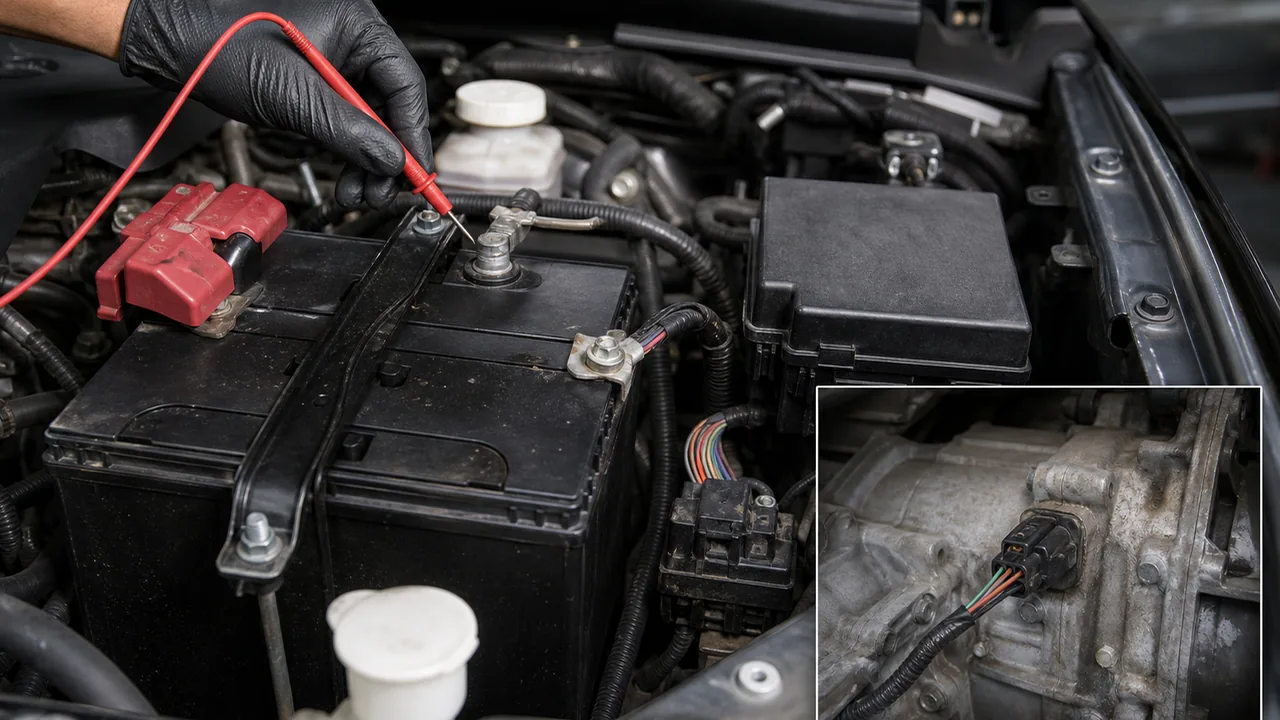
Dead gauges and a locked transmission on a 2017 Mitsubishi L200 should be treated as a shared electrical, power supply, ground, or communication problem until testing proves otherwise.
Do not drive normally if the speedometer, warning lights, gear display, or shifting behavior is not reliable.
- Battery or charging voltage issue. Low system voltage can make the instrument cluster, transmission control, and other modules drop out together, especially after a weak battery, poor charging, or a recent jump-start event.
- Blown main fuse or fusible link. A fuse can look normal but still have no feed or fail under load, so power must be verified with proper testing rather than by sight alone. If the same fuse fails again, suspect a deeper circuit fault instead of replacing fuses repeatedly.
- Poor ground connection. A weak body, engine, or module ground can create multiple unrelated-looking faults at once, including dead gauges, warning lamps, and fail-safe shifting.
- Ignition feed or relay fault. If key-on power does not consistently reach the cluster, control modules, or transmission electronics, the vehicle may show a dead dash and a locked or limp transmission.
- CAN bus communication fault. If one module shorts the network or loses proper power or ground, the cluster, ECU, TCM, BCM, ABS, or immobilizer may stop sharing data and trigger broad system symptoms.
- Instrument cluster power or communication fault. The cluster may be the visible failure point, but it still needs power, ground, and network checks before it is blamed as the root cause.
- ECU, TCM, BCM, or immobilizer issue. Module faults or lost communication can disable normal gear control, but Diagnostic Trouble Codes should guide testing rather than be treated as automatic part-replacement proof.
- Transmission range or speed input fault. If the control system cannot confirm selector position or vehicle speed, it may command fail-safe behavior even when the transmission hardware is not the primary problem.
- Internal transmission fault. This moves lower on the list and should be considered only after shared electrical, power, ground, and communication faults have been properly ruled out.
Dead gauges and a locked transmission on a 2017 Mitsubishi L200 should be treated as a shared electrical, power supply, ground, or communication problem until testing proves otherwise.
Do not drive normally if the speedometer, warning lights, gear display, or shifting behavior is not reliable.
- Start with battery condition and charging-system performance using appropriate test equipment, because unstable supply voltage can disable multiple modules and distort every later test.
- Check main fuses, fusible links, ignition feeds, and key relays with voltage testing under load, not by visual inspection alone.
- Load-test major engine, body, and module grounds, since a poor ground can create cluster faults, lost communication, and transmission fail-safe symptoms at the same time.
- Run a full-system scan and record all modules, not just engine codes, then note which controllers respond, which are offline, and whether the pattern points to a shared network or power branch.
- Read DTCs as direction only. U-codes, low-voltage codes, and lost-communication faults should move the diagnosis toward supply or CAN integrity before part replacement.
- Verify communication behavior on the CAN network with proper tools and OEM procedures before condemning the instrument cluster, TCM, or another control unit.
- If the early checks pass, confirm cluster power, ground, and communication feeds, then verify transmission range, sensor, power, ground, and control inputs with wiring diagrams and live data before blaming the transmission itself.
Dead gauges and a locked transmission on a 2017 Mitsubishi L200 should be treated as a shared electrical, power supply, ground, or communication problem until testing proves otherwise. Do not drive normally if the speedometer, warning lights, gear display, or shifting behavior is not reliable.
DTCs should change the diagnostic direction, not trigger automatic parts replacement. U-codes usually point to a communication path problem on the network, a missing power or ground feed, or a module that has dropped offline; they do not prove the named module has failed. Voltage-related codes can trace back to battery condition, charging problems, fusible links, relays, ignition feed loss, or poor grounds. Transmission range, speed sensor, or related control codes can be primary faults, but they can also appear after unstable power or CAN communication faults.
- Read scan data across all available modules, not just the engine or transmission module.
- Compare which modules are online, which report another module as missing, and whether freeze-frame data shows a shared voltage or communication event.
- Treat every code as evidence to test against wiring diagrams and service information, not as a part-replacement instruction by itself.
Dead gauges and a locked transmission on a 2017 Mitsubishi L200 should be treated as a shared electrical, power supply, ground, or communication problem until testing proves otherwise. Do not drive normally if the speedometer, warning lights, gear display, or shifting behavior is not reliable.
- Do not replace the instrument cluster just because the gauges are dead. First prove that cluster power, ground, ignition feed, and network communication are actually present.
- Do not condemn the ECU, TCM, BCM, immobilizer, or the transmission from one code or one symptom. DTCs guide diagnosis, but they do not prove which module must be replaced.
- Do not bypass fuses, relays, immobilizer circuits, shift-lock functions, or transmission safety logic to force operation. That can hide the real fault and create a safety risk.
- Do not probe CAN, airbag, immobilizer, or high-current circuits without proper training, wiring diagrams, and service information for the 2017 Mitsubishi L200 / Triton.
- Do not rely on forum anecdotes or unverified fuse charts for exact repair steps. Confirm connector identity, circuit purpose, and test method against OEM service data before acting.
If multiple modules are offline, fuses fail again, or communication checks do not make sense, stop parts replacement and move to structured professional diagnosis.
Replacement notes
Dead gauges and a locked transmission on a 2017 Mitsubishi L200 should be treated as a shared electrical, power supply, ground, or communication problem until testing proves otherwise.
Do not drive normally if the speedometer, warning lights, gear display, or shifting behavior is not reliable.
When the instrument cluster and the automatic transmission control system fail together, the fault can sit upstream of the gearbox itself. Shared causes can include battery or charging problems, a blown main fuse or fusible link, poor grounds, an ignition feed or relay fault, instrument cluster power or communication loss, or a CAN bus issue affecting the ECM, TCM, BCM, immobilizer, or ABS module.
That is why transmission replacement is premature before a full-system scan, module communication check, and loaded power and ground testing. Diagnostic Trouble Codes, live data, and OEM wiring information should guide the fault path; they are evidence, not automatic part-replacement instructions.
FAQ
Dead gauges and a locked transmission on a 2017 Mitsubishi L200 should be treated as a shared electrical, power supply, ground, or communication problem until testing proves otherwise.
Do not drive normally if the speedometer, warning lights, gear display, or shifting behavior is not reliable.


Comments
Be the first to add a practical repair note or follow-up question.