
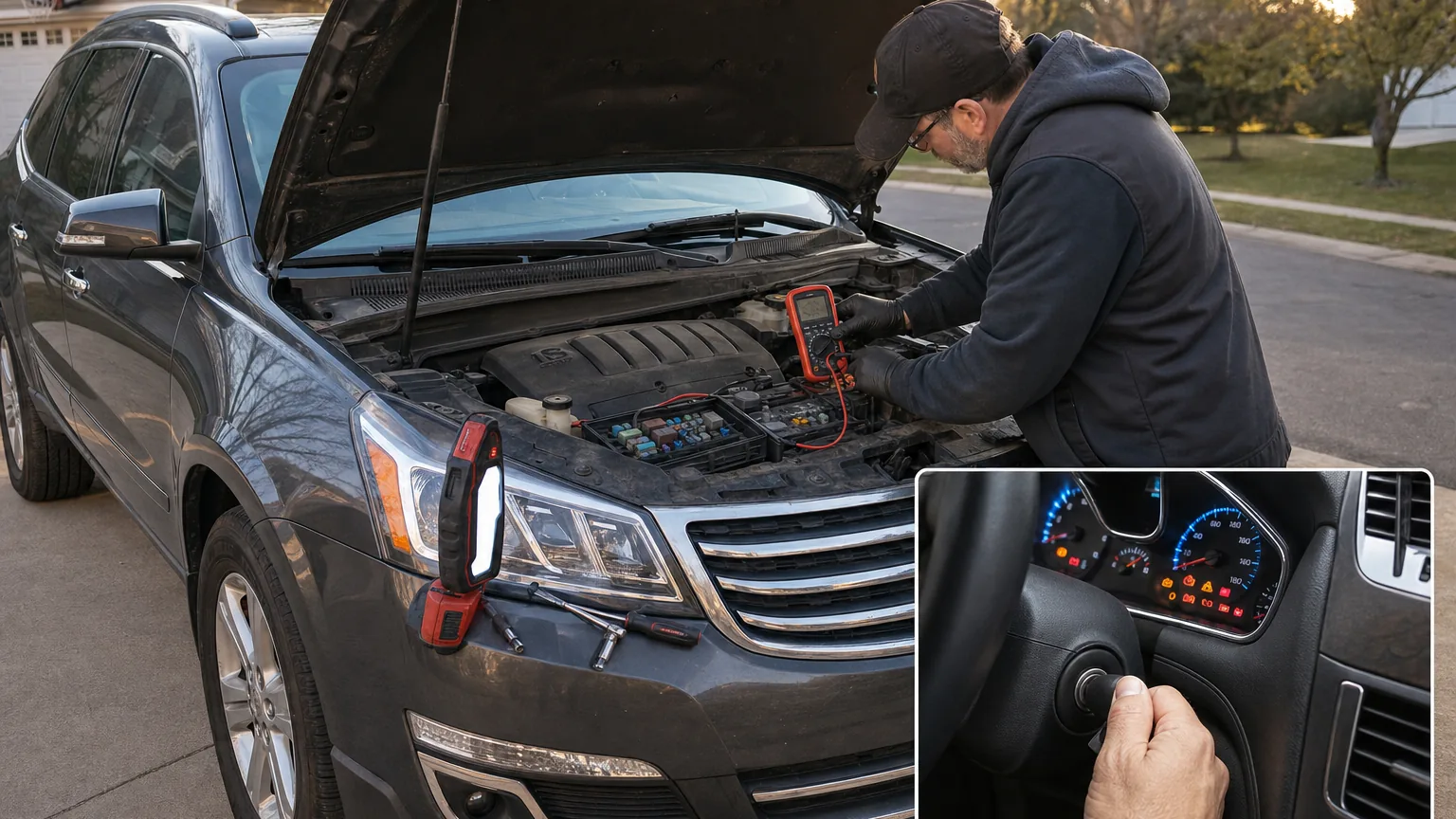
What the symptom usually means
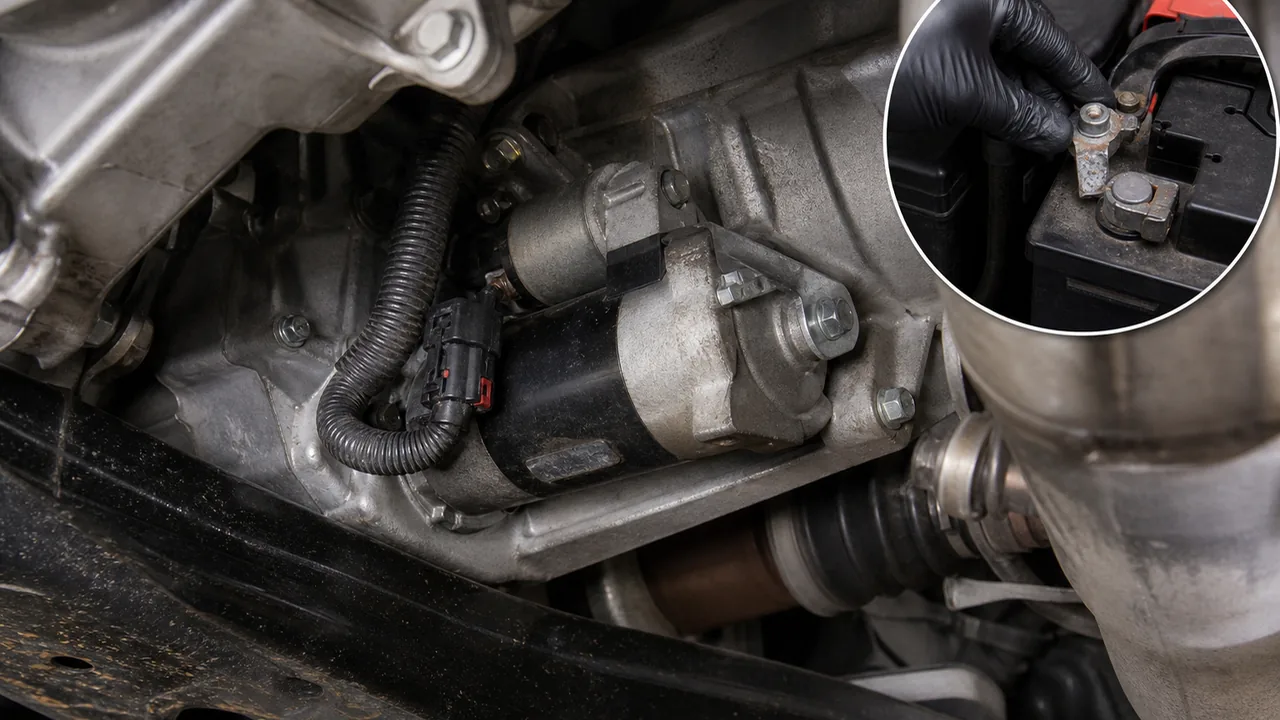
If the lights work but the engine will not crank, the problem is usually in the starting circuit, not the battery alone. On a 2014 Chevrolet Traverse, that can still include a weak battery that has enough power for lights but not enough to turn the starter motor, along with bad battery terminals, a failed starter motor or starter solenoid, a starter relay or starter fuse problem, an ignition or start-command fault, a park/neutral input issue, or a security or control-module fault.
- A weak battery can cause a Chevy Traverse no crank condition even when the dash, radio, or interior lights still work. A common clue is dimming lights, rapid clicking, or a jump-start that changes the symptom.
- Loose, corroded, or damaged battery terminals and cables can block the heavy current the starter motor needs. That can leave you with normal-looking cabin power but little or no starter action.
- A failing starter motor or starter solenoid often shows up as one solid click, intermittent cranking, or complete silence with normal dash power. Repeated key turns may make the problem seem random.
- A starter relay or starter fuse issue can interrupt the start signal before the starter engages. This is a verify-first area, because exact fuse or relay identification should come from reliable service information.
- An ignition switch, push-to-start command path, or park/neutral input problem can prevent cranking if the vehicle does not recognize a valid start request. Sometimes moving the shifter fully into Park, then trying Neutral, changes the symptom.
- A security-system or control-module issue can also block cranking, especially if a warning message or security light appears. In that case, scan data may matter even if no obvious mechanical fault is visible.
Safest first step: stop repeated start attempts, inspect the battery and battery terminals for looseness, corrosion, damage, heat, or sparking, and note whether you hear silence, rapid clicking, or one click. If it still will not crank, arrange proper battery and starting-system testing instead of guessing at parts or probing high-current circuits.
Common causes
If the lights work but the 2014 Chevrolet Traverse will not crank, start by ranking the likely faults in the starting circuit before assuming the starter motor has failed. The usual diagnostic order begins with battery condition and battery terminals, then moves through cable connections, the starter motor or starter solenoid, the starter relay or starter fuse, and the command side of the system.
| Cause | Supporting signs | Signs against it | Next test |
|---|---|---|---|
| Weak battery | Rapid clicking, dimming lights, intermittent starting, improves with a proper jump-start | Strong crank after repeated restarts with no other symptoms | Load-test the battery and confirm terminal condition |
| Loose, corroded, or damaged battery cables | One click or no sound, visible corrosion, heat damage, power present at dash but poor starter response | Clean, tight connections and consistent cranking power | Inspect battery terminals and perform voltage-drop testing |
| Starter motor or starter solenoid fault | Single solid click, normal dash lights, no engine rotation, repeated no-crank with good battery support | Engine cranks normally once the starter engages every time | Verify starter command first, then test starter operation |
| Starter relay or starter fuse issue | Silence when key is turned, no starter engagement, fault may appear suddenly | Starter operates normally and command reaches the starter | Verify fuse and relay operation with service information |
| Ignition switch or start-command problem | No crank in both Park and Neutral, inconsistent response from key turn | Clear starter engagement when command is present | Check for start-request data and command delivery |
| Park/Neutral range input fault | Starts in Neutral but not Park, or behaves inconsistently with shifter position | No change when shifting carefully between Park and Neutral | Confirm range input with scan data and linkage inspection |
| Security or control module issue | Security message or warning light, no-crank after key recognition problem | No security indications and consistent command signal | Scan for related faults and confirm immobilizer status |
| Wiring fault or rare mechanical problem | Intermittent no-crank, prior electrical damage, burning smell, or all commands present with no result | No evidence of harness damage and normal circuit behavior | Inspect wiring integrity; if needed, verify the engine is free to rotate |
This ranking is by common diagnostic order, not certainty. Owner-safe checks come first: battery terminals, visible cable damage, headlight behavior, and whether the vehicle reacts differently in Neutral. Exact fuse location, relay position, wiring path, and advanced electrical testing should be verified from reliable service data before any repair decision.
Diagnostic order
For a 2014 Chevrolet Traverse no-crank condition, the professional test order starts with battery condition and ends with circuit confirmation at the starter, because normal dash lights do not prove the battery, battery terminals, or cables can support starter load.
- Confirm battery state first. A technician checks whether the battery can hold charge under starting demand, then inspects battery terminals, cable fit, corrosion, and cable damage before blaming the starter motor.
- Check the main power and ground path next. Voltage-drop testing under crank demand, where appropriate, helps show whether resistance in the positive cable or ground side is stealing current even when accessories still work.
- Verify starter-circuit command with service information. Instead of guessing, the technician confirms whether the starter solenoid is being asked to engage when the key is turned to start.
- Test the starter fuse and starter relay logically. The goal is to confirm power feed, ground path, and control-side operation rather than swapping the starter relay or assuming the starter fuse is failed without proof.
- Review scan-tool data before chasing wiring. On a Chevy Traverse no crank complaint, start request status, park or neutral input, theft authorization, and module communication can show why the crank command is missing even when no obvious symptom points there.
- Inspect wiring and connectors last, not first. Once battery, cable, starter fuse, starter relay, and command checks are understood, connector fit, harness damage, or corrosion becomes a more focused inspection instead of a parts-guessing exercise.
If the early checks pass, the next sensible confirmation step is to verify actual starter motor and starter solenoid response against reliable service information before replacing parts.
Sometimes, yes, but not always. On a 2014 Chevrolet Traverse, diagnostic trouble codes can help explain a no-crank when the starting command is being blocked by a control issue, yet simple battery, battery terminals, starter motor, starter solenoid, starter relay, or starter fuse faults may leave little or no useful visible code behind.
- Start by separating a basic power fault from a command-path fault. If the Chevy Traverse no crank symptom still acts the same after the earlier battery and cable checks, do not assume the absence of a warning light means the system is code-free or electrically healthy.
- Scan all available modules, not just the engine computer. A no-crank can involve security, transmission range input, body or power management functions, ignition request logic, or network communication faults that may not turn on the check engine light.
- Read the codes as clues, not instant parts verdicts. A stored communication, theft deterrent, start-enable, or range-related fault can point the technician toward why the starter motor is not being commanded, but it does not automatically prove a failed module.
- If no useful codes are present, keep the diagnosis moving. Many straightforward starting circuit problems, including weak battery performance under load, poor battery terminals, wiring loss, a failed starter relay, a starter fuse issue, or a bad starter solenoid, may not set a clear diagnostic trail.
- Use live scan data when the start command path is uncertain. A technician can verify whether the vehicle is seeing the key start request, correct gear position, and any start-inhibit condition before moving deeper into circuit confirmation.
If the early physical checks pass and scan results are unclear, the next sensible step is technician-level scan-tool confirmation of the start request and inhibit status before guessing at parts.
For a 2014 Chevrolet Traverse no-crank problem, the repair path should follow the confirmed fault, not the last part replaced. If the lights work but the engine will not crank, the issue is often in the starting circuit, and working dash power still does not prove the battery is strong enough under starter load.
Low-risk service path
- Choose battery testing service first if the battery is weak, the headlights dim sharply during a start attempt, or you hear rapid clicking.
- Address obvious battery terminal corrosion or a loose cable connection before buying another battery, starter motor, starter relay, or ignition part.
- Use towing or a mobile service if the Traverse is stranded, repeated attempts are making symptoms worse, or the vehicle is not safe to keep testing.
When deeper diagnosis is the right move
- A single heavy click with no crank can point toward the starter motor or starter solenoid, but replacement makes sense only after command and circuit checks confirm it.
- If symptoms suggest a starter fuse, starter relay, ignition switch, park/neutral input, wiring issue, or control-module problem, use an electrical diagnostic service rather than guessing at parts.
- If the no-crank pattern is intermittent, includes a security warning, or stays unclear after basic checks, scan data and circuit verification matter more than parts swapping.
Practical next step: match the symptom to the service. Book battery testing for weak-battery signs, starter-system diagnosis for a one-click pattern, and full electrical diagnosis for silent no-crank, intermittent starting, or suspected fuse, relay, ignition, or module faults.
Parts that may be involved
A 2014 Chevy that will not crank usually means the starter is not turning the engine, even if the lights, radio, or dash still come on. If the lights work but the engine will not crank, the problem usually points to the starting circuit, not the battery alone. The most common no-crank causes are a weak battery, poor battery connections, starter or solenoid failure, a starter relay or fuse issue, an ignition/start-command fault, a park/neutral input issue, or a security-system interruption. No-crank means the engine does not rotate when you turn the key or press start. That is different from crank-no-start, where the engine spins normally but does not fire. Before testing or calling for service, note whether you hear silence, one click, rapid clicking, or a starter sound that cuts out. Also watch whether the dash lights stay bright, dim heavily, flicker, show a security warning, or behave differently in Park than in Neutral. Avoid repeated crank attempts, keep hands clear of moving parts, and seek professional help if battery cables are hot, damaged, sparking, or if diagnosis requires testing beyond basic visual checks and safe jump-start procedures.
No-crank is different from crank-no-start. If the engine rotates but will not fire, that points to a different path. For this Chevy Traverse no crank symptom, note what happens when you turn the key or press start: whether the dash stays bright, the headlights weaken, you hear one click or repeated clicks, the security light stays on, or it starts only intermittently. That information helps separate weak battery power, poor battery terminals, starter or solenoid failure, a relay or fuse issue, an ignition/start-command fault, a park/neutral input issue, or a security-system interruption.
Avoid repeated crank attempts, keep hands clear of moving parts, and get professional help if battery cables are hot, damaged, or sparking, or if the next step would require testing beyond basic visual checks and standard jump-start safety.
- Confirm the engine does not crank at all, rather than cranking normally and failing to start.
- Watch for silence, one click, rapid clicking, dim lights, normal dash lights, or a security message.
- Note whether the problem changes in park versus neutral or happens only sometimes.
- Record what you observe before testing, jump-starting, or calling for service so the diagnosis starts in the right place.
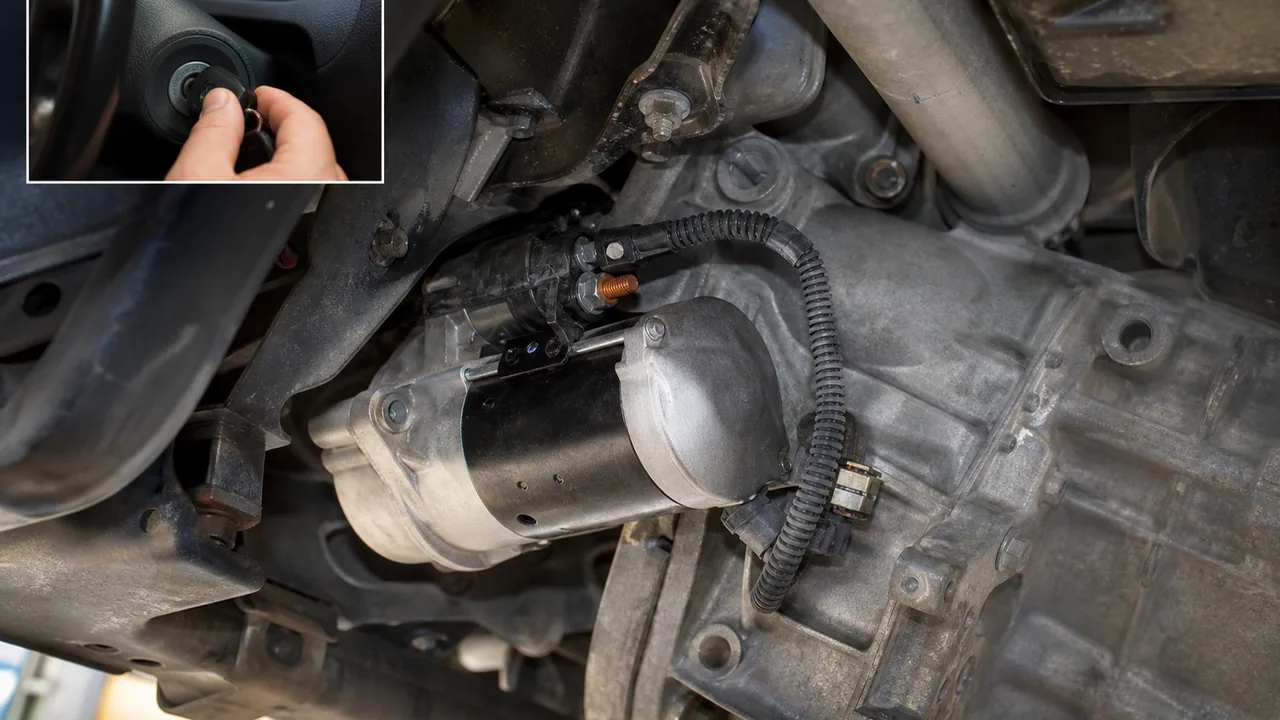
On a 2014 Chevrolet Traverse, a true no-crank problem means the starter is not turning the engine at all. If the lights work but the engine does not rotate, stay focused on the starting circuit first, while remembering that dash power alone does not prove the battery is strong enough under starter load.
This is different from a crank-no-start condition. In a crank-no-start situation, the engine spins normally but will not fire and run. That points you toward fuel, spark, air, timing, or control issues instead of the first layer of Chevy Traverse no crank checks.
What to listen and watch for
- Silence when you turn the key or press start often suggests a start-command, battery connection, park/neutral input, security, relay, fuse, or control-side issue.
- Rapid clicking can fit a weak battery, poor battery terminals, or a bad cable connection that drops power under load.
- One heavy click without engine movement can point toward the starter solenoid, starter motor, or a high-resistance connection.
- Normal, steady cranking means it is not a no-crank problem, so the next tests should follow a crank-no-start path instead.
Before choosing tests or parts, sort the symptom correctly: silence, clicking, one heavy click, or normal cranking. That prevents replacing a starter fuse, starter relay, or starter motor when the real problem is elsewhere.
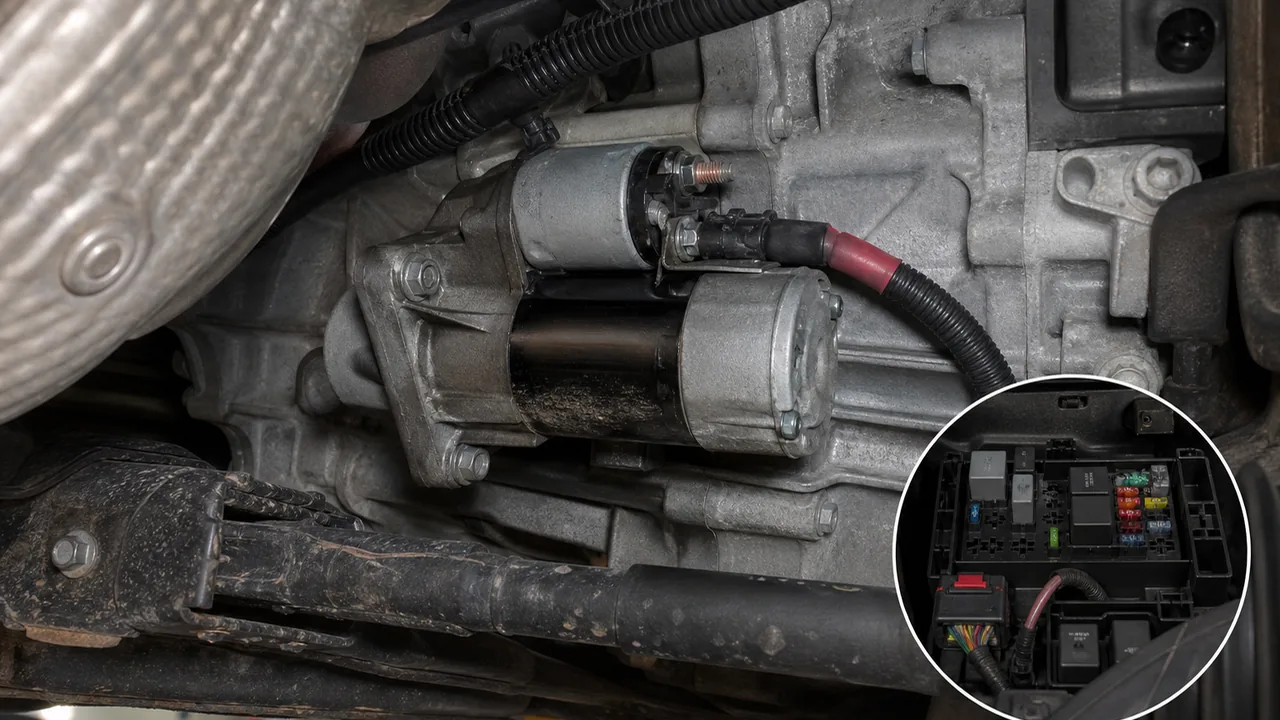
On a 2014 Chevrolet Traverse, the symptom pattern usually tells you more than the working lights do. If the engine will not crank at all, the fault is often in the starting circuit rather than in the battery alone, and that can still include a battery that looks normal until it is asked to crank.
- No sound at all during a start attempt can point to a missing start command, starter relay or starter fuse trouble, a park/neutral input issue, a security-related block, wiring trouble, or severe power loss.
- Rapid clicking usually suggests low available battery power or poor battery terminal or cable connections that cannot carry starter load.
- One solid click often points closer to the starter motor, starter solenoid, a main cable problem, or a voltage-drop issue under load.
- Lights that dim hard when you turn the key raise battery, battery terminals, or cable concerns before you assume the starter motor has failed.
- Normal dash lights do not rule out a weak battery, because accessories need far less power than cranking the engine.
- A security light or warning message increases suspicion around theft-deterrent or control-side faults rather than a simple dead battery.
- An intermittent no-crank pattern can fit heat-related starter trouble, loose connections, relay problems, range input issues, or wiring faults that need testing while the failure is present.
Use these clues to narrow the path, not to guess at parts. Owner-safe next steps are visual battery and cable checks, watching headlight behavior during a start attempt, trying Neutral, and noting any security message. Electrical command testing, relay control checks, fuse verification, and wiring diagnosis are better left to a technician with service data.
A weak battery is still one of the most common reasons a 2014 Chevrolet Traverse will not crank, even when the lights, radio, or dash still work. Those lower-demand accessories can operate with a battery that no longer has enough strength to turn the starter motor, so working power inside the cabin does not rule the battery out.
In a Chevy Traverse no crank situation, battery suspicion rises if the vehicle had slow cranking, hesitant starts, repeated clicking, or an intermittent start pattern before it stopped cranking altogether. A single failed start after sitting, short-trip use, or a recent drain event can also point back to the battery. Even a recently replaced battery should not be assumed good automatically. It may be discharged, defective, connected poorly at the battery terminals, or limited by a cable problem that prevents full starter demand from being met.
- If the headlights look strong at first but drop noticeably when you try to start, the battery or its connections still deserve attention.
- If you hear rapid clicking, battery output or connection quality becomes more likely than a completely silent starter fault.
- If the battery is new but the no-crank symptom remains, inspect for loose terminal clamps, corrosion, or an installation issue before moving on.
The practical next step is battery testing, not guessing. An owner-safe check is to inspect the battery terminals for looseness or corrosion and note what changes when the key is turned to start. A technician can then confirm battery condition under load and separate a weak battery from a cable, starter relay, starter solenoid, or starter motor problem.
Loose, corroded, or damaged battery cables are a common reason a 2014 Chevrolet Traverse has power at the dash but still will not crank. The starter needs much more current than the lights or radio, so a bad connection at the battery terminals or a damaged ground can block starting even when the battery itself is not completely dead.
This is easy to miss after a battery or starter motor replacement because the real fault may be at the cable ends, inside the terminal connection, or under insulation where damage is not obvious. Cable trouble can mimic a weak battery, a bad starter solenoid, or even an intermittent Chevy Traverse no crank complaint that seems to come and go.
- Check for battery terminals that can be moved by hand, heavy corrosion buildup, cracked or swollen insulation, broken hold-downs, or signs of heat at the connection.
- Inspect the ground side as closely as the positive side. A loose or corroded ground path can stop starter current just as effectively as a bad positive cable.
- Treat sparking, melted insulation, or a burned smell as a stop-and-service condition rather than a keep-trying condition.
Owner-safe checking should stay visual. Do not bypass relays, jump high-current terminals, or probe starting-circuit wiring. If the connections look questionable, the safer confirmation step is technician testing.
A technician can confirm cable health with voltage-drop testing and wiring inspection instead of guessing at parts. That matters because replacing the battery, starter relay, or starter fuse will not fix a 2014 Chevrolet Traverse no-crank problem caused by hidden cable resistance or a poor ground connection.
A failed starter motor or starter solenoid is a strong suspect when a 2014 Chevrolet Traverse shows normal dash power but gives one solid click, starts intermittently, or has confirmed start-command activity with no crank. In a Chevy Traverse no crank case, this points deeper into the starting circuit, but it still does not prove the starter is the only fault.
This symptom pattern matters because the starter motor needs both a healthy power feed and a proper command to engage. A weak battery, poor battery terminals, or damaged cables can mimic a bad starter by starving it under load. The same is true if the start signal never reaches the starter solenoid. That is why a recently replaced starter motor does not automatically clear the rest of the circuit.
- One click with no engine movement can fit a failing starter motor or starter solenoid.
- Intermittent starting can happen when internal starter contacts wear or stick.
- Normal lights and radio do not rule out a battery or cable problem under starter load.
- Silence instead of a click may point more toward a command, relay, fuse, or park/neutral issue than the starter itself.
For owners, the safe move is symptom sorting, not parts guessing. If jump-starting does not change the behavior and the battery terminals look clean and tight, starter replacement diagnosis becomes a reasonable service path. A technician should verify battery condition, cable integrity, and starter command before recommending a starter motor or starter solenoid repair.
Avoid replacing the starter motor on a 2014 Chevrolet Traverse until battery, cable, and command checks support it. Exact fuse positions, relay locations, wiring paths, and electrical test values should be verified from reliable service data before final diagnosis.
If a 2014 Chevrolet Traverse has dash power but will not crank, a starter fuse problem, starter relay fault, lost relay control, or another power-feed issue in the starting circuit is a realistic cause. In a Chevy Traverse no crank situation, this fits best when the battery and battery terminals do not show an obvious problem and the starter motor does not engage at all.
This kind of failure can look a lot like a bad starter motor or starter solenoid from the driver seat. You may hear nothing, get a single click, or have an intermittent no-crank pattern that changes from one attempt to the next. The important point is that a working radio, interior lights, or normal dash lights still do not prove the start circuit is delivering what the starter relay and starter motor need.
- Owner-safe check: use the owner manual procedure to inspect only the clearly identified starter fuse or related starting-system fuses for an obvious blown element.
- Verify first before naming a fuse number, relay position, or underhood location for a 2014 Chevrolet Traverse; exact identification should come from the manual or service information.
- If a fuse appears damaged more than once, stop replacing parts blindly and have the circuit diagnosed, because repeated failure can point to a deeper wiring or component problem.
- Do not bypass the starter relay, jump terminals, or probe high-current circuits at home.
Relay control checks, fuse-feed verification, scan-tool review, and wiring integrity testing belong in technician diagnostics. That is the safe way to separate a failed starter relay from a start-command issue or another control-side fault.
If the fuse looks intact and the no-crank symptom remains, the next step is usually to verify whether the starter relay is being commanded correctly or whether the problem is farther upstream in the ignition or start-command path.
A 2014 Chevrolet Traverse can have normal lights and dash power yet stay completely silent if the ignition switch, key-on start input, or another control-side start-command path does not send a usable crank request. In a Chevy Traverse no crank situation, this points to the command side of the starting circuit, not automatically to the battery, starter motor, or key cylinder alone.
Common clues include no crank with accessories working normally, an intermittent response when turning the key, or a pattern where the vehicle starts on one attempt and does nothing on the next. That does not prove the mechanical key cylinder is bad. It can also reflect wear inside the ignition switch, a weak or inconsistent start signal, or a module-side issue that prevents the starter relay from being commanded.
- Owner-safe checks are limited: note whether the dash stays bright, watch for any security warning, and see whether the symptom changes in Park versus Neutral.
- If the engine remains silent with no strong clicking, and battery terminals already look clean and tight, the start-command path becomes a more realistic suspect.
- Avoid guessing at parts or probing high-current circuits based on silence alone.
A technician should verify whether a start request is present in scan data and whether the related control circuit behavior matches that request. That step helps separate an ignition switch or start-command fault from a starter relay issue, park-neutral input problem, wiring fault, or security-related block before any repair decision is made.
A Park/Neutral or transmission range input problem can cause a 2014 Chevrolet Traverse no-crank condition when the vehicle does not recognize that it is safely in Park or Neutral. In that case, the starting circuit may stay blocked even though the dash lights, radio, or other accessories still work.
This branch fits best when the Chevy Traverse no crank symptom changes with shifter position. A silent no-crank in Park that suddenly cranks in Neutral, or starts only after moving the shifter and trying again, points toward a gear-recognition issue rather than a starter motor failure alone.
- Owner-safe check: with the vehicle fully stationary, hold the brake, confirm it is in Park, and try starting it.
- If nothing changes, try Neutral only if the area is safe and the vehicle cannot roll.
- Notice whether the shifter feels loose, inconsistent, or gives an intermittent start pattern after being moved.
Do not treat this as proof that the range switch or related part has failed. On a 2014 Chevrolet Traverse, scan data and guided service testing should confirm whether the control system is seeing the correct gear input before any replacement decision is made. That matters because a similar no-crank pattern can also overlap with a start-command fault, wiring issue, or control-side problem.
Avoid bypassing the starter relay, jumping terminals, or probing transmission-related circuits. If the no-crank symptom changes between Park and Neutral, that is a strong reason to schedule proper starting-system and scan-data diagnosis instead of guessing at parts.
If a 2014 Chevrolet Traverse has power but will not crank, a security-system or module-control issue can block the starter command even when the battery is not the main problem. This matters most when the Chevy Traverse no crank symptom appears with a security message, unusual security light behavior, or an intermittent pattern that does not fit a simple battery or starter motor failure.
In this situation, the theft-deterrent system, body control logic, or another control module may not be allowing a valid start request to reach the starter relay path. The key point is that a visible dashboard light alone does not confirm the full cause. A no-crank condition can come from lost start authorization, a communication problem between modules, or another control-side fault that needs scan data to sort correctly.
- Watch for a security warning, flashing security indicator, or a start attempt that stays completely silent with normal dash power.
- Do not try to defeat, bypass, or jump around the security system.
- If the problem is intermittent, note whether it happens with one key, after locking and unlocking, or after the vehicle sits.
Diagnostic trouble codes can help, but they are only part of the picture. Technician-level scan-tool data, including start-request and immobilizer or authorization status, is often more useful than guessing from symptoms alone. If security or module symptoms are present, professional diagnosis is the safest repair path before replacing parts.
Owner-safe check: look for security messages and pattern changes. Technician check: verify module communication and start authorization with proper scan data rather than bypass testing.
If the lights work but a 2014 Chevrolet Traverse still will not crank after the common battery, battery terminals, starter relay, starter fuse, and start-command causes have been checked, a less common wiring or mechanical fault moves higher on the list. In a Chevy Traverse no crank case, that can include damaged cables, poor grounds, heat-damaged connectors, or a fault in the path between the battery and starter motor.
These problems can mimic a bad starter motor or starter solenoid because the engine stays silent or gives only a single click even though dash power looks normal. A weak engine ground can also limit starter current without making the battery appear completely dead. In rarer cases, severe engine or accessory binding can keep the engine from turning and make the starting system look like the main failure when it is not.
- Look for visible cable damage, loose ground connections, melted insulation, corrosion at hidden connection points, or connectors that appear overheated.
- Treat an intermittent no-crank that changes with vibration, heat, or recent electrical work as a wiring or connector clue, not automatic proof that the starter motor has failed.
- If there is a burning smell, smoke, sparking, unusual heat around cables, or repeated electrical failure, stop trying to crank the vehicle and move it into urgent service territory.
Owner-safe checks here are mainly visual. Exact fuse positions, relay locations, wiring paths, and electrical test values on a 2014 Chevrolet Traverse should be verified from reliable service information before deeper diagnosis or repair.
If a 2014 Chevrolet Traverse has lights but will not crank, start with safe symptom checks before assuming the battery, starter motor, starter relay, or starter fuse has failed. Working dash power does not prove the battery is strong enough under starter load, so the goal here is to sort the pattern without probing high-current parts.
- Confirm the symptom: does the engine stay completely still, give one solid click, make rapid clicking, or crank only sometimes?
- Watch the headlights while someone tries to start it. If they drop sharply or go very weak, that points back toward battery condition or a battery terminal or cable problem.
- Check the dash for warning text or a security light. A start-blocking message matters even if accessories still work.
- Open the hood and look only for obvious issues: loose battery terminals, heavy corrosion, damaged battery cables, or a disconnected ground. Do not touch exposed or damaged wiring.
If the battery connections look questionable, do not guess at hidden wiring faults. Cleanliness, tight contact, and intact cable ends matter more than whether the radio or interior lights still come on. If anything looks burned, swollen, wet with acid, or physically damaged, stop there and arrange service.
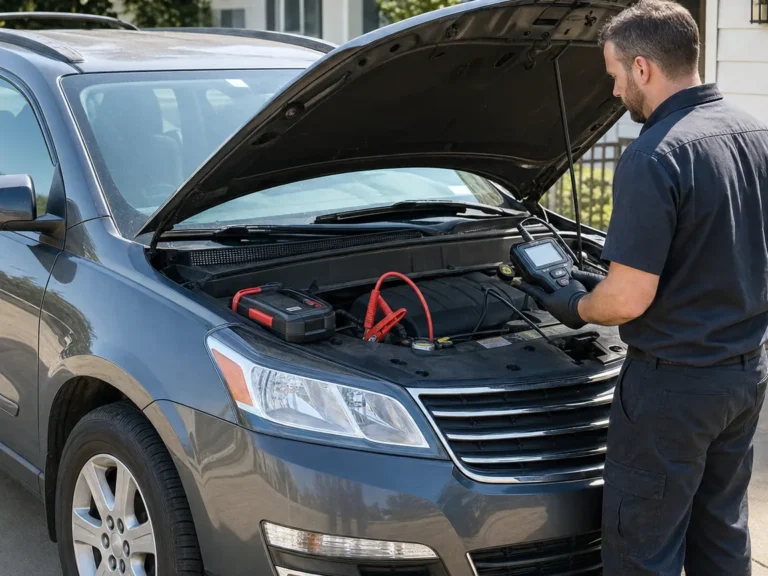
If you use a jump start, follow the owner-manual cautions and use the proper connection points for the vehicle. A jump attempt can help separate a weak battery from a deeper starting-circuit problem, but if the Chevy Traverse no crank condition does not change, the fault may be elsewhere in the starting circuit.
With the brake applied and the vehicle parked safely, try starting in Neutral once. If it behaves differently than it does in Park, that supports a Park/Neutral input issue rather than a simple dead-battery conclusion.
Stop DIY checks and do not keep trying to start it if you see smoke, heat, sparking, acid leakage, badly damaged cables, or anything you are not confident handling safely.
If your 2014 Chevrolet Traverse has lights but will not crank, stop repeated start attempts when the electrical behavior gets worse or anything looks unsafe. A Chevy Traverse no crank problem can move from a weak battery or poor connection into overheated cables, damaged terminals, or starter circuit stress if you keep cycling the key.
Do not keep trying if you hear rapid clicking, the dash lights dim more each time, the starter sound becomes strained, or the response changes abruptly from one attempt to the next. The same applies if you notice heat at the battery area, smoke, a burning smell, visible sparking, damaged battery terminals, split cable insulation, or any sign of acid leakage. Those are stop signs, not signs to keep guessing at the battery, starter motor, starter solenoid, starter relay, or starter fuse.
- Stop and step back if repeated attempts cause faster clicking, heavier dimming, or a harsher electrical sound.
- Do not continue if you see cable damage, corrosion that looks severe, heat, smoke, sparks, or leaking battery acid.
- Request a tow or mobile service if the vehicle is stuck in an unsafe location, cannot be checked safely, or does not respond to a safe jump-start.
- Do not drive the 2014 Chevrolet Traverse until it starts reliably and the no-crank cause is identified.
Owner-safe checks end at basic visual inspection and standard jump-start safety. If the symptom persists or the electrical behavior turns abnormal, the next step is proper starting-system diagnosis rather than more start attempts.
If the lights work but your 2014 Chevrolet Traverse will not crank, the fault is usually in the starting circuit, not proof that the battery is fine. Dash lights, radio, and interior power can still work when the battery, battery terminals, or cable connections cannot support starter load, so the correct fix comes from a tested order instead of guessing at parts.
- Start with owner-safe basics: inspect the battery terminals for looseness, corrosion, damage, or heat signs, and watch whether the lights dim sharply during a start attempt.
- If the battery and cable condition are not clearly confirmed, treat them as suspects first before moving deeper into the Chevy Traverse no crank diagnosis.
- If power delivery checks out, the next likely areas are the starter motor, starter solenoid, starter relay, and starter fuse, followed by the ignition start command and the park/neutral range input.
- If the symptom is intermittent, or if a security light or warning message appears, scan data and module information matter even when no obvious trouble code points straight to the cause.
- Less common mechanical or control-side faults are still possible, but they should be confirmed after the basic starting path is tested in order.
When owner-safe checks do not solve it, professional diagnosis is the safest path. A technician can verify battery performance under load, cable integrity, starter command, relay and fuse operation, and security or control-module data without unsafe bypassing or probing of high-current circuits.
FAQ
If the lights work but your 2014 Chevrolet Traverse will not crank, the fault is often in the starting circuit rather than accessories alone. Working dash lights, radio, or interior lamps do not prove the battery, battery terminals, starter relay, starter fuse, or starter motor are all able to handle starter load, so the next step is symptom-based checking instead of guessing at parts.
Owner-safe checks include looking for loose or damaged battery terminals, watching for dimming lights during a start attempt, trying Neutral if Park does nothing, and noting any security warning. Electrical testing beyond basic inspection should be left to a qualified technician.
Comments
Be the first to add a practical repair note or follow-up question.