
What the symptom usually means
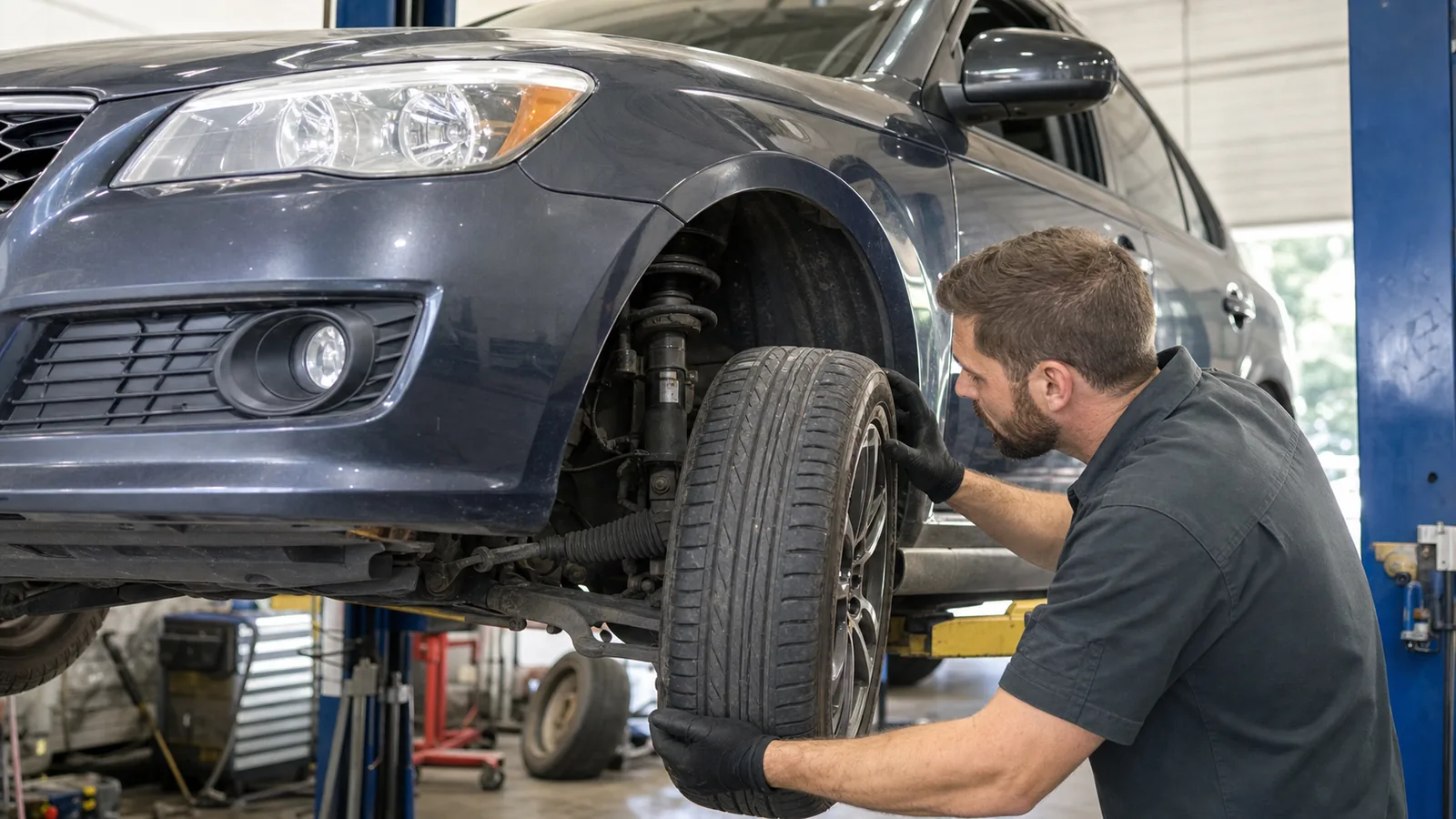
Vibration that appears only within a narrow speed band ofonce road speed rises occurs because the wheel and tire assembly reaches a rotational frequency that magnifies even minor imbalances, creating a resonant shake through the steering column. This characteristic speed window helps separate the issue from constant driveline vibrations or brake-related judder, which typically surfaces during pedal application. Although tire imbalance is the most common cause, ignoring the symptom allows small imbalances to escalate into scalloped tire wear (cupping) and places extra cyclical stress on tie rod ends, ball joints, and wheel bearings. Your first step should be a visual check of each front tire for irregular wear and a verification that all lug nuts are torqued to the manufacturer’s specification.
Common causes
Several mechanical failures can generate steering wheel shake at highway speed, but the vast majority trace back to rotating assembly irregularity or worn steering linkages. Multiple factors often coexist: aged suspension accelerates tire wear, creating a feedback loop.
Quick checks
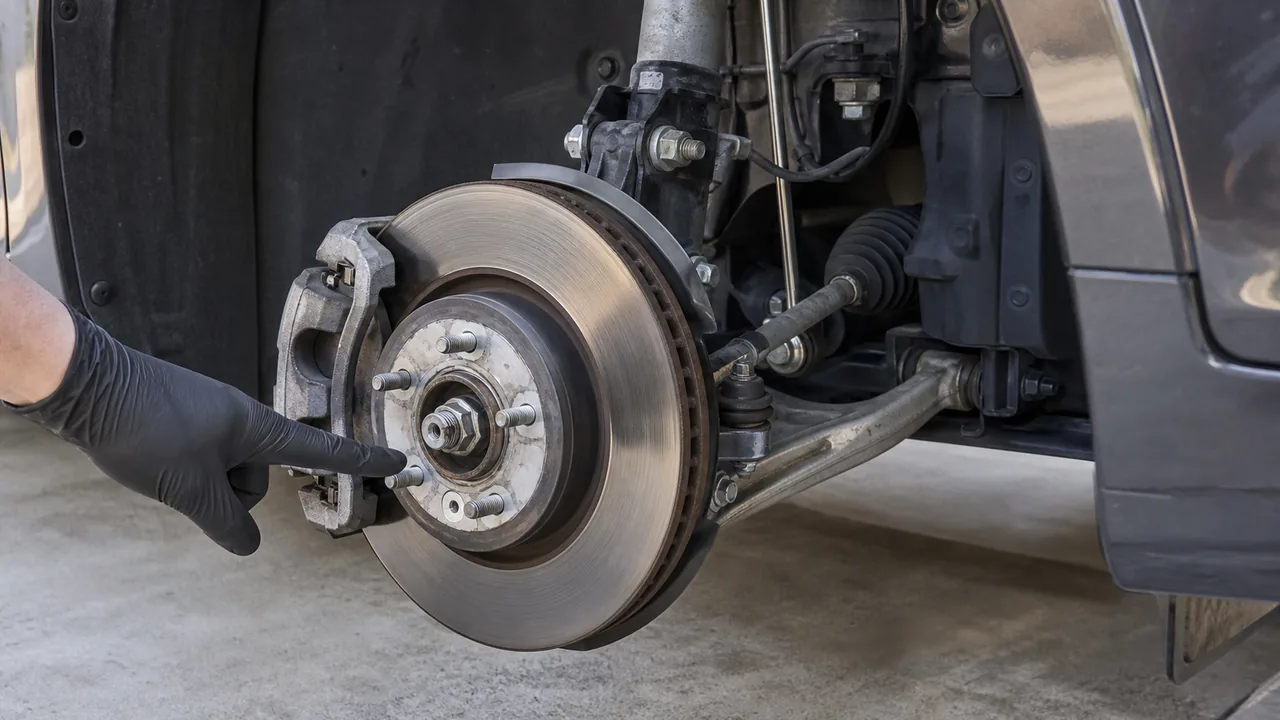
Before booking a service, perform these safe, at-home inspections to narrow the cause. First action: Park on level ground, chock rear wheels, and set the parking brake.
Visual Tire Inspection
- Examine tread blocks for cupping (scalloped dips around the circumference).
- Look for feathering (edges worn smooth on one side, sharp on the other).
- Check for broken or shifted belts (bulges or wavy tread distortion, often accompanied by a thumping noise).
- Ensure all wheel weights are present; missing clip-on weights can cause a single-plane imbalance.
- Verify lug nuts are tight with a torque wrench, not just a breaker bar.
Push-Pull Suspension Test
Safety: Never perform these checks with the engine running or the vehicle supported only by a jack. Use jack stands on level ground, with the wheels chocked.
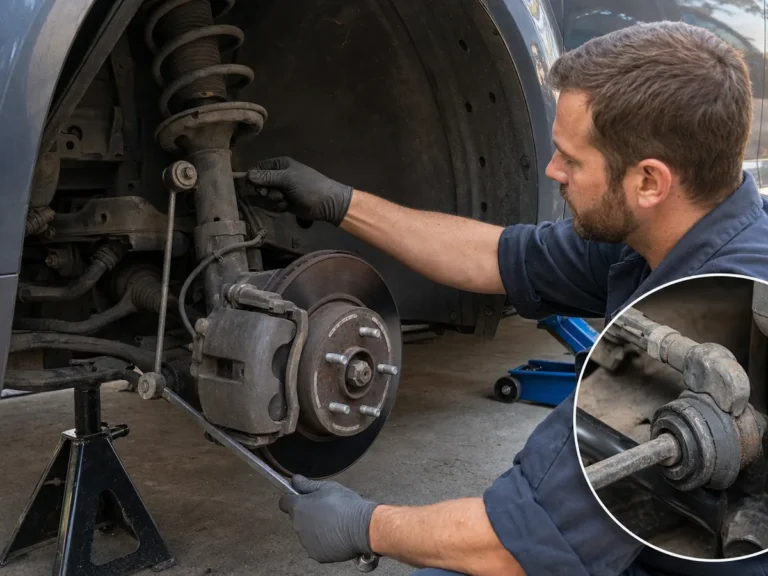
- Raise the front of the vehicle and support it securely on jack stands.
- Grasp the tire at the 9 and 3 o’clock positions and rock it side-to-side. Excessive movement indicates worn tie rod ends or inner sockets.
- Grasp the tire at 12 and 6 o’clock and rock it. Looseness points to a failing ball joint or, if movement is present in both axes when prying behind the wheel, a wheel bearing.
- With the vehicle back on the ground, have an assistant turn the steering wheel slightly while you observe tie rod ends for any clunking or visible play.
If any free play, cupping, or missing weights are found, do not delay: schedule a professional diagnostic inspection to prevent further damage. <a href='/suspension-steering-inspection'>Book a Suspension & Steering System Inspection</a>.
When it is urgent
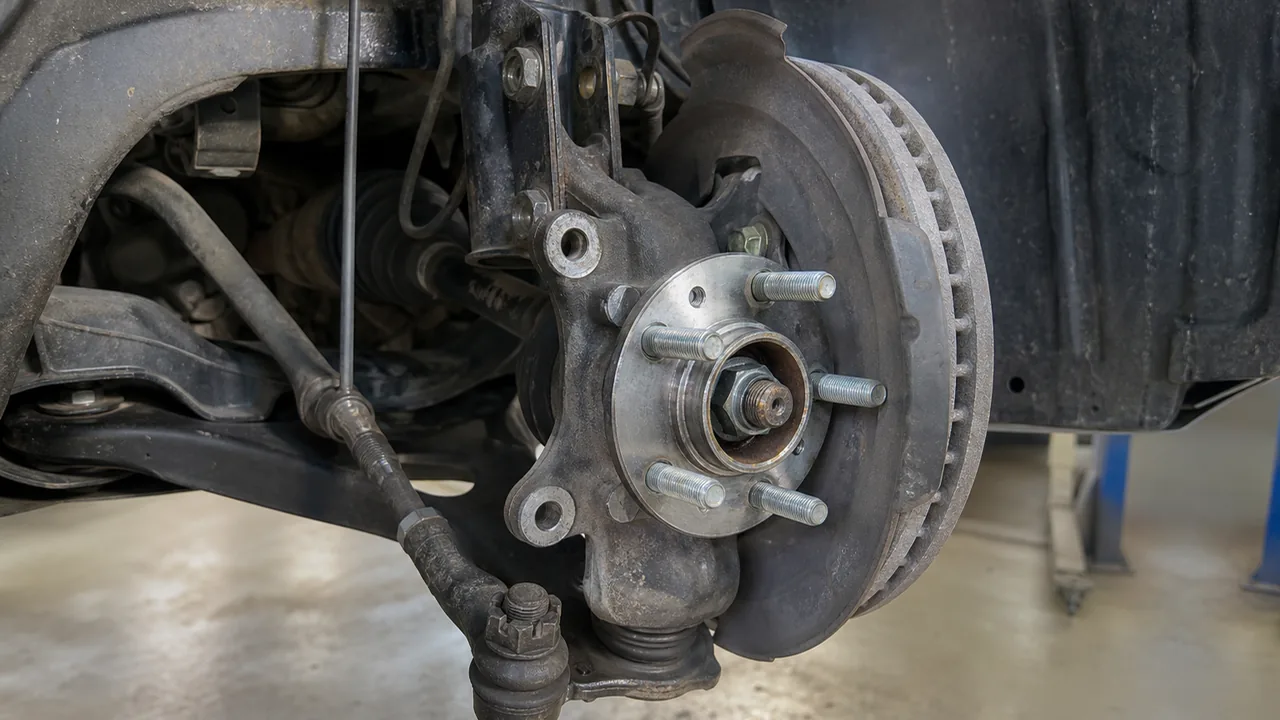
Mild shimmy can often wait until your next service if you keep speeds below the vibration window, but certain signs demand immediate action. If the shake is severe enough to cause the steering wheel to oscillate more than a few degrees, or if it is accompanied by a humming, grinding noise that changes pitch with speed, you may have a failing wheel bearing or damaged belt. Never continue highway travel if you suspect a shifted or broken tire belt; a blowout at speed can be catastrophic. In such cases, reduce speed, pull over when safe, and either have the vehicle towed or drive directly to the nearest tire shop at low speed on secondary roads. Additionally, if the vehicle pulls strongly to one side and the shake worsens under engine load, a failing drivetrain component (CV axle or driveshaft) could be responsible, which requires urgent attention.
If a belt separation is suspected, do not attempt to balance the tire – it will not correct the issue and may mask a dangerous condition.
Diagnostic order
- Set tire pressures to door-jamb specification and perform a visual tread inspection (cupping, feathering, missing weights).
- Torque all lug nuts to the vehicle maker’s specification (typically 85–100 lb-ft for passenger cars, but verify).
- Proceed to a shop equipped with a road force balancer (Hunter GSP9700 or equivalent). Request a road force measurement below 15–20 lbs for each tire; any tire exceeding 30 lbs of road force may need match mounting or replacement.
- With the vehicle on a lift, perform the dry park push-pull test on tie rods, ball joints, and control arm bushings using a pry bar and dial indicator if necessary.
- Measure wheel runout with a dial indicator; lateral runout beyond 0.030 inches or radial runout beyond 0.040 inches often indicates a bent wheel or damaged tire that needs replacement.
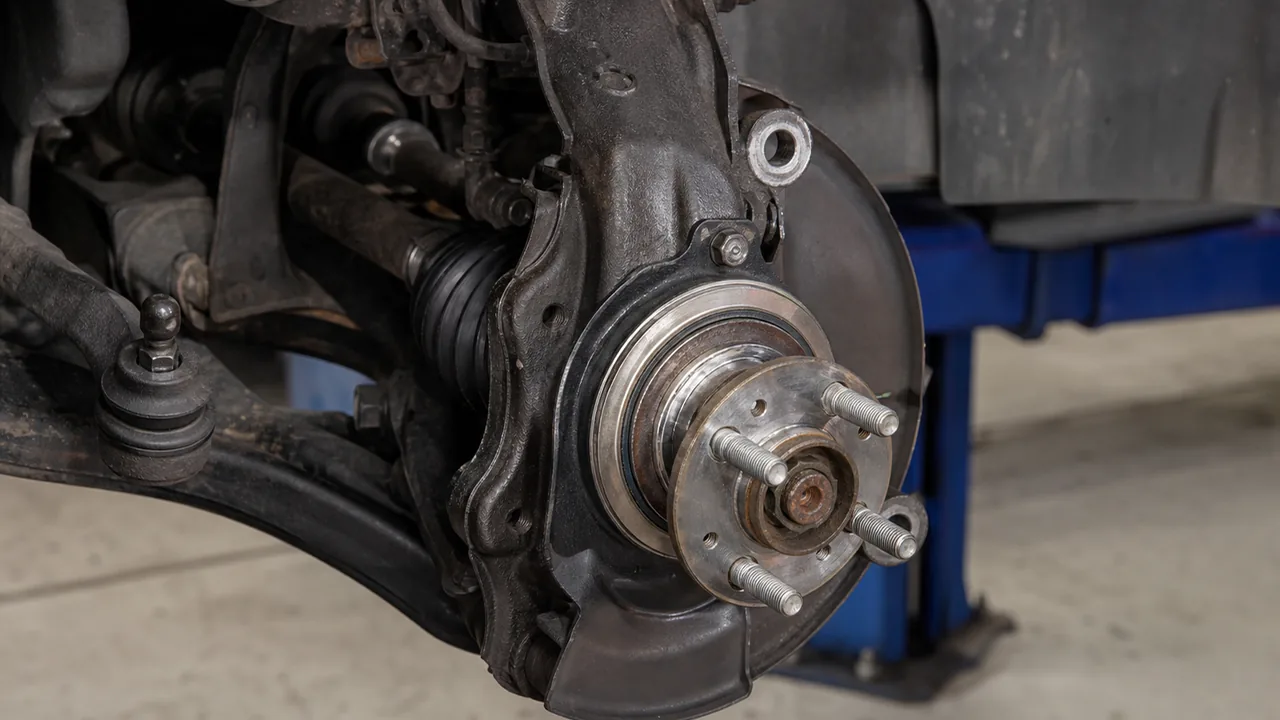
- If vibration persists after balancing and suspension checks, inspect wheel bearings for roughness by rotating the hub by hand and listening for grinding; also check driveshaft support bearings and CV axles for play.
Advanced on-car balancing can correct residual vibration on some vehicles but requires specialized equipment and should not be attempted on wheels with unknown history.
Professional diagnosis saves time and parts: a technician can isolate whether a tire, wheel, or chassis part is responsible in one bay visit. <a href='/diagnostic-check'>Schedule a diagnostic check</a> to confirm the root cause.
Parts that may be involved
- Tire (cupped, feathered, broken belt)
- Wheel (bent, out-of-round, missing weights)
- Wheel hub assembly (runout, corrosion between hub and rotor)
- Outer tie rod ends
- Inner tie rod sockets
- Lower ball joints
- Control arm bushings (especially the rearward bushing)
- Wheel bearings (front)
- Axle shaft (FWD, if vibration changes with torque)
- Driveshaft center bearing (RWD/4WD)
- Engine/transmission mounts (rare, but can transmit vibration at certain speeds)
FAQ
Can I keep driving with a steering wheel shake atonce road speed rises?
If the vibration is mild and you stay below the shake speed, it is often safe for a short period. However, the underlying cause will worsen tire wear and may damage suspension components, so address it within your next service interval. If the shake becomes violent or is accompanied by noise, stop driving immediately and have the vehicle inspected.
How do I know if it’s tire balance or a suspension problem?
Tire balance issues typically produce a narrow-speed shimmy that smooths out at higher or lower speeds and is usually felt only in the steering wheel. Suspension wear tends to produce a looser, wandering feel along with rattling over bumps, and the shake may not disappear outside theonce road speed rises window. A dry park test can help distinguish the two.
Why does the vibration go away once road speed rises?
As wheel speed increases, the resonant frequency of the imbalance shifts out of the chassis’s natural harmonic range, so the vibration amplitude decreases. This does not mean the problem is gone; it is simply outside the sensitivity range for that particular unbalance.
What is road force balancing, and do I need it?
Road force balancing applies a load roller to the tire to simulate the vehicle’s weight and measures force variation. It can detect internal belt damage or stiffness differences that a standard balancer misses. For persistent shakes at highway speed, road force balancing is the most effective diagnostic and correction method.
Will rotating the tires fix the shake?
If the shake moves to the seat or rear of the vehicle after rotation, the problem is tire-related (balance or force variation). If the shake remains in the steering wheel, the issue is likely in the front suspension. Rotation does not cure the root imbalance; it only relocates the symptom.
How much does it cost to diagnose and fix steering shake?
Repair cost depends on the failed part, parts quality, and local labor rates. Repair cost depends on the failed part, parts quality, and local labor rates. Costs vary by region and vehicle.

Comments
Be the first to add a practical repair note or follow-up question.