
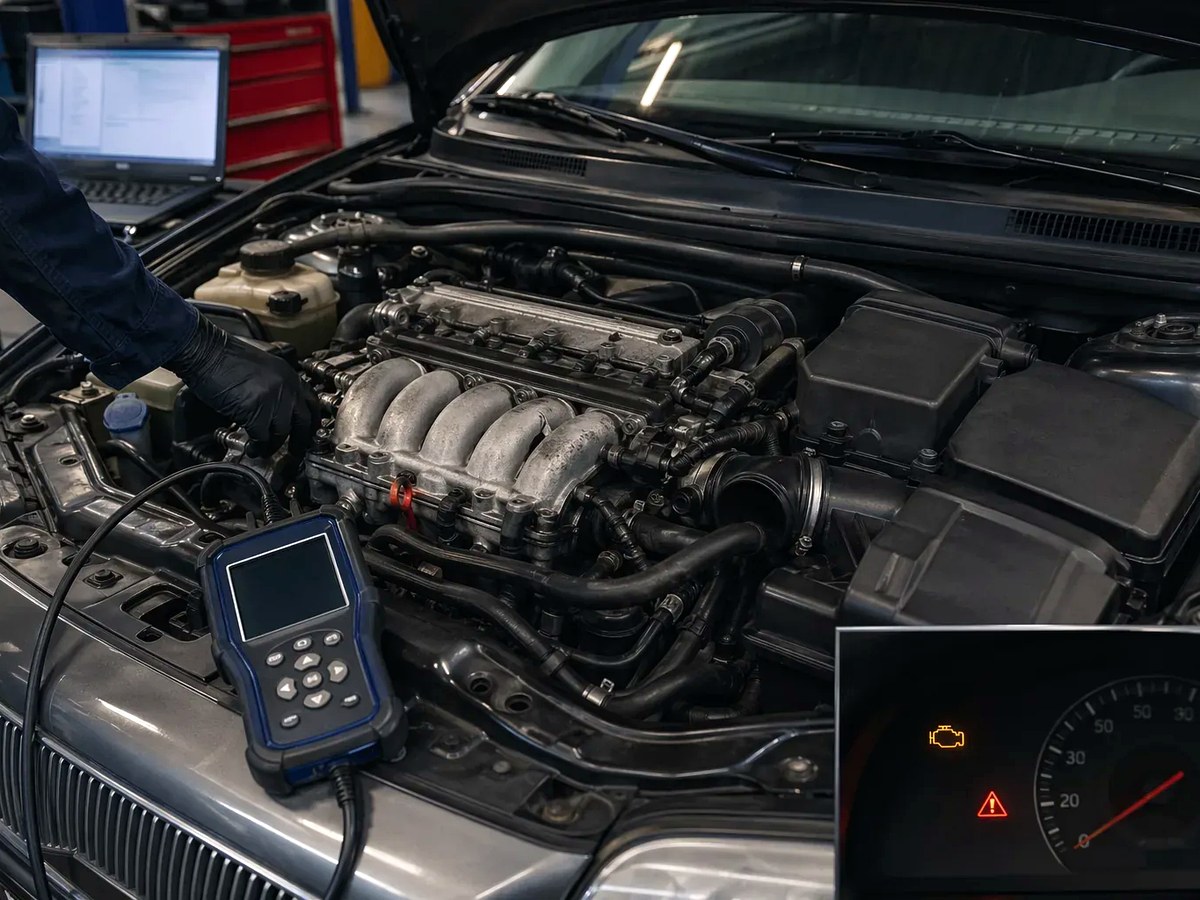
What the code means
P0304 usually means the engine computer detected a misfire in cylinder 4. If the check engine light is flashing or the engine is running rough, driving should be minimized because raw fuel can overheat the catalytic converter and the fault can worsen quickly.
Urgency note: a flashing light, heavy shaking, stalling, or obvious power loss points to a higher-risk condition than a mild intermittent stumble at idle.
- Quick owner checks usually start with scanning for related codes, noting when the misfire happens, and inspecting the spark plug and ignition coil condition if access is straightforward.
- Technician diagnosis usually adds live misfire counters when available, fuel trim review, swap testing, injector checks, vacuum leak testing, and compression or leak-down testing when ignition and fuel checks do not explain the fault.
- P0304 identifies the affected cylinder in the fault logic, but it does not confirm the exact physical cause by itself.
Symptoms
A cylinder 4 misfire often feels like an uneven idle, a stumble when pulling away, or a sharp hesitation under throttle. In mild cases the engine may still run fairly normally between events, but fuel economy, emissions, and catalyst safety can still suffer.
- Rough idle or intermittent shaking
- Hesitation, bucking, or poor acceleration
- Flashing or steady check engine light
- Hard starting or cold-start stumble
- Fuel smell from the exhaust in stronger misfire cases
- Reduced power when climbing or merging
A single-cylinder code can still be linked to a wider issue. If P0304 appears with P0300, lean codes, fuel trim issues, or injector circuit faults, broaden the diagnosis instead of focusing only on the plug.
Main causes
- Worn, fouled, damaged, or incorrectly gapped spark plug
- Weak ignition coil, coil boot tracking, or coil connector problem
- Fuel injector restriction, poor injector operation, or injector circuit issue
- Localized vacuum leak or air leak affecting that cylinder
- Low compression from valve, ring, or head gasket related mechanical loss
- Oil or coolant contamination that fouls the plug and repeats the misfire
Cause ranking changes with engine design, mileage, maintenance history, and when the fault appears. A cold-start-only misfire may point in a different direction than a constant hot misfire under load, so the best cause list is always the one supported by scan evidence and targeted testing.
A common misdiagnosis mistake is replacing the coil, plug, injector, or sensor before confirming the code pattern, freeze-frame clues, and the actual test result on that cylinder.
What to check first
- Scan for all stored, pending, and history codes.
- Record freeze frame data before clearing anything.
- Check whether the misfire is cold, hot, idle-only, or load-related.
- Inspect the plug, coil boot, and connector if access is safe and straightforward.
- Look for vacuum hose issues, intake leaks, or signs of oil or coolant contamination near the affected cylinder.
- Clear the code only after recording evidence, then verify whether P0304 returns under the same conditions.
Do not assume cylinder 4 is in the same location on every engine. Verify cylinder numbering from the correct service information if the physical location matters for inspection or part access.
Diagnostic order
- Confirm P0304 and note any related codes such as lean, injector, or other misfire codes.
- Review freeze frame and live data for load, rpm, coolant temperature, and fuel trim context.
- Inspect and test the cylinder 4 ignition path, including plug, coil, boot, connector, and basic power or ground integrity where applicable.
- If appropriate for the design, perform a controlled swap test with a known-good coil or plug and watch whether the misfire follows the part.
- Evaluate injector operation and fuel delivery clues, including injector control, sound, balance behavior, or cylinder contribution where available.
- Check for localized air leaks or intake sealing issues affecting that cylinder.
- If the code persists, verify compression and consider leak-down or valve train investigation.
This order keeps the quickest common faults near the front while protecting against the classic mistake of replacing ignition parts on an engine that actually has a fueling or compression problem.
You can sometimes move the vehicle a short distance for diagnosis if the light is steady and the engine is only mildly affected, but extended driving is a poor bet because a misfire can damage the catalytic converter and leave you with a larger repair.
- Stop driving if the check engine light is flashing.
- Stop driving if the engine is shaking heavily or stalling.
- Minimize driving if power is reduced enough to affect merging or climbing.
- Use caution if there is a strong raw-fuel smell or repeated backfiring.
A steady light does not mean harmless. It only means the control module is not currently warning of the highest immediate catalyst risk threshold it can detect.
What usually fixes it
| Repair path | What it can solve | What it does not prove by itself |
|---|---|---|
| Spark plug replacement | Worn, fouled, or damaged plug causing weak combustion | It does not prove the plug was the only cause if oil, coolant, or fuel problems fouled it again |
| Ignition coil or boot replacement | Weak spark, insulation breakdown, or boot tracking | It does not rule out wiring faults or plug issues unless verified |
| Injector service or replacement | Restricted or poorly operating injector on cylinder 4 | It does not rule out low fuel pressure or control issues elsewhere |
| Vacuum or intake leak repair | Lean misfire affecting one cylinder or runner | It does not rule out ignition weakness under load |
| Compression or valve repair | Mechanical sealing loss causing repeated misfire | It does not prove ignition and fuel were healthy unless tested first |
After repair, the fix should be verified by road testing under the original freeze frame conditions, checking whether misfire counters stay stable where available, and confirming that P0304 does not return with the same operating pattern.
FAQ
What does P0304 mean in plain English?
It usually means the engine computer detected a misfire in cylinder 4.
Can a bad spark plug cause P0304?
Yes. A worn, fouled, or damaged spark plug is a common cause, but it is not the only cause and should not be assumed without inspection or testing.
Is P0304 safe to drive with?
Only very cautiously and only if the light is steady and the engine is not shaking badly. If the light is flashing or the engine runs rough, driving should be minimized or stopped.
Can an ignition coil cause P0304?
Yes. A weak coil, damaged boot, poor connection, or related wiring fault can all trigger a cylinder 4 misfire.
What if P0304 comes with P0300 or lean codes?
That can point to a broader misfire or air-fuel problem, so the diagnosis should widen instead of focusing on one plug alone.
Comments
Be the first to add a practical repair note or follow-up question.