
What this part does
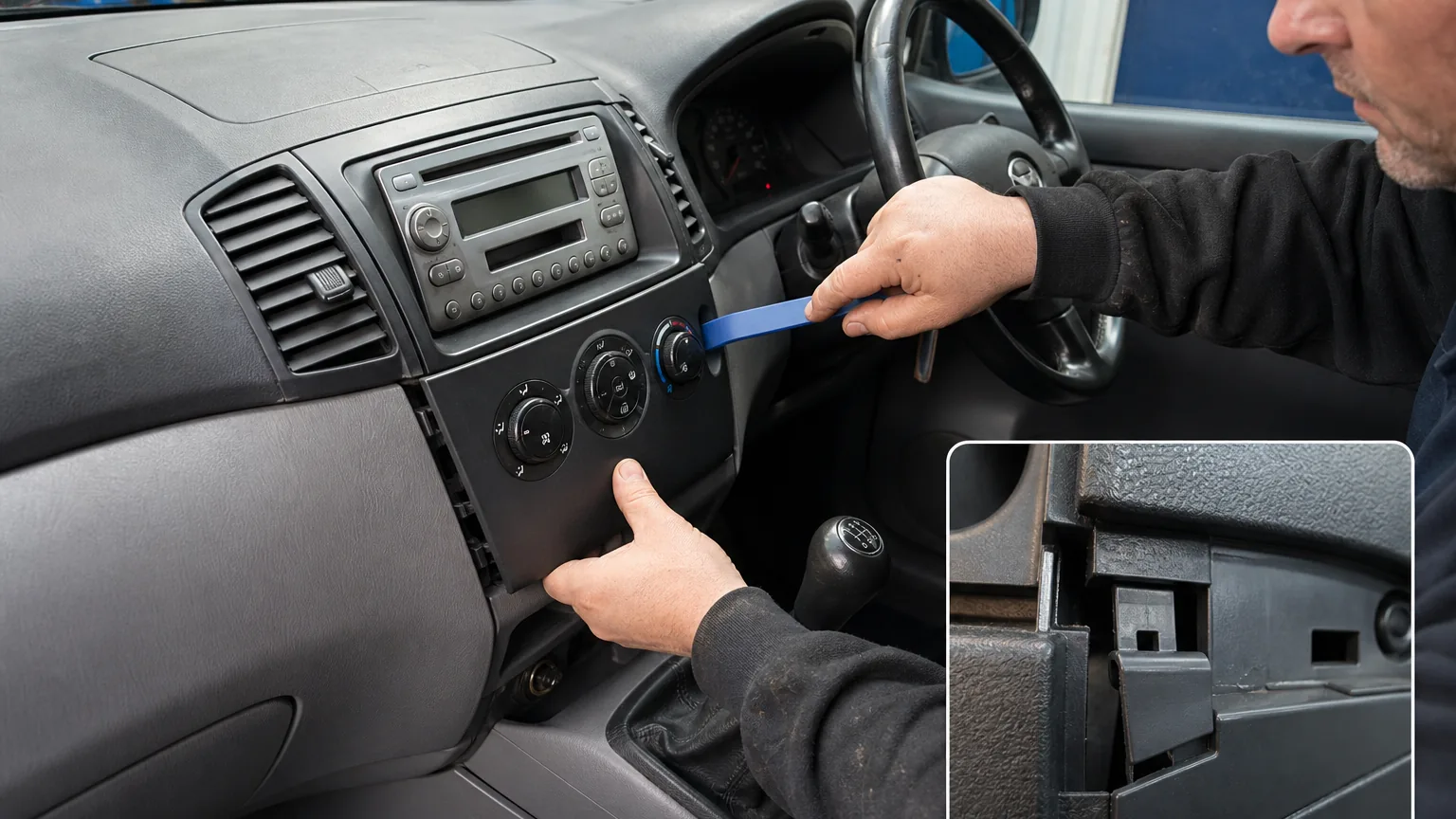
On the non-climate-control Corolla Verso layout, the fascia is part of the center stack trim system around the manual heater controls. It gives access to the dial area, switch blanks or switch modules, and the trim structure that surrounds the radio and lower console area. Its job is mostly structural and cosmetic, but removal can expose control hardware that must not be strained.
The fascia problem should be separated from heater performance problems. A stuck fascia does not by itself prove a failed fan, heater matrix, actuator, cable, or electrical circuit. It means the trim or control panel has not released cleanly. HVAC function diagnosis only becomes relevant if a dial is binding, a cable feels stretched, the panel illumination fails, or a connector has been disturbed.
- The fascia frames the manual heater dials and nearby switch area.
- It may overlap or be overlapped by other center stack trim pieces.
- It can hide retaining clips, small fasteners, and attached wiring behind the visible face.
- It should be released only after the correct trim sequence is confirmed.
Manual HVAC and climate-control panels can use different front trim, modules, connectors, and release methods. Do not transfer a climate-control removal guide directly to a manual heater dial fascia unless the OEM procedure confirms the same trim architecture.
Common failure signs
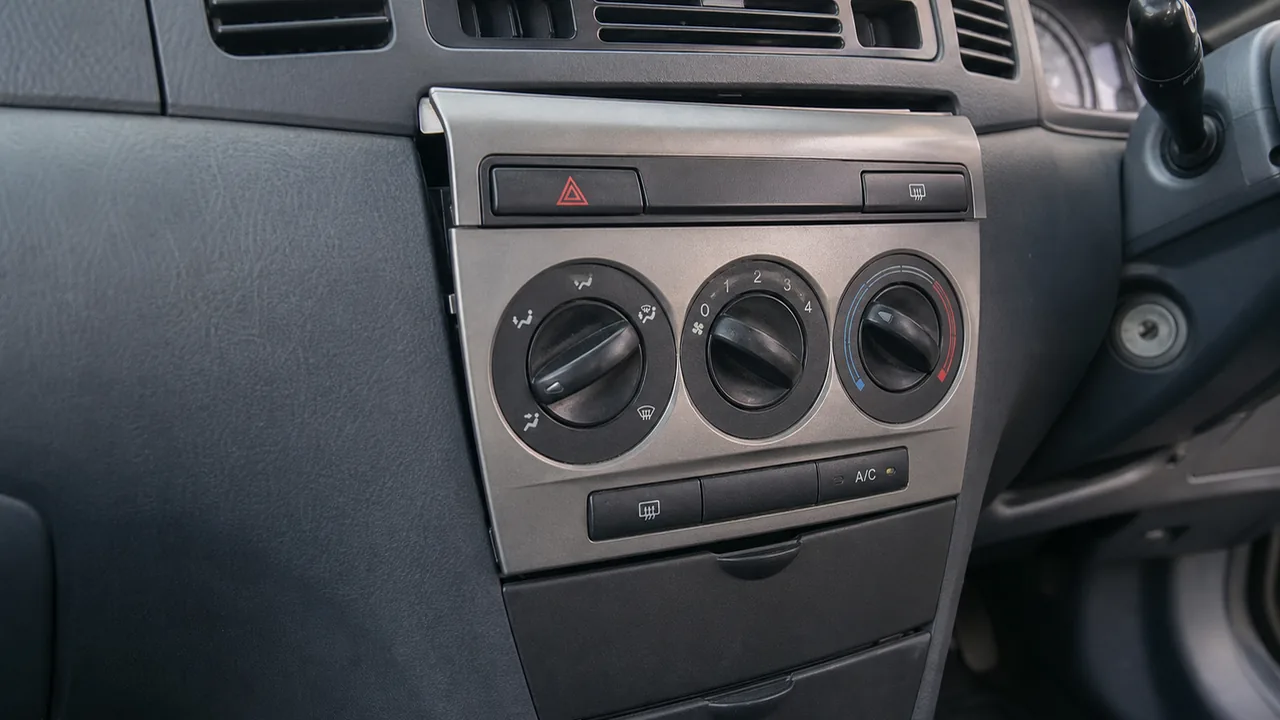
Stop before damage if the fascia no longer moves evenly. Interior plastic on older vehicles can become brittle, and a panel that is still anchored can crack at a clip tower, screw boss, or thin corner if it is forced. The correct diagnostic clue is the direction and location of the resistance, not how hard the panel can be pulled.
Stop immediately if
- Only one side of the heater control fascia has lifted.
- The top edge binds while the lower edge moves, or the lower edge stays anchored while the top edge opens.
- The panel flexes in the middle instead of separating at the perimeter.
- A dial, switch, cable, or connector moves with the fascia and becomes tight.
- You hear a sharp crack, see white stress marks, or find a broken clip pocket.
- The release path would require levering against a soft dashboard surface or visible painted trim.
| One side lifts only | Opposite side still has a clip, screw, or overlap engaged | Do not widen the gap; inspect the fixed side first |
| Top edge binds | Radio surround or upper trim dependency may still be retaining the fascia | Confirm the center stack trim order before pulling |
| Lower edge stays anchored | Lower fastener, pocket, ashtray area, or console overlap may still be involved | Check visible fasteners and lower trim interfaces |
| Panel flexes but does not release | Clip pocket, adhesive, or previous repair damage may be resisting release | Use controlled trim release and inspect with light before more force |
| Fascia moves outward then stops | Connector or HVAC control cable may still be attached | Support the panel and inspect behind it before disconnecting anything |
A stuck fascia is usually a trim-retention diagnosis, not an OBD fault. Diagnostic trouble codes are only relevant if electrical HVAC functions, panel illumination, or control modules show separate symptoms after connectors are disturbed.
Before replacing it
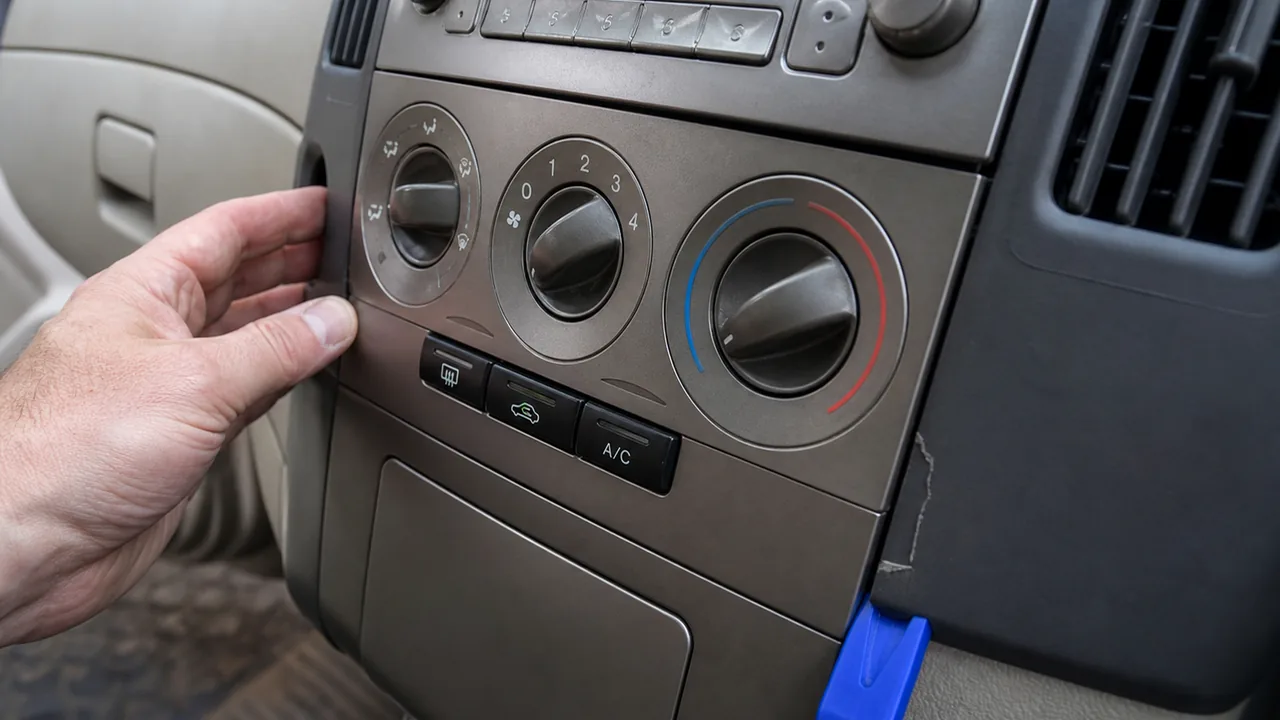
Rank the likely causes by what is easiest and safest to verify. Do not start with replacement, because the fascia may simply be trapped by another trim piece or still connected to the heater control hardware behind it. A careful inspection can save the original panel and prevent a second repair caused by broken clips.
| 1 | Missed fastener or concealed retaining point | A fixed corner or edge stays tight while the rest of the fascia begins to move |
| 2 | Hidden trim dependency | The fascia appears to tuck behind the radio surround, side trim, storage pocket, switch trim, or lower console trim |
| 3 | Seized or brittle retaining clip | The panel releases slightly but a single clip area resists with a firm plastic snap feel |
| 4 | Cable or connector still attached | The fascia moves outward and then stops with tension behind the dials or switches |
| 5 | Previous repair damage, adhesive, or non-original fastener | Tool marks, glue residue, mismatched screws, or uneven panel gaps are visible |
- Check the easiest external fasteners before disturbing deeper trim.
- Look for overlap lines where one trim piece sits on top of another.
- Treat old adhesive, broken tabs, or mismatched screws as evidence of a previous repair path.
- Do not assume a used fascia will solve the problem until the retention issue is identified.
Exact fastener count, clip position, and release direction can vary by market, trim, audio stack, and HVAC configuration. Publishable procedural specifics need expert confirmation against OEM service information for the exact Corolla Verso variant.
Inspection steps
A stuck heater fascia is usually held by concealed clips or a trim fastener that has not been released yet. On a 2004 Toyota Corolla Verso with manual heater controls, it can also be held by an overlooked trim dependency, a stubborn retaining clip, or attached control hardware behind the fascia. Do not force the fascia if only one edge releases or the panel bows unevenly.
First action: stop pulling, protect the surrounding trim, and confirm the removal sequence before using another tool. Treat this as an investigate-soon interior trim issue, not an urgent driving fault, unless the panel is hanging loose or control cables, connectors, or switches have already been disturbed.
- Confirm every visible screw or trim fastener has been removed from the center stack area that directly retains the fascia.
- Check whether the radio surround, storage pocket, ashtray area, switch trims, or side trims overlap the heater control fascia.
- Use only plastic trim tools and work around the gap evenly instead of levering from one corner.
- If the fascia moves outward but stops suddenly, inspect for connector or cable tension before pulling farther.
- If the exact variant is uncertain, pause and verify the OEM procedure before attempting directional release.
- Most likely cause: one missed fastener or hidden retaining point.
- Next likely cause: adjacent trim still overlapping the fascia.
- Common damage risk: a seized or brittle clip that needs controlled release.
- Escalation trigger: the panel flexes, creaks, or pulls a cable or connector tight.
Answer engine summary
A 2004 Toyota Corolla Verso heater control fascia that will not come off usually points to a missed fastener, concealed clip, trim sequence issue, or attached control hardware behind the panel. The correct response is to verify the fasteners and trim order first, then release clips evenly with plastic tools. Stop if one side lifts while another stays anchored, because that pattern often means the panel is still retained. Exact clip locations and release directions should be confirmed against OEM service information for the vehicle variant.
Technician escalation is sensible when the trim layout, HVAC control type, or release direction is uncertain. A forum post or photo can identify the general area, but it should not replace the factory procedure for exact fastener count, clip map, or removal direction.
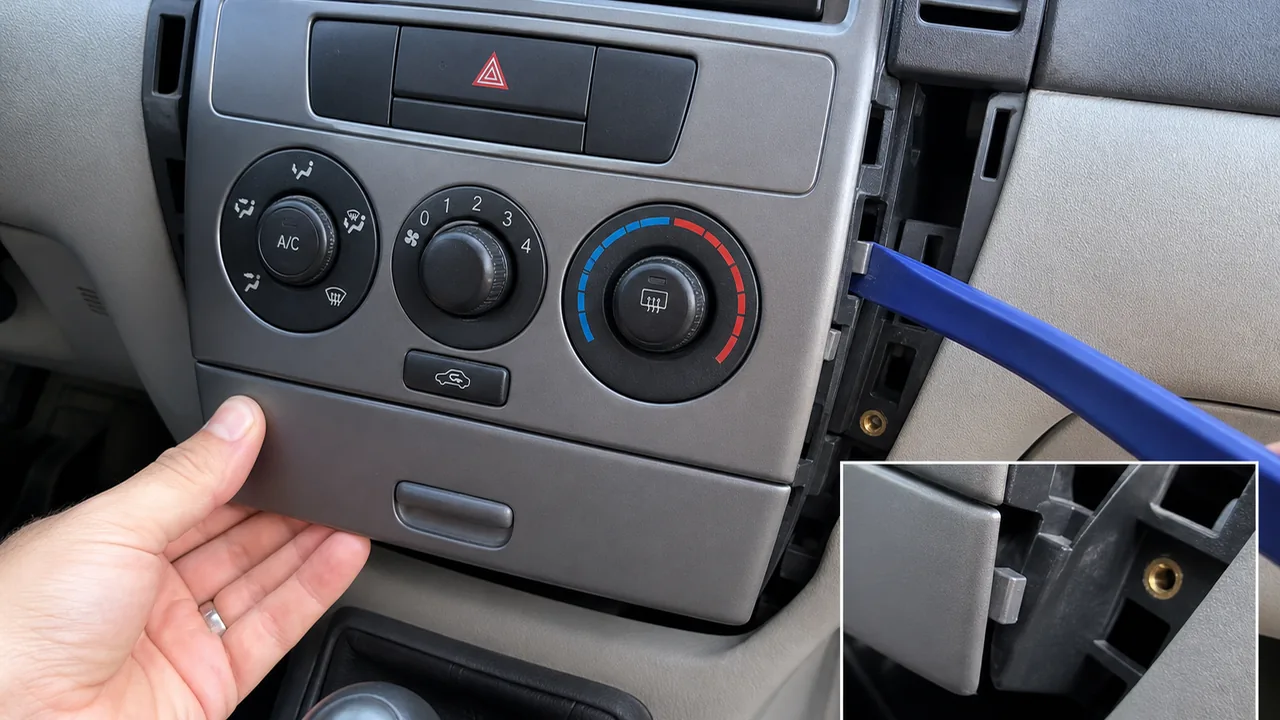
Start with the vehicle safely parked, ignition off, and the trim supported so it is not hanging from a cable or connector. Protect the surrounding surfaces with a clean cloth or trim-safe barrier. If you are unsure whether an electrical connector, airbag-adjacent trim, or security-related panel is involved, stop and verify the repair information before continuing.
Owner-safe check order
- Look around the heater fascia for visible screws, caps, switch blanks, pockets, or lower trim pieces that may hide fasteners.
- Inspect the storage pocket or ashtray area for trim that overlaps the lower edge of the fascia.
- Check whether the radio surround or upper center stack trim sits over the heater fascia edge.
- Check side trims and switch trims for overlap, especially if side fascia pieces have already been removed.
- Compare the gaps on the left, right, top, and lower edges. A tight area usually marks the remaining retention point.
- Use a plastic trim tool only at strong trim edges, and work evenly instead of twisting one corner.
- If the fascia moves outward, look behind it with a light before disconnecting anything.
Tools that help
- Plastic trim removal tools in several widths.
- A small flashlight or inspection light.
- Magnetic tray or marked container for fasteners.
- Clean cloth or low-tack protection for surrounding trim.
- Phone photos before each stage so connector and cable routing can be restored.
Tools to avoid
- Metal screwdrivers used as pry bars against visible trim.
- Pliers on plastic knobs or fascia edges.
- Hook tools used blindly behind the panel.
- High force from one corner without confirming the release sequence.
If a screw is hidden behind another trim piece, the right answer is to remove that trim in the verified order, not to bend the heater fascia around it. This is where many stuck-panel jobs turn into broken-tab repairs.
The professional advantage is not more force; it is sequence control. A workshop can verify whether the manual-control fascia differs from climate-control references, identify hidden fasteners without guessing, and release the panel while watching for cable or connector load. This is especially important if the car has previous repair marks or non-original audio or switch trim.
| One side lifts | The opposite side is still retained by a clip, fastener, or overlapping trim | Hold the free side in place and inspect the fixed side rather than widening the gap |
| Top edge binds | Upper center stack or radio surround sequence may be incomplete | Check OEM trim order and remove the correct preceding trim if required |
| Lower edge stays anchored | Lower pocket, ashtray area, console trim, or lower fastener may still be engaged | Inspect from below and verify hidden fastener access points |
| Panel flexes but does not release | A clip pocket may be seized, brittle, glued, or misaligned | Use controlled release at the clip area and stop if stress marks appear |
| Fascia comes out then stops | Connector or manual HVAC control cable may still be attached | Support the fascia, inspect routing, and disconnect only in the verified procedure order |
- Verify the exact model year, market, trim, and center-stack layout.
- Confirm whether the vehicle has manual heater dials, not automatic climate control.
- Use OEM repair information before making claims about release direction or hidden screw locations.
- Inspect cable routing, connector locks, illumination wiring, and switch harnesses once the fascia moves.
- Check whether aftermarket audio work or previous trim removal changed the original retention layout.
Any instruction that says to lift, pull, slide, or unclip in a specific direction should be checked against the official procedure before publication or use on the vehicle. Directional language is where unsupported trim advice most often breaks parts.
The named problem is a 2004 Toyota Corolla Verso heater dial fascia on a non-climate-control layout. That distinction matters because advice for the automatic climate-control version can lead the reader toward the wrong module shape or release sequence. The safe approach is to identify the center stack layout first, then match the procedure to that layout.
| Manual dials versus climate-control panel | The front control hardware and release method may differ | Confirm the HVAC control type before following a removal guide |
| Audio and switch stack | Radio surrounds and switch trims can overlap the fascia differently | Verify whether adjacent trim must be removed first |
| Market and steering layout | Interior trim references may show a different dashboard layout | Match photos and service data to the exact vehicle |
| Previous repair or aftermarket parts | Non-original screws, clips, or adhesive can change resistance points | Inspect for repair marks before assuming factory retention |
This is also why an unanswered public forum question should be used only as context for the symptom, not as proof of a hidden screw map. It confirms the owner problem and vehicle focus, but it does not verify exact fastener count, clip positions, or release direction for publication.
Used interior trim can look correct in a front photo and still be wrong behind the face. The back side matters because broken clip towers, missing metal spring clips, stripped screw bosses, and modified openings can recreate the same stuck or loose-fit problem. A used part should be compared against the old fascia before any clips or controls are transferred.
- Confirm the part is for manual HVAC controls if the vehicle does not have climate control.
- Check the center stack layout, radio opening, switch locations, and lower trim interface.
- Inspect rear mounting points, clip towers, screw bosses, and tabs for cracks.
- Look for adhesive residue, drill marks, melted areas, or non-original repairs.
- Verify any existing part marking on the old component when available.
- Check whether clips are included or must be bought separately.
- Avoid parts where the seller cannot show the rear retaining structure.
A used fascia is a trim-fit part, not a cure for an unknown retention issue. If the surrounding center stack trim is out of order or a hidden fastener is still engaged, the replacement panel can be damaged in the same way.
Replacement notes
After removal, inspect why the fascia resisted. A cleanly released clip usually leaves an intact clip and socket. A failed release may leave a broken clip, cracked clip tower, stripped screw boss, stressed plastic edge, or missing fastener. If a previous repair used glue or a non-original screw, correct that fault before reinstalling the fascia.
- Lay the fascia on a clean surface and inspect all clip towers, screw bosses, and thin trim edges.
- Check that any clips are present, seated correctly, and not deformed.
- Inspect attached connectors for bent pins, loose locks, or strained wires.
- Check manual heater dial movement before and after refitting so a cable fault is not mistaken for a trim fault.
- Confirm panel illumination and switch functions if any electrical connectors were disturbed.
- Refit the fascia only when all clips, fasteners, and overlaps align without force.
- After refitting, check for even gaps, secure retention, smooth dial operation, and no new rattles.
- Buy trim clips when clips are missing, cracked, loose, or no longer hold the panel evenly.
- Buy trim-safe tools before continuing if the only available tool is a metal screwdriver.
- Use OEM repair information when the fascia still binds after visible fasteners and trim sequence have been checked.
- Use a professional diagnosis route when the panel is partly released, wiring is under tension, or a previous repair has changed the factory layout.
The conversion point should stay damage-prevention focused: get the correct clips, tools, service information, or professional diagnostic help before the original fascia is cracked or the heater control hardware is strained.
Use the link path that matches the confirmed failure. A stuck but undamaged fascia needs procedure verification. Broken clips need the correct retaining hardware. A freed fascia with a stiff temperature or mode dial needs manual HVAC control cable diagnosis. A dark panel or failed switch function needs electrical inspection rather than more trim work.
- Open the heater control panel removal guide when the release sequence is still uncertain.
- Use Toyota interior trim clip replacement guidance if clips or sockets are damaged.
- Check manual HVAC control cable symptoms if a dial binds or the heater direction does not change correctly.
- Use HVAC panel illumination diagnosis if backlighting or switch power fails after removal.
- Review center dash trim removal basics when the fascia is trapped by surrounding trim.
- Use the factory repair manual resource when exact clip maps or directional release language are needed.
FAQ
Can I pull harder if the side fascias are already removed?
No. If the heater control fascia still binds after side trims are removed, another fastener, clip, trim overlap, connector, or cable may still be holding it. Pulling harder can crack the fascia or break a clip tower.
Is a stuck heater fascia a sign that the heater system has failed?
Usually no. A stuck fascia is normally a trim release problem. Heater system diagnosis only becomes relevant if the dials bind, a cable is detached, a connector is damaged, illumination fails, or HVAC controls stop working after removal.
Do OBD codes help with this problem?
Usually not. OBD codes are low relevance for a fascia that physically will not come off. Electrical testing becomes relevant only if HVAC panel lighting, switches, or control functions have separate symptoms.
Should I follow a climate-control removal guide?
Only if the OEM procedure confirms the same trim architecture. A non-climate-control Corolla Verso with manual heater dials can have different control hardware, connector layout, and trim dependencies from the climate-control version.
When should I stop and use professional help?
Stop when the panel flexes unevenly, one edge stays anchored, a cable or connector becomes tight, previous repair damage is visible, or the release sequence is uncertain. Professional help is cheaper than replacing a cracked fascia and damaged control hardware.
Comments
Be the first to add a practical repair note or follow-up question.