
What this part does
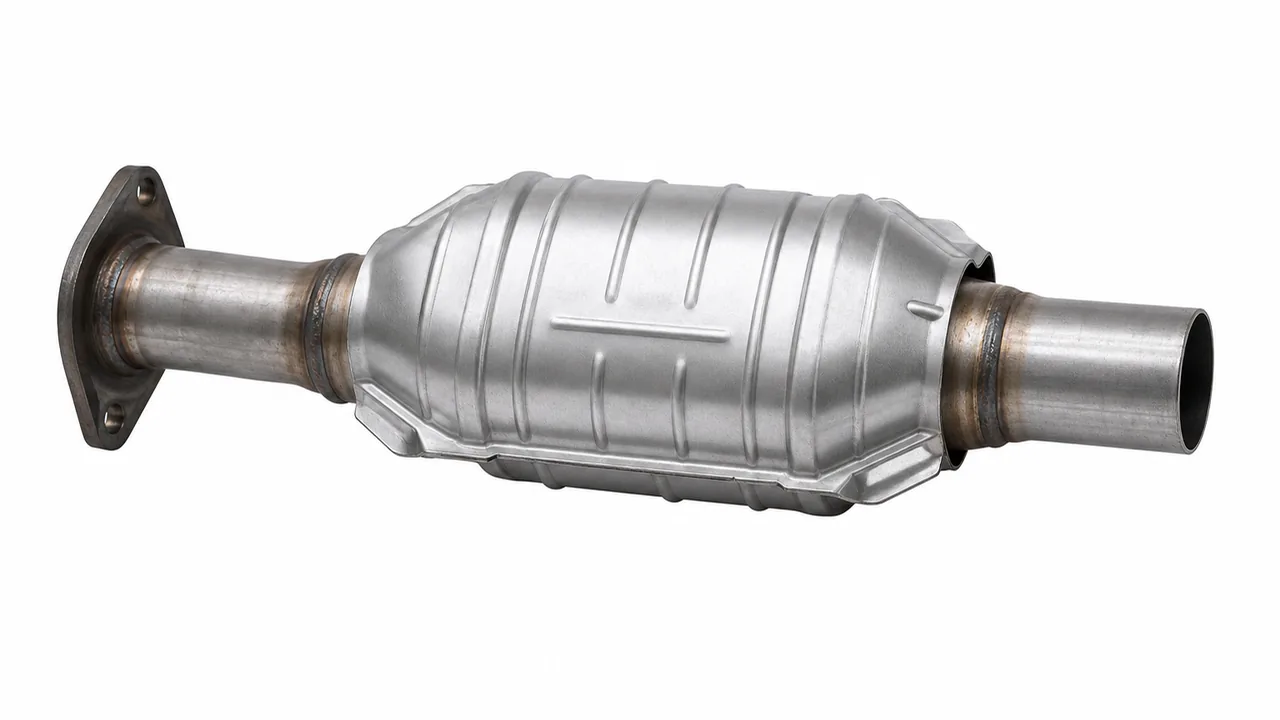
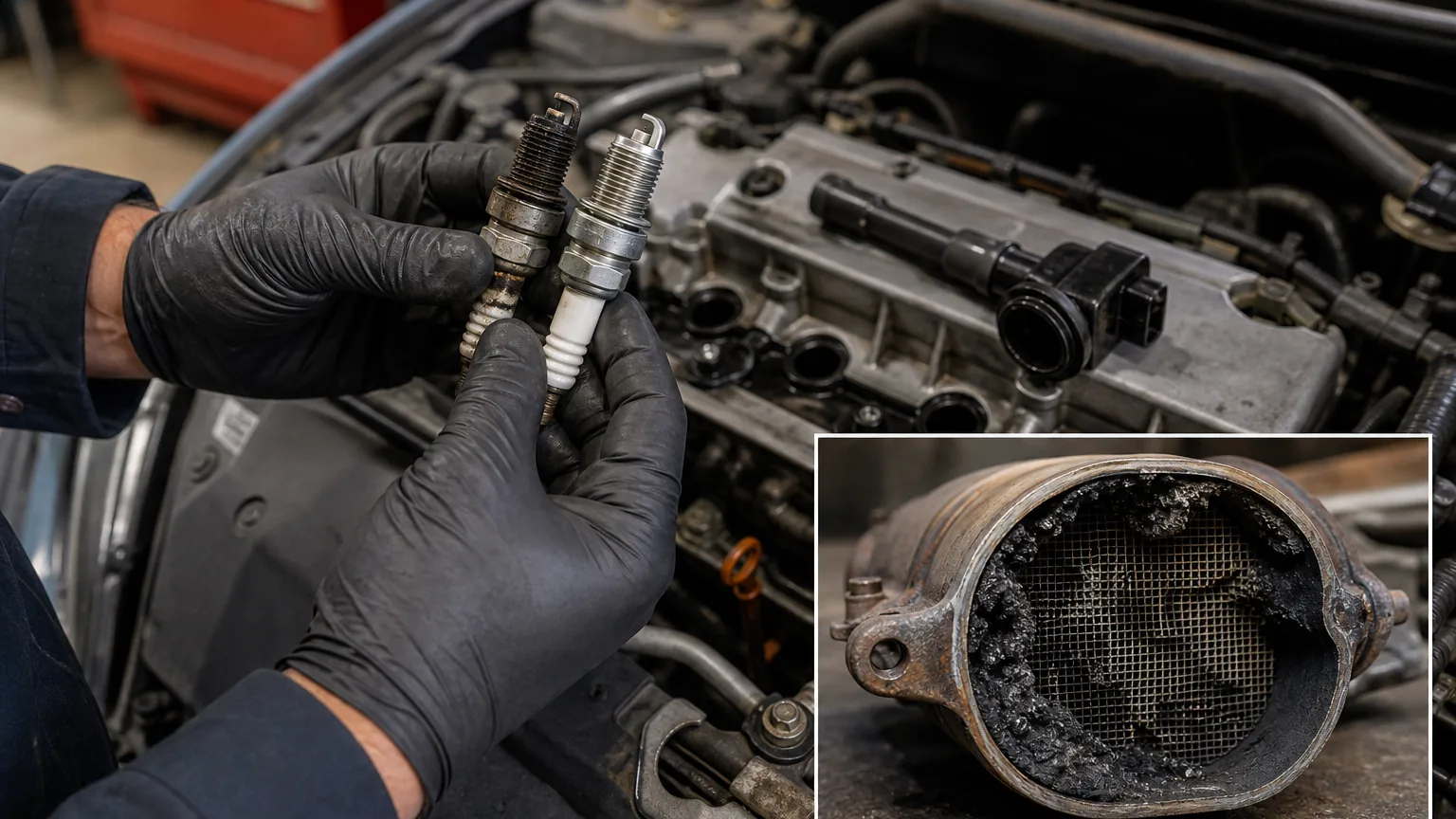
The spark plug ignites the air-fuel mixture in the cylinder, while the catalytic converter treats the exhaust gases after combustion. When combustion is clean and stable, the converter handles the remaining emissions load within its intended role.
A catalytic converter is not designed to process a steady stream of raw fuel from repeated misfires. When unburned fuel reaches the catalyst, the converter can run hotter than intended and the internal substrate may be damaged, melted, contaminated, or restricted.
- Spark plugs support stable combustion.
- Coils and plug wires or boots help deliver ignition energy.
- Fuel injectors and sensors influence mixture control.
- The catalytic converter cleans up exhaust after the engine has already burned the mixture.
- A misfire or rich-running condition can overload the converter.
Common failure signs
Rough idle, hesitation, loss of power, poor fuel economy, sulfur odor, flashing check engine light, and reduced acceleration can point to misfire or converter restriction. The pattern matters because misfire symptoms often appear before converter damage, while restriction symptoms may appear after heat damage has occurred.
| Sign | More likely fault path | Why it matters |
|---|---|---|
| Rough idle or shaking | Active misfire | The engine may be failing to burn the mixture consistently. |
| Hesitation or stumble | Weak ignition or fuel-control issue | Combustion may be unstable under load. |
| Flashing check engine light | Potentially damaging misfire | Driving should pause until the fault is checked. |
| Loss of power or reduced acceleration | Misfire or exhaust restriction | The engine may not be producing power or may be fighting backpressure. |
| Poor fuel economy | Misfire, rich running, or sensor issue | Extra fuel can increase converter stress. |
| Sulfur-like exhaust odor | Abnormal exhaust chemistry or catalyst stress | It can appear with fuel-control or catalyst problems. |
These signs do not prove that wrong spark plugs caused the converter problem. They show where diagnosis should begin.
Before replacing it
Before replacing the converter, confirm whether an active upstream fault is still feeding the exhaust with unburned fuel or abnormal mixture. Converter replacement without root-cause repair can lead to repeat failure.
- Incorrect spark plug gap or part number
- Wrong plug heat range, reach, or design
- Poor plug installation or damaged ignition boots
- Worn coils or plug wires where used
- Rich-running condition from fuel-control faults
- Oil burning that can contaminate the catalyst
- Fuel injector leakage or poor spray pattern
- Exhaust leaks that can distort sensor readings
Inspection before converter replacement is cost protection. It separates a converter that has actually failed from a converter that is reacting to an engine problem.
Inspection steps
Wrong spark plugs can lead to catalytic converter clogging when they cause misfires or poor combustion that sends unburned fuel into the exhaust. That fuel can overheat and damage the catalyst substrate, eventually creating restriction or efficiency failure.
The spark plug is not usually the part that physically clogs the converter by itself. The risk comes from the combustion problem it creates: weak ignition, incomplete burn, excess fuel in the exhaust stream, and heat stress inside the converter.
A flashing check engine light should be treated as urgent because it can indicate an active misfire that may damage the catalytic converter if driving continues.
Diagnosis still matters before parts replacement. The wrong plug, a failing coil, a rich fuel mixture, oil burning, injector trouble, or an exhaust leak can create similar symptoms and codes, so the actual cause should be confirmed first.
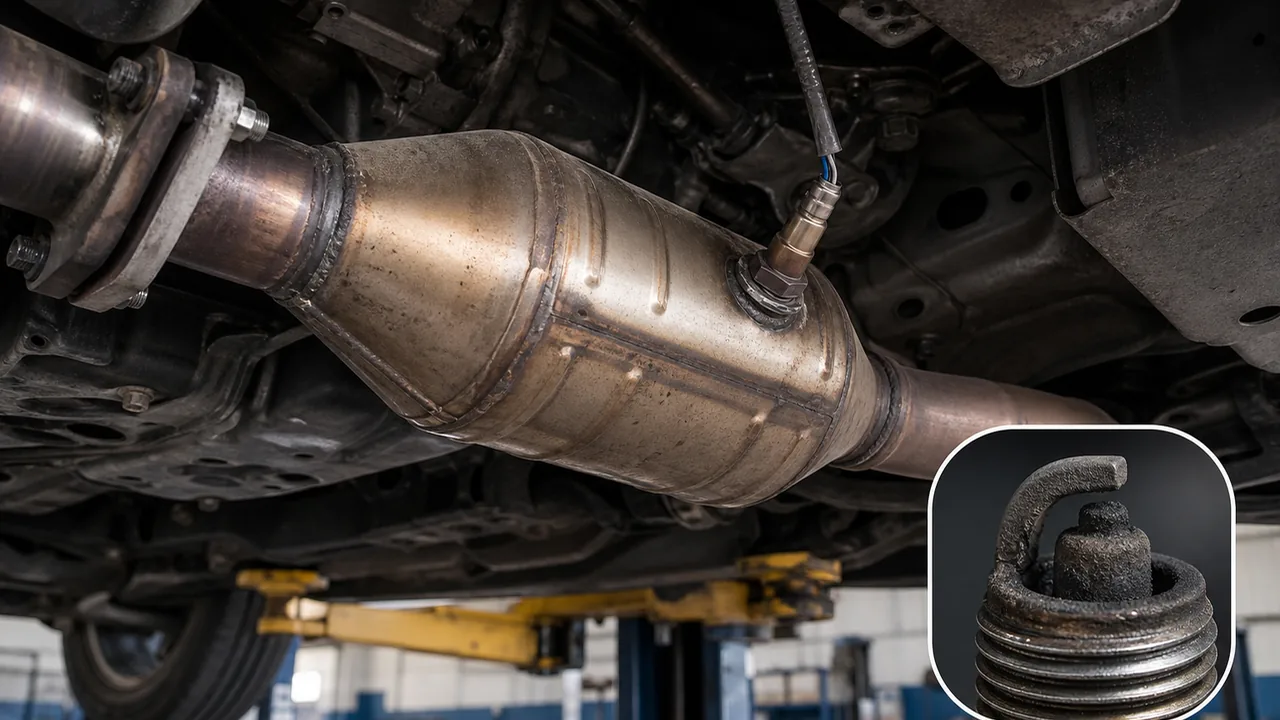
Incorrect plug specification can weaken ignition, create incomplete combustion, overheat the catalyst, and damage or restrict the substrate. The chain usually starts with a plug that does not match the engine requirement or was installed incorrectly.
- Wrong gap, heat range, reach, plug design, or installation quality weakens combustion stability.
- The cylinder may misfire or burn the mixture incompletely.
- Unburned fuel and excess oxygen can enter the exhaust.
- The converter attempts to process the abnormal exhaust load.
- Heat stress or contamination can damage the catalyst substrate.
- The converter may then show efficiency codes, restriction symptoms, or both.
This sequence is gradual in many cases, but an active severe misfire can accelerate the risk. That is why the misfire source should be handled before judging the converter as the only failed part.
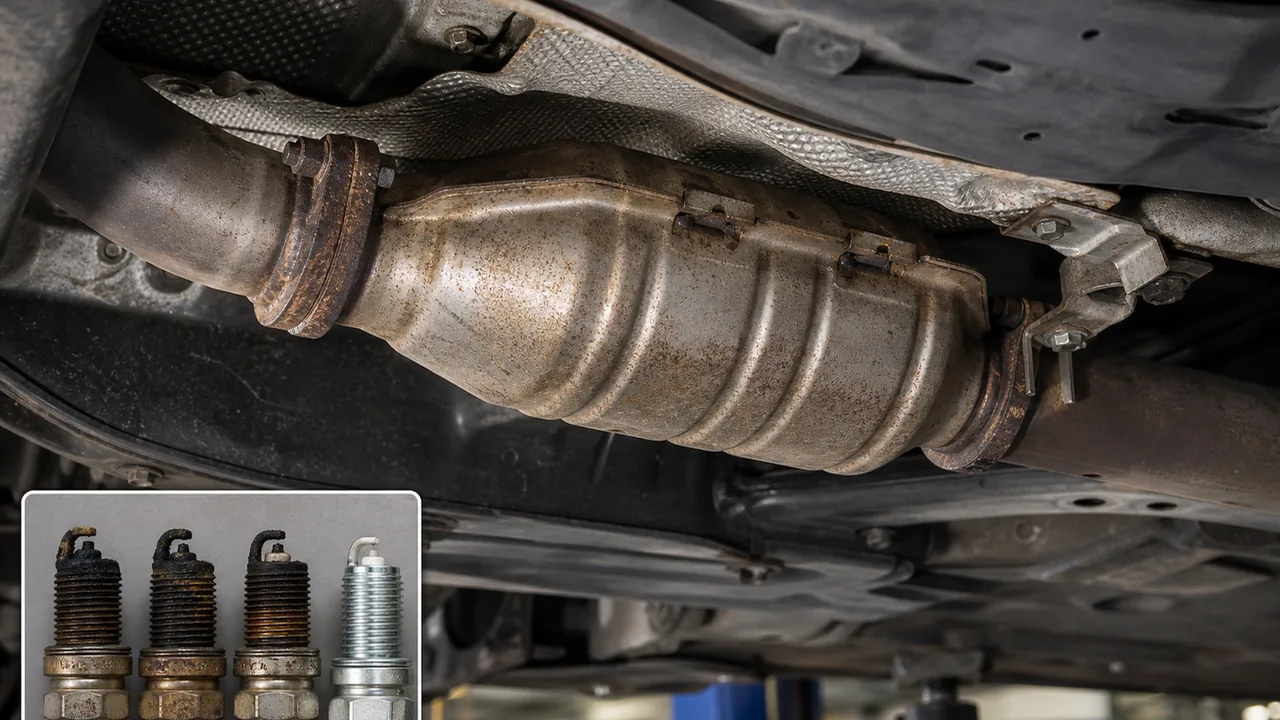
The spark plug mistakes that increase catalyst risk are the ones that change combustion quality. A plug can thread into the engine and still be incorrect for the application.
- Incorrect gap can make the spark weak, unstable, or harder for the ignition system to fire consistently.
- Wrong heat range can affect plug temperature behavior and increase fouling or abnormal combustion risk.
- Wrong reach can place the firing tip in the wrong position for the chamber design and may create mechanical or combustion problems.
- Wrong plug design can conflict with the ignition system or combustion chamber requirement.
- Poor installation can damage threads, crack insulation, create poor seating, or leave a plug loose.
- Reusing worn plugs can continue a misfire pattern that stresses the converter.
Use the owner manual, OEM service information, or a trusted parts catalog tied to the exact vehicle configuration before selecting plugs.
P0300 and P030x can indicate misfire patterns, while P0420 and P0430 can indicate catalyst efficiency concerns. Codes guide testing, but they do not prove the failed part alone.
| Code family | What it can indicate | How to use it |
|---|---|---|
| P0300 | Random or multiple-cylinder misfire | Check plugs, coils, fuel delivery, air leaks, compression-related clues, and scan data. |
| P030x | Misfire detected on a specific cylinder | Start with that cylinder, then compare ignition, fuel, and mechanical clues. |
| P0420 | Catalyst efficiency concern on one bank | Check for unresolved misfire, fuel-control problems, oxygen sensor data issues, and exhaust leaks before condemning the converter. |
| P0430 | Catalyst efficiency concern on the other bank | Use the same validation steps and compare bank-to-bank data where applicable. |
A vehicle can have both misfire and catalyst codes. The misfire should be addressed first because it can be the upstream cause of converter damage.
Owner checks should focus on history, warning-light behavior, visible information, and safe operating decisions. Avoid hot exhaust work, unsafe lifting, and ignition testing that requires professional equipment.
- Check whether the spark plugs were replaced recently.
- Confirm the plug part number against the owner manual, OEM information, or a reliable application-specific catalog.
- Look for a flashing check engine light and avoid driving if it appears.
- Note rough idle, hesitation, fuel smell, sulfur odor, loss of power, or poor acceleration.
- Keep records of recent plug, coil, injector, or oxygen sensor work.
- Schedule diagnosis if misfire symptoms or catalyst codes are present.
Do not clear codes repeatedly just to keep driving. Stored and pending data can help identify whether the fault is active, intermittent, or returning after repair.
A technician should test the engine fault and converter condition as connected systems. The goal is to identify whether spark plugs started the problem, whether another fault is feeding the converter, and whether the converter is now restricted or inefficient.
- Inspect the installed spark plugs for correct application, condition, seating, and visible damage.
- Check coils, boots, wires where used, and ignition-related connectors.
- Use scan data to review misfire counters, fuel trims, oxygen sensor behavior, and catalyst monitor clues.
- Verify whether the mixture is rich, lean, unstable, or affected by an air or exhaust leak.
- Check for injector issues, oil burning evidence, or other contamination sources.
- Evaluate converter restriction or temperature pattern with appropriate professional test methods.
- Confirm the repair by verifying that misfire data and catalyst-related symptoms do not return after correction.
The important point is sequence. The converter should not be judged in isolation while the engine still has an active combustion fault.
The best diagnostic flow starts at the most active fault and moves downstream. If misfire is present, solve it first; if misfire is gone but catalyst efficiency or restriction symptoms remain, then test the converter directly.
- If the check engine light is flashing, stop normal driving and diagnose the misfire first.
- If P0300 or P030x is present, inspect plug specification, installation, coils, fuel delivery, and related mechanical clues.
- If the plugs are wrong, install the correct OEM-equivalent plugs and verify that misfire data improves.
- If misfire remains, continue testing coils, injectors, air leaks, fuel trims, and mechanical condition instead of blaming the converter immediately.
- If P0420 or P0430 remains after the engine runs correctly, test catalyst efficiency, sensor data, and exhaust leaks.
- If power loss or reduced acceleration suggests restriction, check exhaust flow or backpressure using professional procedures.
- Replace the converter only after the upstream cause is corrected and the converter fault is confirmed.
Branch rule: active misfire comes first; confirmed converter restriction or efficiency failure comes after upstream causes are controlled.
Driving with a possible wrong-plug misfire is risky when the check engine light flashes, the engine shakes, or power drops. Continued driving can increase converter damage risk if unburned fuel is entering the exhaust.
- Stop normal driving if the check engine light flashes.
- Avoid highway or heavy-load driving if the engine is shaking, stumbling, or losing power.
- Do not continue a trip if there is a strong fuel smell, severe hesitation, or obvious overheating behavior.
- Schedule diagnosis soon if P0300, P030x, P0420, or P0430 appears after recent spark plug service.
- Tow the vehicle or seek immediate service if drivability is poor or the warning light behavior suggests an active damaging misfire.
If the light is steady and the vehicle drives normally, it may be possible to drive a short distance for diagnosis, but delaying the repair is not a safe strategy when misfire symptoms are present.
Used catalytic converters are a poor blind purchase for this problem because internal substrate condition, contamination, and emissions legality may be unknown. Used ignition parts can also carry hidden wear that makes diagnosis harder.
- Confirm local emissions legality before considering any used converter.
- Avoid converters with unknown mileage, impact damage, contamination, or missing application details.
- Do not use used plugs as a diagnostic shortcut.
- Be cautious with used coils unless they can be tested and matched to the application.
- Prioritize verified correct new spark plugs before judging converter condition.
Prevention is mostly about keeping the ignition system correct and stable. Use plugs that match the vehicle maker’s specification and replace them at the appropriate service interval for that vehicle.
- Match plug part number, heat range, reach, design, and gap guidance to reliable application information.
- Inspect coils, boots, wires where used, and plug wells during service.
- Address oil leaks into plug wells, oil burning, fuel trim problems, and injector issues early.
- Do not ignore rough running after plug replacement.
- Recheck codes and drivability after ignition service if catalyst codes were already present.
The converter is downstream from the engine. Protecting it starts with stable combustion and prompt diagnosis when misfire signs appear.
Replacement notes
Repair priority is root cause first, converter second. Correct the spark plug specification, misfire, fuel-control problem, oil burning, coolant contamination, or exhaust leak before installing a catalytic converter.
| Repair decision | When it makes sense | Why it matters |
|---|---|---|
| Replace incorrect spark plugs | The installed plugs do not match verified application information | Correct plugs restore the baseline before deeper diagnosis. |
| Repair ignition or fuel faults | Misfire data, fuel trims, or component tests show an active upstream fault | The converter can be damaged again if the cause continues. |
| Replace the converter | Testing confirms efficiency failure, substrate damage, or restriction after upstream faults are corrected | This avoids replacing an expensive emissions part without proof. |
A converter can be the damaged result, not the original cause. The repair should protect the new part by proving the engine is no longer feeding it abnormal exhaust.
FAQ
These questions focus on the practical decisions owners usually face after spark plug service and catalyst-related symptoms appear.
Can the wrong spark plugs ruin a catalytic converter?
Wrong spark plugs can contribute to catalytic converter damage when they cause misfire or incomplete combustion that sends unburned fuel into the exhaust. They do not prove converter failure by themselves.
Will replacing the spark plugs fix a P0420 or P0430 code?
It might help only if the catalyst code was being influenced by an active misfire or poor combustion. The converter, oxygen sensor data, fuel control, and exhaust leaks still need to be checked.
Is a flashing check engine light more serious than a steady light?
Yes. A flashing check engine light can indicate an active misfire that may damage the catalytic converter, so normal driving should stop until the fault is diagnosed.
Can a converter be clogged even after the misfire is fixed?
Yes. If the converter substrate was overheated, melted, contaminated, or restricted, symptoms or catalyst codes may remain after the misfire is repaired.
Should I replace the converter first if the car has no power?
Not automatically. Loss of power can come from misfire, fuel-control problems, or exhaust restriction, so testing should confirm the converter is restricted before replacement.
What should be checked first after a recent spark plug change?
Confirm the plug part number, gap guidance, installation quality, coil or boot condition, and misfire data before moving downstream to converter testing.

Comments
Be the first to add a practical repair note or follow-up question.